Home Blog Page 221

Trip inspires islanders’ fundraiser for well in Tanzania 

1

BY MELANIE FURMAN 

SPECIAL TO THE DRIFTWOOD  

My 13-year-old son and I recently returned from a month long vacation from Tanzania. We were mostly on the tropical Island of Zanzibar, enjoying the white sand beaches, warm Indian ocean and rich food from the melting pot of Muslim, Indian and Indigenous cuisine.  

But It didn’t take me long to notice a change from the last time I visited Zanzibar 15 years ago while working for a local NGO in Zimbabwe. There is now an enormous population of the semi-nomadic cattle-herding Maasai peoples living here. I befriended a few of the young men who graciously and generously welcomed my many questions about why they are here now, and how their lives have changed in the past few years.   

The more time I spent with my new Maasai friends I began to notice a trend in their answers.  

“I left school in Grade 4 because it was too far to run. I would be late so my teacher would beat me. I told my parents that I would rather be herding cows than being beaten,” Ole said. 

 I heard the same story from Matema and Moy. It turns out most of the young men between the ages of 24 and 28 had similar experiences. Things have changed for the Maasai people in a very short time, and they are feeling the effects of this big change in their nomadic, pastoralist way of life. Climate catastrophe, encroaching maize farms, and land displacement due to game parks and sport hunting. These are the big three impacts that are changing the lifestyle and sustainability of this ancient culture and people. Because of this, the Maasai cannot have as many cattle as their parents and since the cattle are not only their way of life culturally, they are also their main economy. There isn’t enough water or land to sustain them. These young men are supporting their families by uprooting themselves to go and make a small scrap of money off the tourist industry to offset the lack of cattle they would normally sell to bring in income.   

Adam, who has been coming to Zanzibar since 2018, says he makes $100 USD a month as an overnight security guard for a bar. He stays awake from 8 p.m. to 8 alml every night. He sends this money home to pay for his niece’s school bus fees. When he doesn’t have enough to send home for school bus fees, she walks (or runs) one and a half hours to school and then back again five days a week. This is the only way she can get an education. He knows this and feels proud to sacrifice his life and time away from home so she and their family can survive in this new world. He is putting his hope in her that she can get a better job than him. It’s this pride and loyalty that I noticed in all the Maasai men I met. Adam said that at age 15 they start their rights of passage into adulthood, and one of the main pillars of the teachings is to protect and care for your people. 

Ole invited my son and I to his family boma, and he told me I would be the first white person to visit. We took him up on his generous offer and headed out from Zanzibar to mainland Tanzania.  

It was a long journey: 14 hours from Dar es Salaam to Kimana by taxi, bus, dala dala and, lastly, a 45-minute walk under the clearest darkest, starriest sky I have even seen. No electricity for kilometres will do this.  

We were welcomed into the family’s guest hut made of mud and sticks. There was a raised bed made of cowhide. It is the typical home of the Maasai and the architecture was stunning both in its beauty and its engineering, due to the use of natural materials that created zero waste.  

The next morning I understood the heavy impact of drought and climate catastrophe first hand. After being taken over by the beauty of the people, complex culture and lifestyle, and now witnessing the fragility of all of it, I got to see the burden these young Maasai warriors are willfully taking on for the survival of their people. I now understood why they are having to pivot from living with their land and family and relying on their cattle as economy, to resourcing the tourist industry in order to bring in any money they can.  

I asked what the most useful resource is for their way of life to continue. The resounding answer is water. I soon learned of a few organizations that implement wells of various types, depending on how much and where the water in the ground is, and am now fundraising $8,000 to sink a well in Kimana.  

With every donation of $50 or more, a gift of Zanzibarian spice will be brought to you from the Spice Island of Africa. If you would like to contribute, please check out our www.culturalivefoods.com/spice/ website. E-transfers and PayPal are set up for donations.  

Editorial: Let generosity and gratitude prevail 

0

The holiday season brings out the best in most people. 

It’s a time when those with some extra cash are motivated to donate to worthy causes like the food bank or other social-service-related agencies. The impetus to buy gifts helps local small business operators and artisans. And it provides an opportunity to step off the treadmill of busy life for a brief time, at least, to enjoy spiritual and cultural traditions of this time of year, and to connect with friends and family members close by and farther away.  

It also provides time for reflection about things we have been grateful for in the past year. 

Those include the extraordinary efforts of the islands’ not-for-profit groups, whose staff and volunteers work diligently and often quietly behind the scenes to make things better for the most vulnerable, the elderly, the young or the sick; or to enrich our lives with arts, cultural, sports and spiritual activities.   

Health-care workers and those who work for various government agencies have had an extra-challenging year and deserve our kindest consideration and appreciation.  

As we are currently buried after a heavy pre-Christmas snowfall, we will be grateful to all the people in emergency services who will be doing their best to keep us safe; and to those who will inevitably be needed to restore electrical service. It’s been said by many people in the past two years, but we will say it again: Emcon Services Inc. rocks it in inclement weather when compared to their predecessors. 

From the impacts of runaway inflation and an ongoing labour shortage to widespread mental health challenges, it’s been a challenging year. 

If you have the means to help others at this time, please do. If not, some words of gratitude towards any individual or group that you have appreciated will go a long way towards making things better than they would otherwise be.  

And if you’d like to widen your circle of gratitude and connection on Christmas Day, the community will gather at Fulford Community Hall with the now-traditional Christmas Ball at Fulford Hall event. All are welcome and encouraged to enjoy companionship, music, food and more.  

Low precipitation impacts basins 

0

Water levels at Maxwell Lake — and in Salt Spring’s other freshwater basins — are finally creeping up, according to monitors, but the process certainly seems to be taking its time.  

“So our lakes are recovering very slowly,” said North Salt Spring Waterworks District (NSSWD) operations manager Vaughn Figueira. “Yes, we’ve had some snow, but it’s not nearly as much precipitation as we would have expected normally.”  

Figueira presented data to NSSWD trustees Thursday, Dec. 15. Since August, he said, rain levels have been well below normal. Last year, he noted, heavy rains in the fall quickly filled lakes after a long, dry summer.  

“In November [2021], we really started to come on with some heavy rains, and that helped us recover,” said Figueira. “Unfortunately, that’s not happening at the moment.”  

The crawling pace at which lakes are refilling is the product of several months of stubbornly low precipitation, well below not just 1981-2010 “climate normal” averages, but also less than Environment Canada’s more recent recordings. There have been far drier summers, where Salt Spring experienced lower lake levels than 2022, but few wet seasons have been this slow to effect a refill.   

Figueira said longer-term predictions are difficult to make — Environment Canada offered a “60 per cent chance we’ll get rains above normal,” he laughed — but barring large weather events, it will be well into January, or even February, before lakes reach normal capacity.  

“If we got an atmospheric river? We need probably a couple to get us back in shape here,” said Figueira.  

Letter: Islanders’ Ukraine support recognized

0

Last week, from Ukraine and via the internet, I received an award from the Chortkiv District Military Administration and Chortkiv District Council.  

In translation, the award is “…for…charitable and volunteer activities, significant and systemic support of the Armed Forces of Ukraine and on the occasion of Volunteer Day.” 

This award, with my name on it, belongs to the generous people of Salt Spring, who starting with the Help Ukraine fundraiser in April, have donated over $54,000 to Ukraine over the last seven months. In Chortkiv, where my late husband’s relative has a parish, some of those funds have paid for an ambulance (found in Germany) and a jeep (Latvia), both of which were needed to transport supplies, refugees and the injured. Temporary shelter, food and clothing have been provided for people fleeing to the west, mostly women with children and the elderly.  

The latest support, again through Fr. Oleg Olchowecki, has been for a commercial kitchen and bakery, built in the basement of the church. Meals are prepared and wrapped by volunteers for transport to soldiers and refugees. Oleg called today and spoke about the award and his heartfelt appreciation for the support from the people of Salt Spring. 

As we know, the situation in Ukraine remains dire. The Help Ukraine Account, #10314 at Island Savings continues to welcome donations. 

My sincere thanks. 

Victoria Olchowecki, 

Salt Spring 

Trustees ask for assessment, public engagement

0

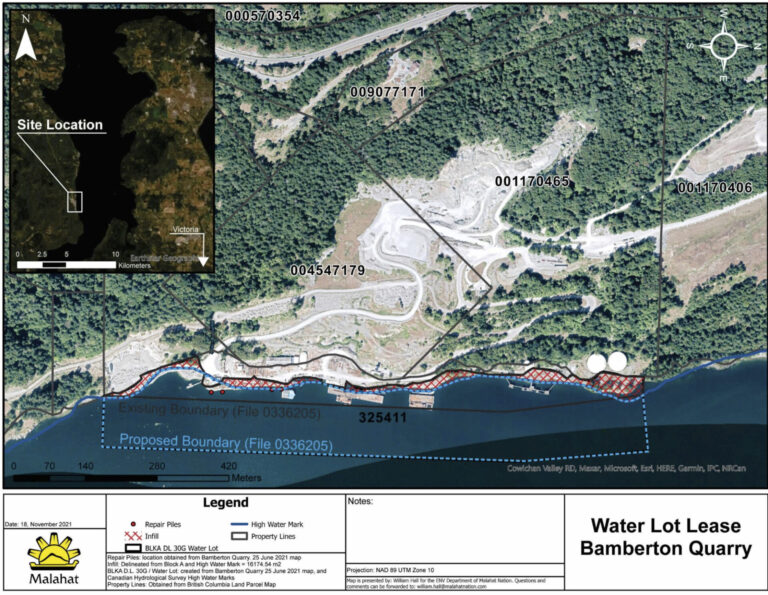
Salt Spring’s Local Trust Committee weighed in last week on a resource project’s request to expand its aquatic lease, joining several municipalities in officially expressing concern about the potential for contaminated soil to spill into Saanich Inlet.  

A unanimous motion passed Tuesday, Dec. 13 was among the new committee’s first, as returning trustee Laura Patrick was joined by newly elected trustee Jamie Harris and newly appointed LTC chair Tim Peterson in their first public meeting — the last of 2022. Salt Spring’s resolution closely follows one passed last month by North Saanich and Central Saanich’s councils, and asks the province to more closely examine long-term environmental impacts before issuing permits to the Malahat Investment Corporation for that company’s plans to expand its foreshore lease near Bamberton.  

The lease expansion lies within the Salt Spring Island Local Trust Area’s coastal and marine shoreland boundaries, and as such the Crown referred the matter to the LTC for comment. Regional planning manager Chris Hutton referred to a submitted management plan, which noted the existing lease had been in place since 1989; proposed uses for the expansion included the loading and unloading of “barges of contaminated soils, creosote piles, cement powder, scrap metal, aggregate and fuels.”   

“As this is a referral from the Crown, there’s no public input process to follow here,” said Hutton. However, he added they had received a “fair bit” of unsolicited correspondence. Committee members agreed to hear from long-time area diver Frank White, who was in favour of a letter from the LTC.  

“What they want to do is to expand the mine by 47 per cent,” said White. “To be expanded by 50 per cent, you have to have an environmental study. They’ve increased [the size of the lease] this way twice.”  

White said Islands Trust, and specifically Salt Spring’s LTC, was in a unique position to ask questions, due to its mandate as a steward of the natural environment.  

“You have the mandate to say, ‘hold on, are you going to hurt the environment?’” said White. “Or, ‘so, what is the contaminant? How are they going to store it? Is it going to be on that slope above the water and wash into the ocean?’ There are a whole bunch of questions.”  

“One of the things that stood out for me was hearing that [the project] expanded a couple of times, always in amounts just below the threshold of causing a public engagement process,” said Peterson. “So it’s clearly been done at least a couple of times to try to expand as much as possible without having to hear from the public.”  

Harris pointed out the complexity of the situation, noting that while the applicant was a numbered corporation, it was owned by Malahat First Nation — and activity there had been going on for several years.  

“They are following the rules,” said Harris. “Is it something we could ask, something along the lines of, ‘can some sort of solutions be put in place to ensure that the environment will be harmed as little as possible?’”  

“My suggestion is that we respond,” said Patrick, “and recommend that potential longer-term environmental impacts be understood and mitigated before permits are considered.”  

“That’s pretty reasonable,” said Harris.  

The LTC’s resolution ultimately also requested additional public consultation be conducted. 

More information is available through the Environmental Assessment Office website.

Bloom Trust donates and adds matching offer for Reginald Hill campaign

1

The Susan Bloom Trust is once again making a big difference to fundraising efforts on Salt Spring Island by supporting the Nature Conservancy of Canada (NCC) Reginald Hill campaign.

The NCC announced Wednesday that trustees of Bloom’s estate have pledged to contribute $150,000 directly to the project, and to match all donations made by others starting Dec. 15, up to an additional $150,000.

A total of $500,000 is needed by Jan. 31, 2023 to finalize the $7-million purchase of 400 acres of land on the south end of Salt Spring.

“We are so honoured to receive this gift,” said Krista Sheppard, senior director of development and communications with the NCC in a press release. “Susan has left an incredible legacy for nature and for the island community that she called home. She was always bold and encouraging about getting conservation done. It’s heartwarming to see her continue to encourage others to support conservation, even though she is no longer with us in person.”

Anyone wishing to help conserve Reginald Hill can make a donation online at www.natureconservancy.ca/reginaldhill or reach out to bcoffice@natureconservancy.ca.

A long-time Salt Spring resident and quiet philanthropist, Susan Bloom died Dec. 6, 2021. Since her death, conservation-related donations announced by her estate include $100,000 to the Islands Trust Conservancy, an undisclosed amount through the Salt Spring Island Foundation to secure the 75-acre Salt Spring Community Park acquisition on Mount Maxwell and support for the Salt Spring Island Conservancy’s campaign to preserve the Creekside Rainforest. One of her last major giving acts while alive was an anonymous $1-million donation to the Lady Minto Hospital Foundation’s emergency department campaign, allowing her name to be attached to the donation posthumously.

UPDATE: Quinsam return date now Jan. 11

0

BC Ferries now says the MV Quinsam won’t be returning to the Vesuvius-Crofton route until Jan. 11, 2023.

“During the scheduled refit of the Quinsam, an unexpected mechanical issue occurred with a critical engine component,” the corporation states in a Dec. 16 service notice. “As a result, the return of the Quinsam has been delayed.”

After being advised by the corporation’s scheduling team that the Quinsam should take over from the Quinitsa at about 1:30 p.m. on Wednesday, Dec. 21, BC Ferries communications manager Dan McIntosh said on Thursday afternoon that he has subsequently been told the date and time is not yet certain.

“The refit is not going as smoothly as hoped,” he told the Driftwood. “Dec. 21 remains a target, but we’re being told that could be pushed back.”

A revised service notice with the Jan. 11 date was issued on Friday afternoon.

The Quinsam, which carries 19 more cars than the Quinitsa — 63 versus 44 — was originally due to return from scheduled maintenance work on Monday, Dec. 12. It has been off the route since Oct. 24.

Drake Road supportive housing project updated

1

The discovery of a vulnerable riparian area at 161 Drake Road was the first of several surprises for BC Housing planners, according to representatives hosting a community meeting last week. 

And as the agency’s delays and challenges were outlined for Zoom meeting attendees, islanders seemed politely incredulous that planners for the 28-unit supportive housing project there hadn’t anticipated some issues earlier. 

In January, BC Housing — and then-Attorney General and Minister Responsible for Housing David Eby — touted the fast tracking of the project, to support and house people experiencing or at risk of homelessness on Salt Spring Island. The province used its authority under the Interpretation Act — commonly known as “statutory immunity” — to bypass the local zoning process, predicted an opening date for the facility in late summer, and announced construction would begin “within weeks.” 

Some 45 weeks later, BC Housing representatives agreed progress — measured, so far, by the clearing of some blackberry bushes — had been slow. Asked why it was taking so long, and whether “due diligence” had been completed, BC Housing development manager Kirsten Baillie characterized that step as “the phase that we’re wrapping up now.” 

“We’ve hired a biologist to work with us through the environmental assessment,” said Baillie. “We’ve hired an arbourist to look at tree protection and wind hazards, and what trees can stay and need to go in order to make sure the slope is secure — and also to be respectful of any birds that may be nesting or will be nesting in the springtime.”

That work has taken longer than expected, admitted Baillie. “And to be honest, the site’s proven more complicated than we anticipated.” 

The more extensive environmental assessment, along with perennial Salt Spring issues such as road access, stormwater drainage and adequate drinking water have been the source of delays, she said, adding BC Housing had more than 30 people currently working on the project. 

“We do anticipate construction of the supportive housing starting sometime in 2023,” said Baillie. “I’m hopeful it’ll be spring 2023.” 

At the meeting, BC Housing presented a draft design and site plan for the project, which envisioned two storeys of studio units set at an angle off the road — following the slope of the land, according to planners — along with an outdoor amenity space and a modest amount of landscaping. Builders intend to leave not only the riparian stream area through the property wooded, but also the natural trees and shrubs along Drake Road. Situating the building at the front of the 5.5-acre property — owned by the Capital Regional District (CRD) but leased for the next 60 years by BC Housing — will allow an option to build additional units further up, although Baillie said there were currently no plans to expand into that section.  

In addition to asking about delays, meeting participants questioned whether there were enough units set aside for residents who may have difficulty with stairs — there are six or seven in the current plan, Baillie said — and whether the seven planned parking stalls would be sufficient to keep residents and guests from parking along the narrow street.  

Concerns about worsening stormwater drainage were met with assurances that the issue was being carefully considered by civil engineers.  

“As you know, some of the challenges are that there’s not a consistent culvert system along Drake Road. It’s wide, then it narrows, and then it’s wide again,” said Baillie. “I think that’s the role of Islands Trust and CRD, to work on the infrastructure on Salt Spring Island; I’m happy to work with those agencies, but I certainly don’t feel this development can take on stormwater management [all] along Drake Road. We will absolutely manage the water that comes off the site.” 

CRD director Gary Holman pointed out neither Islands Trust nor CRD maintain roadways on Salt Spring, but rather that Drake Road’s culverts fall within the Ministry of Transportation and Infrastructure (MoTI) rights-of-way. 

“We don’t own our roads here,” said Holman. “That’s MoTI. We can talk about coordinating with them.” 

Looking ahead, officials said they were receiving proposals from organizations interested in eventually operating the facility, and supportive housing advisor Lois Gabitous said there was still “a lot of flexibility” on management policies for things like pets and number of staff needed. 

“It’s part of the reason we’re a little bit vague right now,” said Gabitous, “because we want to wait until we have the operator named.” 

BC Housing did not specify which community partners would work with BC Housing to determine eligibility to live in the units, described as being intended for Salt Spring Island residents. 

“So far those partners have been identified from four different community-serving agencies,” said Gabitous, “as well as the Ministry of Social Development, and Island Health. Together those six agencies would get together to determine what’s important to you as a community.” 

Gabitous said typical metrics used are length of time in the community, whether someone is fleeing violence, a member of the Indigenous community, or coming out of foster care; but ultimately, she said, it would be “local experts” working with social service agencies who would make those decisions. She added that being a local resident tended to land high on the list.  

“Usually, communities come together and really prioritize those folks who have been in need in their community already,” said Gabitous.  

From the inside: Insights and advice to help others cope with mental illness

2

By THERIN GOWER

The struggles of people who have health conditions affecting their mental function and ability to communicate are much on my mind due to some new insights.

Oh, I had education from a psychology B.A, teacher certification and on-going paramedic training. I had 40 years of experience interacting with people in need and crisis. I thought I understood. But nothing but personal experience can convey what it is really like from the inside when your thinking and emotions have gone wild.

In my case, this was a temporary situation caused by a medication intended to fix another problem, now being tapered off, plus another drug reaction causing anemia. I spent a month and a half warm and dry in a house with food and loving support of family and friends. I had the luxury of telling strangers I had to interact with that I couldn’t function well mentally right now because of medication I was on. No stigma or shame in that. I’m returning to “normal” functioning more every day.

But there are a lot of people on this island and elsewhere who live for years, even their whole lives, with these immense mental/emotional challenges, often in much worse physical locations, with few supports. These insights and suggestions may help you to help them.

1. What seems to the observer like a tiny thing to accomplish is an enormous task. There is only so much ability/energy to put together a sentence; only make them do that for things that matter.

2. It was like having ADHD x 1000. Lines of thought shooting off in all directions, intentions formed and immediately lost, distracted by the next thing. Walk two steps to do something, think of something else and move to do it, forget the first, be agonized trying to remember what is important. Making lists and ticking things off saved my sanity. You could help them do that if they don’t have the mental or physical resources.

3. Managing to eat was a huge task. Even with food made and set on the table, sitting down and consuming it often took several attempts as distractions occurred, and required someone to monitor that it happened. Get them food and make sure it gets into them.

4. What can you trust if you can’t trust your own thoughts? It was clear a minute ago, now it makes no sense. Maybe this bad thing is happening. You can’t stop obsessive thoughts. You read what you wrote and it says something different than what you thought. Or something is so clear to you, but everybody else is seeing it differently. Is that because you are missing something, or are you right and they are dismissing you, assuming you aren’t thinking clearly? Be the person they can trust. Consider what they are saying. Paraphrase to clarify, so they can agree or disagree. Acknowledge they see it that way, but say you see it differently. Reassure them if you can, repeatedly.

5. It’s too much work to make a decision. Avoid multiple options.

6. I needed help but it was too much work mentally and emotionally even to call a friend. Conversely, once I started talking I couldn’t stop. Be prepared either way. Be the one that calls them. They can always say they don’t want to talk. If you send them an encouraging email or message, be prepared for them to not respond. It may be just using too much mental power for them at that point, but they will be encouraged.

7. When things did get arranged, I forgot them. Remind the person, confirm more than once, or better yet be the one that makes the arrangements and picks them up.

8. Every task seems insurmountable. Go to this place, talk to this person, explain this problem? Better to not even try. If you can accompany them, do. The reassurance of having a second brain there that will understand and remember what happens is enormous. This is especially true of medical appointments. Bring a notebook to write down questions ahead of time. Note the answers, and new instructions. If they must do a task alone, make each step short and clear for them. Don’t run steps together.

9. Medications/health monitoring become a big part of the day, with multiple steps and combinations. Again lists, charts and especially bubble packs helped. Anything that can help with organization and routine and confirmation is good here. Make sure they take the medication immediately from the bubble pack to their mouth without putting it down anywhere. Recognize that it all gets wearisome.

10. I couldn’t control what I said without big effort. I couldn’t control emotional outbursts at all. Listen to the good parts, toss out the bad parts, don’t take it personally, don’t think they mean it. Never say “Calm down.” Be calm yourself. Be there. (Caveat: be aware of your personal safety. You can comfort them by your physical presence from a distance, with an exit available behind you if applicable.) Participate in the calming: “How about if we take some breaths together?” If you can and they want you to, just hold them.

11. I couldn’t cope. With pretty much anything. Just be the person who copes.

12. Everything becomes self-centred because the inside of your massively chaotic brain is as huge as a planet, and you feel like you are trying to control the winds of Jupiter in there. The whole world outside your brain keeps trying to thrust more information in. Too much! So don’t expect thanks, don’t expect understanding or empathy in return, just know that you are helping to make it slightly more manageable in there. And that is a huge gift to give.

The writer is a long-time Salt Spring resident.

Local community commission election date to be May 27, 2023

0

Salt Spring voters will choose four members of the island’s first local community commission (LCC) at an election Saturday, May 27, 2023. 

That’s the tentative date recommended by Capital Regional District (CRD) staff and, if a relevant bylaw passes as expected today (Dec. 14), the process to plan the election and to dissolve certain local commissions to be taken over by the LCC will begin.  

The CRD’s Electoral Areas Committee was expected to adopt Salt Spring Island Local Community Commission Bylaw No. 1 at its Dec. 14 meeting, laying out a transition plan that includes considerations for an expected quorum of newly elected commissioners holding their first LCC meeting in June. Before then, a transition plan would involve minor changes to some bylaws relating to the soon-to-be-disbanded commissions, as well as final reports and transition materials provided to the incoming LCC before those commissions fully wind down. 

Commissions whose purviews will now be administrated fully by the LCC delegation are the Salt Spring Island Economic Sustainability Commission, the Salt Spring Island Liquid Waste Disposal Local Service Commission, Salt Spring Parks and Recreation Commission and Salt Spring Transportation Commission. Further administrative authority falling to the new LCC will be that established for street lighting, and for grants in aid — the latter requiring the local director’s approval in addition to that of the LCC in order for grants to be awarded.

The LCC will also administer livestock injury compensation matters, and serve in an advisory capacity for funds allocated via the Salt Spring Island Arts Contribution Service, Salt Spring Island Public Library Service, and the Salt Spring Island Search and Rescue Service. 

The LCC will be composed of the four new commissioners and the Salt Spring Island Electoral Area CRD director, currently Gary Holman. Commissioners will serve four-year terms, and will hold regular public meetings each month. The LCC may also choose to create advisory bodies. Details surrounding how individuals should express their interest in running for LCC positions are expected in the coming weeks.