Home Blog Page 37

Use of Common Ground process urged for OCP survey input

0

SUBMITTED BY TRANSITION SALT SPRING

For those of you who want to make your voice heard in the upcoming revision of the Salt Spring Island Official Community Plan (OCP), it’s time to pick up a pen or hit the keyboard: Phase 1 of the engagement being done by our Local Trust Committee (LTC) ends this Friday, Oct. 24!

And if you’re not even sure what that means, you’re not alone! Many Salt Springers still aren’t sure what the OCP is, or why they should care. Others are skeptical that the LTC will listen to their input, and still others are convinced that the LTC will continue its inexplicable agenda to [insert your certainty here].

But of course, the LTC is just made of people, most of them exhausted by a workload that has completely outgrown its dated budget and infrastructure. And yet, they’re aware that the OCP — our collective vision for the future of our community — hasn’t been updated in 17 years, and they undertook to do a review knowing that, if tradition holds, they will take arrows from all sides.

Transition Salt Spring set out, a year ago, to try to change that tradition. We started something we called the Common Ground process, which the Driftwood has reported on periodically, to find what the areas of agreement are that we share, instead of focusing on the much smaller areas where we disagree. Hundreds of hours of one-to-one and group consultation led into the Common Ground Summit in April, which brought together a broad and diverse group of community representatives and organizations.

Legitimate concerns have been expressed about this approach. The principles of the Common Ground process led us to accesspry dwelling units (ADUs) and short-term rentals (STRs) because the community representatives in the group didn’t find common ground there. Many believe those issues are critical to the housing discussion, but we don’t consider their exclusion to be a flaw, because the Common Ground process was not created to take on divisive issues. It was created to build more trust within our community, and identify the low-hanging fruit that we could agree on and support — together.

The change has been noticed. Our MLA Rob Botterell sensed the new spirit of cooperation and collaboration that grew out of the Common Ground Summit, and wanted the new Minister of Housing and Municipal Affairs, Christine Boyle, to experience it. At the end of her visit last week, she noted: “One of the first things I heard arriving here was a description of Salt Spring as an argument surrounded by water. I’d not heard that description before, and it wasn’t what I experienced. I was really grateful all day to see really solutions-oriented conversations and people listening to one another and finding a path forward.”

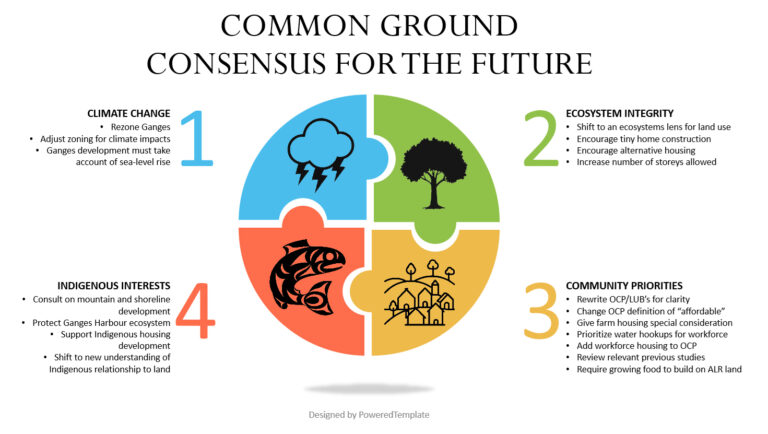
So we at Transition believe we have a new option in approaching this revision of our OCP and accompanying land use bylaws (LUBs). Instead of voicing 11,000 (or so) individual opinions, we can look at the work that’s already been done, and — if we like it — get behind the holistic package of proposals for the OCP revision that grew out of the Common Ground Summit, called the Consensus for the Future.

Is it everything everyone wants? By definition, no. But it aligns with the lenses through which the LTC is asking for input on housing — preparing for climate change, protecting whole ecosystems and respecting Indigenous rights — which we believe reflect values that are deeply held by our community. And in addition to that tasty low-hanging fruit, it also has some unexpected ideas that may surprise you.

So if you want to be part of a new way of working on Salt Spring, and help get us the affordable housing we need while protecting the environment we all love, dig into the Common Ground consensus at transitionsaltspring.com/ocp. By Friday!


‘Comedy with substance’ in McCreary live show

SUBMITTED BY ARTSPRING

Author, comedian, actor and TEDx speaker Michael McCreary has a lot in the works: a play, a book, a documentary and even getting his driver’s licence. Now, he’s adding a comedy tour to the list. On Friday, Oct. 24, McCreary is launching his B.C. run of Funny, You Don’t Look Autistic at ArtSpring, as part of the ArtSpring Presents series.

Green Thumb Theatre, the show’s producer, prefaces its description with a piece of advice: “Whatever you think you know about autism, think again.”

Named after McCreary’s hit memoir, Funny, You Don’t Look Autistic is a masterclass in funnelling lived experience into razor-sharp comedy. He tackles the challenges and misconceptions of being neurodivergent in a neurotypical world with a signature deadpan delivery and heartfelt storytelling. By challenging the audience’s expectation of what autism “looks” like, McCreary delivers an insightful and hilarious lesson in dismantling preconceptions. He highlights the complex, nuanced and often joyful reality of life on the spectrum and empowers those who feel misunderstood. This is more than just stand-up; it’s officially described as “part stand-up, part storytelling, and all heart.”  

Though only 28, McCreary has been in the comedy game for well over a decade, having first caught the stage bug at age 13. Since then, he has performed and given keynote addresses in every Canadian province and across the U.S., and has been featured on both The National and CBC Radio’s Laugh Out Loud!. He also gives life to neurodivergent characters on the screen. McCreary played Eggs in the show Astrid & Lilly Save the World and Chris in Ginny & Georgia, and consulted for the show Ransom to ensure the authenticity of an autistic character.

Green Thumb Theatre is a Vancouver-based theatre company known for producing shows that hit home for children, youth and young adults. Green Thumb spotlights social issues that affect young people and provides “theatre that celebrates the language and stories of today’s generation and culture to stimulate empathy, debate and critical thinking.”

This powerful performance has garnered critical praise for its honesty and humour. Whether you are on the spectrum, know someone who is, or are simply looking for a comedy show with substance, McCreary delivers an unforgettable experience.

The show, which begins at 7:30 p.m., is appropriate for all ages.

For tickets, visit purchase.artspring.ca or the ArtSpring box office.

Two road incidents task emergency crews

0

Two nearly simultaneous incidents on Friday, Oct. 10 sent emergency responders to both ends of Salt Spring’s long-running Fulford-Ganges Road improvement project at practically the same time.

And despite lunchtime traffic, compounded by single-lane alternating flows around construction sites on the island’s busiest road, crews from Salt Spring Island Fire Rescue (SSIFR), BC Ambulance and RCMP were quick to arrive at each, according to SSIFR Deputy Chief Dale Lundy, who said both Friday afternoon accidents resulted in patients being transported to Lady Minto Hospital.

The first call for help went out on behalf of a man whose mobility scooter didn’t successfully navigate the corner of Drake and Fulford-Ganges roads, Lundy said, carrying him into the newly excavated ditch — and impeding the rider beneath.

“[The scooter] had landed partially on him,” said Lundy. “Our crews extricated him from the ditch, provided initial care and supported BC Ambulance once they arrived.”

Lundy said he was less involved in response to the second scene — in which a pedestrian had “some interaction” with a vehicle at Fulford-Ganges Road’s intersection with Cranberry Road. That call came within five minutes of the first, Lundy said. A SSIFR member responded in their own vehicle, he added, and assisted BC Ambulance and RCMP with traffic and patient care. The patient was already loading into the ambulance when Lundy arrived, he said, and additional SSIFR resources were redirected back to the first scene.

Traffic was flowing again quickly after crews cleared each scene — at least, as much as it had been before. 

Climate change adaptation tested in ‘dry farming’ project

BY STEVE MARTINDALE

DRIFTWOOD CONTRIBUTOR

When her father died in 2016, Skye Larmour moved back from Victoria to the family farm on Salt Spring, where she struggled with how to make a living from the land in the face of water restrictions and the rising cost of irrigation. 

“Water’s actually very expensive here and agriculture uses a lot of it,” says Larmour, noting that irrigation wasn’t something that her father Mike Larmour ever had to concern himself with, as the family property had previously been blessed with abundant well water.

“If you’re used to just turning on the tap and water comes out, you don’t give it a second thought. But the moment that tap starts to drip a little bit and it doesn’t flow, you realize what an incredibly precious resource we have.”

Experimenting with dry farming, Larmour founded an online seed company based on her hands-on research into how best to adapt to the changing climate. Tardigrade Seeds now sells drought-resistant varieties of common staple crops all across Canada, as well as heat-tolerant plants from around the world.

Larmour was the host and featured speaker at a recent one-day seminar held on her property on Beddis Road, in which dozens of local farmers and gardeners gathered to learn about the principles and techniques of dry farming.

“People really want to figure out how they can stretch the amount of water they have further,” says Larmour, “to either grow food with less water or to grow more food with the same amount of water.”

The term “dry farming” is a bit of a misnomer, as it’s really about retaining soil moisture for as long as possible throughout the growing season. The basic premise is this: crops are planted in the spring when the ground is still wet with rain, and as the soil dries out they send roots down to continue accessing deeper moisture throughout the summer months. With the added protection of mulch, ground cloths, cover crops and wind breaks to reduce the speed at which the soil dries out, drought-resistant plants ideally won’t require any supplemental irrigation.

“Drought is a slow-moving emergency — from day to day it’s sometimes hard to notice,” says agricultural researcher Naomi Robert. “Water stress is an issue throughout B.C., particularly in agricultural contexts. Even in places that historically had wetter summers, like here on the coast, we’re seeing that change, so we need to adapt to it.”

Noting that 2023 was unusually dry, Robert recalls how a provincial protection order in response to low stream flow levels — which threatened spawning salmon — resulted in irrigation licences being suspended for forage farmers in the Comox Valley.

“That was a wake-up call for a lot of folks to start thinking seriously about water management and drought preparedness, so we organized a dialogue session on drought for farmers in the Comox Valley,” says Robert, “and this dry farming initiative came out of that as a whole-farm approach to drought management that can be one of the tools for drought resilience.”

Pleased with the turn-out for the Salt Spring seminar, Robert has found people on the Gulf Islands to be extremely engaged in the subject.

“There’s a lot of interest in different strategies for drought management. People are really interested in how dry farming as an agro-ecological practice can support climate resilience broadly, and what that means for our future.” 

Originally from England, Chris Lampl attended the seminar to learn about water-reduction techniques that might be applied at Foxglove Farm on Mount Maxwell, where he lives and works.

“I’ve been curious about a different way of farming that uses less irrigation,” says Lampl. “With farming you always think about irrigating, you always think the plants need water and you have to water to take care of them, so it’s interesting to think about people doing things in a different way. Especially as it seems like things are getting drier and drier most places around the world, it feels like a good skill to know.”

With an off-grid permaculture farm on Mount Tuam which she and her son have been developing for the past decade, growing a broad spectrum of food crops, seminar participant Nomi Adamson is acutely aware of the perils of drought.

“Most of our irrigation comes from water that we save during the rainy season,” she says, “so conserving water is always essential, particularly given the unpredictability of weather patterns.” 

Having moved to Salt Spring from Victoria just last month, Phanh Nguyen immediately signed up for the seminar in order to meet other people interested in minimal-input farming, which she has tried over the past 15 years — with mixed results — in three different countries: at a farm near Victoria, in Croatia where she lived before emigrating to Canada, and in her native Vietnam.

Currently restricted to container gardening on the deck of her new home on Fulford-Ganges Road, Nguyen has previously experimented with growing food crops such as peppers in containers with enclosed water reservoirs in their bases, which don’t require watering from above.

“There are a lot of things to consider,” says Nguyen, “but if you work with what you have, that’s what makes gardening interesting, as there are tons of things for you to play around with.”

The seminar included a tour of Larmour’s property, one of three dry farming demonstration sites established this year as part of a regional research project, which include Yellow Boot Farm in the Comox Valley and the Sandown Centre for Regenerative Agriculture in North Saanich.

One of a series of workshops conducted by the Institute for Sustainable Food Systems at Kwantlen Polytechnic University, with funding from the B.C. Ministry of Agriculture and the B.C. Centre for Agritech Innovation at SFU, the seminar provided an overview of the research results from all three trial sites, a complimentary lunch by Sweetgrass Food Co., and demonstrations of tools such as moisture sensors (known as tensiometers), which measure and monitor the soil’s water retention at various depths.

“One of the reasons that I’ve taken this journey is that I need a sense of hope for myself,” says Larmour, looking back on her family’s intergenerational experience farming the land and looking ahead to an uncertain future as the climate continues to change. “With all the craziness going on in the world, I hope that the community can find some hope and agency in these approaches as well.”

Mouat’s Home Hardware manager wins national award

0

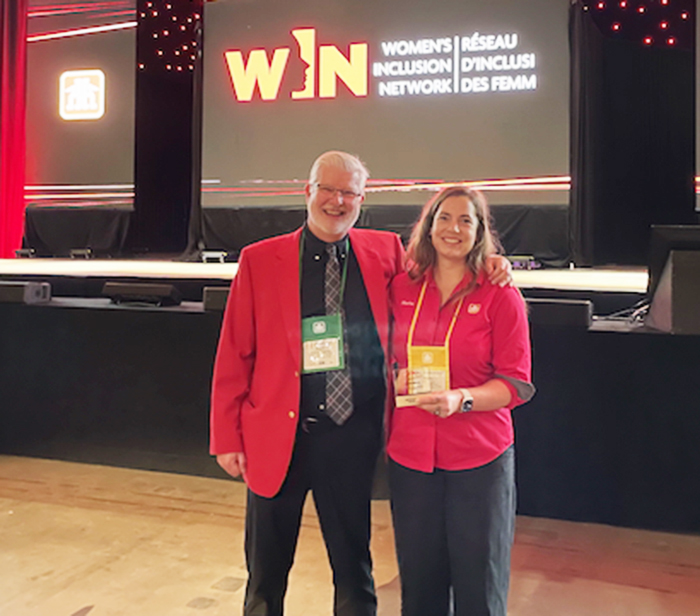
When Mouat’s Home Hardware store manager Maria Elsser took to a Toronto conference hall stage to receive a national award from the company, she said that up until that moment, she hadn’t fully internalized how big the crowd would be.

“If you can just imagine,” laughed Elsser. “All the dealers and owners and everybody; there were thousands of attendees.”

Elsser, who grew up on Salt Spring Island and now manages her hometown store, was honoured with the company’s Canada-wide Women’s Inclusion Network (WIN) award, selected for her “exceptional work in inclusion, diversity, equity and accessibility,” according to Home Hardware — a humbling moment, she said, given the “competition.” Elsser said after a fascinating panel discussion, featuring women in executive positions talking about diversity in the workplace, they called her up on stage to be presented with the award.

“And I also got to make a little speech, which was very terrifying. My face was up on a huge projector, there was a whole room full of people clapping. It was just an incredible experience.”

In hardware stores generally, Elsser said, the vast majority of employees are male. She launched her own retail career working for one of the quintessential “big box” stores, where she said she was the youngest person — and only woman — in management. 

“It is a male-dominated industry,” said Elsser. “It  was a very hard thing to break into, not exactly inviting. I always thought, you know, if I’m ever in a role where I’m able to have an influence on a store, I want to ensure that everyone comes to work and feels valued. I want people to be able to come into the store and feel like no matter who they are or how they identify, that they are welcome, and they are cared for. 

“And that they belong here,” she added.

One of the things that Elsser found so attractive about Mouat’s right from the start was that not only was that kind of culture already in place, but the business itself was founded by a woman.

“And Home Hardware as a company is really trying to focus, not just on women, but on inclusivity within their stores and communities,” said Elsser. “Especially within their leadership teams.”

For the last three years, Elsser said, WIN has been honouring one employee — not necessarily a woman, she added — that has demonstrated an ability to foster inclusion and diversity within their store’s environment. 

“I’m just so grateful and humbled,” said Elsser. “You know the two previous winners introduced me, and one of them was on the board of directors for Home Hardware corporate, the other owns her own store. Just such incredible people, so to be able to sit next to them and be considered as part of that group was just amazing.”

Mouat’s Trading Co. president Jessie Toynbee said Elsser was if anything being modest; in the five years Elsser’s been at the store, Toynbee said, she has managed to create a lasting impact on its workplace culture. Toynbee said Elsser made Mouat’s a dedicated employer partner to Salt Spring’s GIFTS program — providing employment opportunities for people with cognitive and development disabilities — and has actively fostered a safe, welcoming work environment for the island’s LGBTQ+ community.

“Above all else, Maria always leads with kindness,” said Toynbee, “and embodies a passion for making Mouat’s a positive workplace and active contributor to our Salt Spring community. Our whole team celebrates Maria’s accomplishment with pride and gratitude.”

“Now I have this network of women who do work for nonprofits and support community events and all that kind of great stuff,” said Elsser. “So I can really start planning and thinking of what I can do next for the community. I have lots of ideas, and it’s wonderful to have that sort of support and inspiration.”

Elsser said whatever the future holds, she plans to keep up with one of her favourite duties: mentoring and working with “14 year olds on their first job,” she said — high school students starting out at Mouat’s. 

“I really love how I get to watch them grow, develop, learn,” said Elsser. “Help them feel supported and appreciated as part of the team, just as much as any other employee.”

This past June, she got to watch her first round of former 14 year olds graduate and move on to bigger things.

“They invited me to their graduation!” she said. “I was so happy for them.”

Resistance to human rights erosion and autocracy has an impact

0

It seems almost impossible to have a conversation of any length these days without the dire state of the world being put on the table for gruesome dissection.

Human rights abuses around the world, the rise of autocracy in the U.S., Israel’s genocide against the Palestinian people, Russia’s war against Ukraine and the ravages of climate change coming our way are solid reasons to weep, moan and collapse in despair. What’s been most troubling to me is that I don’t see how change is possible without transforming the hearts and minds of people who do not respect fellow humans and want to deliberately harm them. How the hell is that ever going to happen?

But the Salt Spring Forum’s latest esteemed guest shifted my thinking about that. Kenneth Roth is the former longtime executive director of Human Rights Watch (HRW), a nonprofit group that documents human rights abuses around the world, publishes reports on its findings and takes action to stop the abuses from continuing. Roth’s new book is called Righting Wrongs: Three Decades on the Front Lines Battling Abusive Governments.

As Roth told more than 200 people at Fulford Hall on Friday, Oct. 10, trying to change the hearts and minds of dictators and corrupt power-mongers is not one of the tools HRW uses, and doesn’t need to be. Instead, they confront those regimes and bring pressure to bear in areas of importance to the perpetrators, and/or convince more respected nations like Canada to join others in doing the same. Just do what works and let go of what cannot be changed is what I took from that part of his talk.

Roth also let some air out of our collective helplessness balloon by pointing out that while some democratic countries appear to be sliding towards autocracy, others that have experienced autocratic rule are rejecting it vehemently, and he gave several examples. He also assured the crowd that resistance to autocracy in the U.S. is strong and it’s not inevitable that tenets of democracy like fair elections, free speech and respect for the judiciary will be snuffed out there.

“My overall point is that we should not be defeatist,” he said. “There is nothing ordained about Trump destroying America’s democracy, and there’s nothing ordained about the demise of democracy. This is a serious threat, but there is a battle underway. There’s a fight. We’ve got to engage in it, and we can push back and we can win it.”

In other words, the news is not all bad and activism does make a difference.

Roth commented in depth on the Israel-Palestine situation, explaining how Israel’s actions constitute genocide against the Palestinian people, and he described U.S. President Donald Trump’s important role in leading to the ceasefire agreement. Israel has basically become a “pariah state,” Roth said, but still needs U.S. support to function.

That reminded me of what a Canadian orthopaedic surgeon who’s been working at hospitals in Gaza said at an All Saints event last month when asked how people can best help the Palestinians.

“I firmly believe that what will really benefit Palestinian people is a ceasefire and an end to the occupation, an end to apartheid, [having] self determination,” said Dr. Deirdre Nunan. “And that is not going to happen from a couple of doctors going over there and treating wounds. It’s going to happen from policy change here. It’s going to happen from that long grassroots work, which is kind of thankless, and it does feel very far away, but this is the work that matters.”

While a ceasefire is just the first step, pressure from individuals, organizations and governments around the world has at least made that happen.

Another human rights-focused event I attended this fall was the Vancouver session of Alex Neve’s CBC Massey Lecture series titled Universal: Renewing Human Rights in a Fractured World. At one point Neve — a human rights lawyer and former secretary general of Amnesty International Canada — asked us to look around the York Theatre space and consider that everyone there was an individual concerned about human rights and making the world a better place. doing that did make me feel more hopeful.

In a Sept. 2 piece on his alexneve.ca website Neve wrote: “We each have a responsibility to uphold human rights; the Universal Declaration of Human Rights tells us so. But even more importantly, we all have the potential and the power to do so. When we come together, be it a small neighbourhood campaign organized by a handful of people or a global movement that draws millions together, we do indeed overcome injustice and transform our world. Never tell yourself you’re insignificant and you can’t make a difference. Nothing could be further from the truth. History tells us so.”

Then on Saturday I came across another example of an individual dropping his cloak of inhibition and adding his voice to the chorus rejecting cruelty and injustice.

“How do well-fed artists working in a peaceful corner of the world respond to the ethnic cleansing of a small country thousands of miles away?” asks Michael Wall in the artist statement to his impactful piece called Merciless – We Were But Children. “Do they have the moral right to express their outrage and distress, or is that just jumping on a bandwagon? I asked an artist friend who is a refugee from there, and her response was that my support would be welcome.”

The piece is a photograph of a rusted, engraved steel plate that looks like something from a war zone. It includes a mutilated child’s shoe — “symbolic of a brutalized people, the victims of genocide,” he said. Wall’s work is part of the Salon des Refusés exhibition up at the Salt Spring Gallery until Oct. 15. Sale proceeds will be donated to Palestinian relief organizations.

From Wall to Nunan to Neve to Roth, and others I’ve heard speak or read about lately, it’s clear we should not keep wallowing in despair or remain paralyzed by the horror of man’s blatant inhumanity to man. Everything we do, say, sing and write in support of human rights, democracy, civil society and justice has the potential to make — and is already making — a difference now and for the future.

The writer is the editor of the Gulf Islands Driftwood newspaper.

SSNAP spotlights ‘medium of the moment’

It’s hard not to notice the number of pieces in this year’s Salt Spring National Art Prize (SSNAP) Finalists Exhibition where fibre is the major element.

From a full-on garment made of vintage Ski-doo coats (Catherine Blackburn’s Caribou Dreamin’) to an industrial felt and gold spandex sculpture resembling a tin can phone (Soft Talk Quiet Listening by Maria Hupfield) to other artworks using textiles in traditional or surprising fashion, the evidence that fibre art “has emerged as the medium of our moment” is fully on display at Mahon Hall in this year’s biennial exhibition.

The sheer abundance provided a perfect opportunity to bring together five artists with fibre-dominated pieces in the exhibit for a well-attended Oct. 9 panel discussion titled Contemporary Fibre Art: The Art World’s New Obsession? Two of the participants are from Salt Spring: Anna Gustafson (with a two-panel wool felt and cotton yarn piece called What George Said . . . ) and Terri Potratz (exhibiting a hand-dyed quilt titled As Above, So Below). Amanda Wood (with a framed, handwoven piece called Generative (In)tension) and Bettina Matzkuhn (with a hand-embroidered landscape work called Alluvium) live in Vancouver. Raul Mendosa Azpiri (with Pianissimo #1, made from salvaged piano parts and textiles) is based in Victoria.

In opening the discussion, Salt Spring Arts board member and moderator Alexandra Montgomery read the full “medium of the moment” quote from a Skye Sherwin Guardian review of a Barbican fibre exhibition in London, England last year.

“Once seen as the creative backwater, thanks to its association with craft and domestic labour, fibre art has emerged as the medium of our moment,” read Montgomery, adding that other major institutions have held textile-focused exhibitions in recent years.

Gustafson said she didn’t consider herself tied to any one medium, but has worked with fibre in the past 10 years in part because it was conveniently portable. She said she believed the medium has been disregarded in part because it’s so ubiquitous.

“It’s just so part of our everyday existence. We need to have clothing. We need to have sheets. It was not an elevated material, because it was everywhere, and it was not an elevated process, mainly because it was ‘women’s work.’”

Mendosa Azpiri said he thought fibre was the oldest of the arts, certainly predating “cave paintings,” because the subjects are wearing clothing in those images.

“My view is that they had such amazing clothing that they decided to paint themselves!” he said with delight.

He also described his experience of growing up in Mexico and learning weaving from his mother, grandmother and other women in the community, and agreed that fibre arts have tended to be devalued because they were usually done by women.

“But I think that I’m seeing in Latin America, especially, that the value of weavers and textile artists in Indigenous communities all over the world is finally being recognized.”

Matzkuhn said she felt one reason for fibre art’s rise in popularity is that “a lot of people are totally sick of push-button everything, and textile is haptic, you know, it’s ‘feely.’”

Being able to see art created around the world may also be a factor, she said, with work from places where fibre is more valued being seen through the internet. Scholarship on the subject is also finally being undertaken, she added.

Potratz pointed out how textiles can be elevated for their “legacy” nature.

“I think there’s such an element of it being an heirloom piece and something to be treasured . . . and I think that’s something that is inherent to textiles, and especially things like quilting and embroidery and stitching.”

Interestingly, the participating artists’ consensus seemed to be that their pieces and what they wanted to express dictated the medium used, rather than the other way around.

“I just think everything is so interconnected,” said Gustafson, “and we can talk about all the issues in our lives through fibre or wood or metal, and when a question comes up, I just look for the right material and process and technique to try and find an answer.”

The evening also provided a unique window into the artists’ lives as they freely shared techniques, thoughts and processes used in not only their SSNAP pieces but others.

The first SSNAP exhibition was held in 2015, bringing exceptional work by Canadian artists to Mahon Hall. Juried separately, the Parallel Art Show (PAS) of work submitted to SSNAP by Gulf Islands artists was first held in 2021. This year an impressive Youth Exhibition is included, set up in the annex part of Mahon Hall, as well as the Salon des Refusés show at Salt Spring Gallery, comprised of works by Gulf Islands artists not chosen for either SSNAP or PAS. All are well worth taking in. Today, Oct. 15, is the last day to see the Salon show. Oct. 19 are final exhibition days for SSNAP and PAS.

The awards gala is set for ArtSpring on Saturday, Oct. 18, with doors open at 5 p.m. to allow time for mingling and enjoying catered food before award announcements begin at 6 p.m. Tickets are available through ArtSpring online and at the box office.

Trust wants residents for Accessibility Committee

0

The newest committee within the Islands Trust is seeking new members to help Trust Council identify, remove and prevent barriers for people who interact with it.

The Accessibility Committee hopes islanders will reach out to join the group’s mission of creating greater equality and inclusiveness for all Trust area residents, employees and clients, according to legislative and information services director David Marlor, who told current members at a special Oct. 7 meeting that any new members would only be committing their time until next year.

“So it’d be from now until the election, and then we would be going out and actually advertising for a new set of members for the committee,” said Marlor, noting that there were currently just four voting members. “One or two more might help spread the load, because obviously not everybody can be at every meeting — and with a small number, it can be a problem.”

The purpose of the Accessibility Committee is to promote inclusive and accessible practices by making accessibility and inclusion-related recommendations to policies, procedures, bylaws and infrastructure; it currently meets four times per year for a two-hour time slot that so far hasn’t been fully utilized, Marlor said, but that’s likely to change once a consultant was engaged and a draft accessibility plan was brought forward.

“It could get a bit more meaty for this committee,” said Marlor. “To really start to spread its wings, so to speak, and take off — finding our feet and the best way to utilize the committee.”

The committee’s existence and structure is mandated by the Accessible British Columbia Act, and requires a minimum of one — and up to four — representatives from “organizations that support people with disabilities, or who have disabilities, in the Islands Trust Area” as well as a minimum of one person who is Indigenous and one or two additional people from the Islands Trust Area.

For information or to express interest visit islandstrust.bc.ca/about-us/governance/accessibility-committee/.

Viewpoint: Hatred and violence not the answer

0

By IZADAURA GODCHILD

Charlie Kirk, love him or hate him, agree or disagree with him, he was first of all a sincere human being of faith and a loving husband, father and beloved son to his parents. He did not deserve to be hatefully gunned down for his opposing views.

Then to add insult to tragedy, many liberal leftists supporting diversity, equity and inclusion and their counterparts proudly “celebrated” his assassination and proceeded to hatefully character assassinate him with their vile accusations and lies (which many of them posted on social media platforms).

In my view, anyone who really believes that he deserved to be assassinated and/or hated for his honest views says everything about how atrociously callas, morally bankrupt and grossly hypocritical the liberal leftists have become in our western societies.

As George Orwell stated, “The further a society drifts from the truth, the more society will hate those who speak it.”

This is, sadly, the very detrimental path the western societies have been going down for far too long. I truly believe we need to be switching back to the path of peaceful civilized discourse and to respectfully agree to disagree when opposing views hit an impasse. Which I believe is precisely how Charlie Kirk handled and guided his public discussions and debates. Was he perfect? Of coarse not, he was the first to admit it. When he was wrong he owned it and apologized.

Contrary to all the nasty propaganda against him, his life was a genuine testimony of faith, truth, love, compassion, courage and freedom of life, liberty and speech. He called a spade a spade, told it like it is, and was a beacon of hope, spiritual enlightenment and inspirational to this generation of youth growing up in a very confusing Western society.

He encouraged them to be critical thinkers, question everything, don’t take anything at face value, embrace their natural-born genders and aspire to be the best versions of themselves.

He was the real deal. (Don’t just take my word for it, do your own research, there are a plethora of videos on his Turning PointUSA website and on social media platforms.)

Kirk founded the TPUSA Society when he was only 18 years old. He and his team toured high schools and college campuses throughout America and beyond. He championed civil discourse, encouraged “inclusive” open debate and did not verbally insult or attack anyone, even when he was verbally attacked by some very aggressive people. He did his best to be a positive example of how to disagree respectfully without hating anyone. He did not use hate speech. He used speech they hated. Consequently it was a bullet of vicious hatred that tragically murdered him publicly, in cold blood. Horrifically brutal and absolutely heartbreaking.

In conclusion, I find it very hard to understand that we live in the 21st century and after centuries of recorded history some of us have not yet learned that hatred, violence and warmongering is never the answer for anything! It is my belief that the basic foundation for peaceful co-existence with each other, no matter if one is left, right or centre, should be based on sincere love, truth, faith, respect and kindness. Otherwise, what real hope is there for the wholesome development and overall well-being for our children of this generation and future generations to come?

Peace, love and blessings, everyone.

The writer is a longtime Salt Spring resident.

‘Dahlia Queen’ next garden club guest

SUBMITTED BY SSI GARDEN CLUB

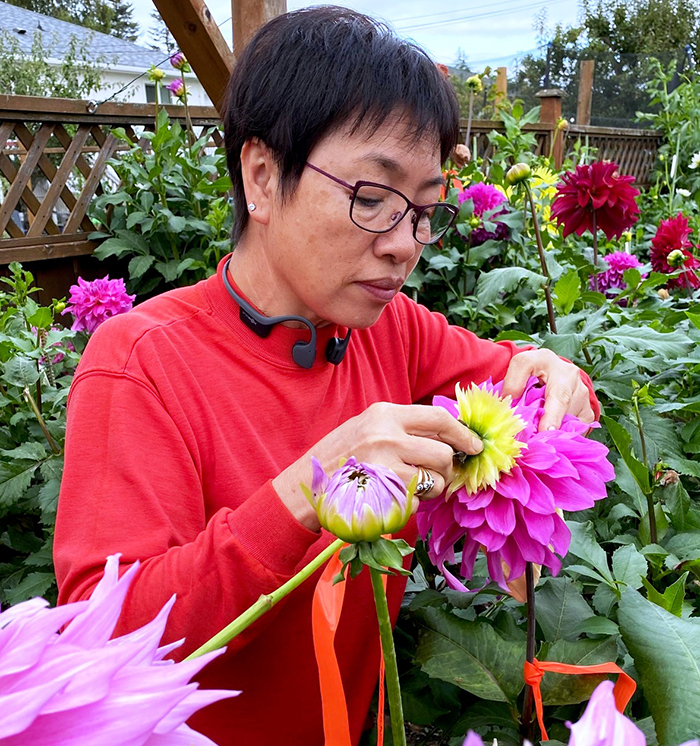
The next Salt Spring Island Garden Club speaker is Connie Young-Davis, with a presentation on growing dahlias.

The meeting will be held at Meaden Hall on Wednesday, Oct. 22 from 6:45 to 9 p.m. 

We are fortunate to have Young-Davis, a.k.a. the “Dahlia Queen,” speak at our club this month, as October is her busiest time of the year. With over 800 dahlias in her garden, you can imagine the time it takes to lift the tubers after the first frost.

Young-Davis’ interest in dahlias was sparked over three decades ago. She said she was drawn to dahlias because of their variety and their ability to keep giving — the more you cut, the more you get. Her spectrum of dahlias has since expanded, with 13 varieties credited to her name. She cross-pollinates by hand, slips stockings over flowers to keep the bees off and waits years for results.

Young-Davis enters competitions around the Pacific Northwest. Over the years, she has won 40 best in show awards for a single entry and 27 for a triple entry. She transports hundreds of blooms to these shows in her van dubbed Dahlia Mobile II.

Young-Davis is also the executive Red Seal chef at The Wellesley Victoria. Throughout the growing season, The Wellesley becomes a showcase for her dahlias, with vases of flowers decorating the tables and halls.

If you have questions about dahlias, this is your opportunity to have them answered.

Newcomers are welcome to attend the Oct. 22 event. An annual membership is $25. Non-members pay $5 at the door.