
It’s hard not to notice the number of pieces in this year’s Salt Spring National Art Prize (SSNAP) Finalists Exhibition where fibre is the major element.
From a full-on garment made of vintage Ski-doo coats (Catherine Blackburn’s Caribou Dreamin’) to an industrial felt and gold spandex sculpture resembling a tin can phone (Soft Talk Quiet Listening by Maria Hupfield) to other artworks using textiles in traditional or surprising fashion, the evidence that fibre art “has emerged as the medium of our moment” is fully on display at Mahon Hall in this year’s biennial exhibition.
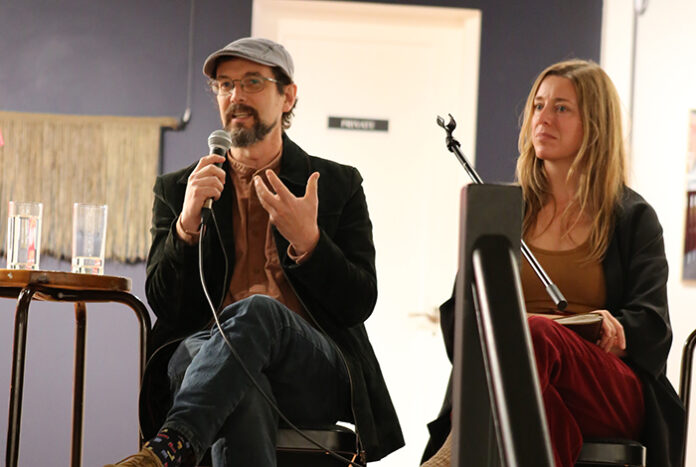
The sheer abundance provided a perfect opportunity to bring together five artists with fibre-dominated pieces in the exhibit for a well-attended Oct. 9 panel discussion titled Contemporary Fibre Art: The Art World’s New Obsession? Two of the participants are from Salt Spring: Anna Gustafson (with a two-panel wool felt and cotton yarn piece called What George Said . . . ) and Terri Potratz (exhibiting a hand-dyed quilt titled As Above, So Below). Amanda Wood (with a framed, handwoven piece called Generative (In)tension) and Bettina Matzkuhn (with a hand-embroidered landscape work called Alluvium) live in Vancouver. Raul Mendosa Azpiri (with Pianissimo #1, made from salvaged piano parts and textiles) is based in Victoria.
In opening the discussion, Salt Spring Arts board member and moderator Alexandra Montgomery read the full “medium of the moment” quote from a Skye Sherwin Guardian review of a Barbican fibre exhibition in London, England last year.
“Once seen as the creative backwater, thanks to its association with craft and domestic labour, fibre art has emerged as the medium of our moment,” read Montgomery, adding that other major institutions have held textile-focused exhibitions in recent years.
Gustafson said she didn’t consider herself tied to any one medium, but has worked with fibre in the past 10 years in part because it was conveniently portable. She said she believed the medium has been disregarded in part because it’s so ubiquitous.
“It’s just so part of our everyday existence. We need to have clothing. We need to have sheets. It was not an elevated material, because it was everywhere, and it was not an elevated process, mainly because it was ‘women’s work.’”
Mendosa Azpiri said he thought fibre was the oldest of the arts, certainly predating “cave paintings,” because the subjects are wearing clothing in those images.
“My view is that they had such amazing clothing that they decided to paint themselves!” he said with delight.
He also described his experience of growing up in Mexico and learning weaving from his mother, grandmother and other women in the community, and agreed that fibre arts have tended to be devalued because they were usually done by women.
“But I think that I’m seeing in Latin America, especially, that the value of weavers and textile artists in Indigenous communities all over the world is finally being recognized.”
Matzkuhn said she felt one reason for fibre art’s rise in popularity is that “a lot of people are totally sick of push-button everything, and textile is haptic, you know, it’s ‘feely.’”
Being able to see art created around the world may also be a factor, she said, with work from places where fibre is more valued being seen through the internet. Scholarship on the subject is also finally being undertaken, she added.
Potratz pointed out how textiles can be elevated for their “legacy” nature.
“I think there’s such an element of it being an heirloom piece and something to be treasured . . . and I think that’s something that is inherent to textiles, and especially things like quilting and embroidery and stitching.”
Interestingly, the participating artists’ consensus seemed to be that their pieces and what they wanted to express dictated the medium used, rather than the other way around.
“I just think everything is so interconnected,” said Gustafson, “and we can talk about all the issues in our lives through fibre or wood or metal, and when a question comes up, I just look for the right material and process and technique to try and find an answer.”
The evening also provided a unique window into the artists’ lives as they freely shared techniques, thoughts and processes used in not only their SSNAP pieces but others.
The first SSNAP exhibition was held in 2015, bringing exceptional work by Canadian artists to Mahon Hall. Juried separately, the Parallel Art Show (PAS) of work submitted to SSNAP by Gulf Islands artists was first held in 2021. This year an impressive Youth Exhibition is included, set up in the annex part of Mahon Hall, as well as the Salon des Refusés show at Salt Spring Gallery, comprised of works by Gulf Islands artists not chosen for either SSNAP or PAS. All are well worth taking in. Today, Oct. 15, is the last day to see the Salon show. Oct. 19 are final exhibition days for SSNAP and PAS.
The awards gala is set for ArtSpring on Saturday, Oct. 18, with doors open at 5 p.m. to allow time for mingling and enjoying catered food before award announcements begin at 6 p.m. Tickets are available through ArtSpring online and at the box office.