Home Blog Page 46

Input invited for Ganges crosswalk study

0

Island road planners are all ears, so to speak, and Salt Spring residents have a unique opportunity to sound off on crosswalks in Ganges village — what works, what doesn’t and where officials need to focus.

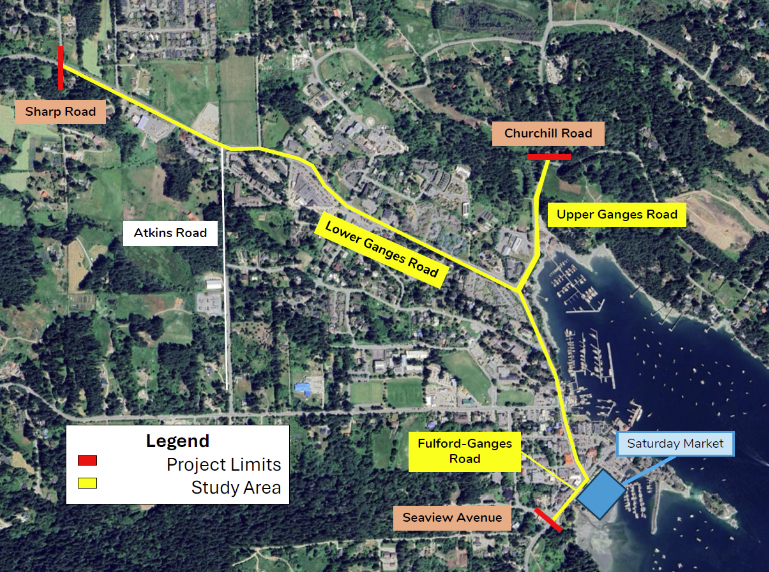
An online survey has already begun, according to Capital Regional District (CRD) officials, looking for islanders’ “experiences, observations and suggestions” to help shape pedestrian safety improvements inside the official project area — 2.5 kilometres of Fulford-Ganges and Lower Ganges roads from Seaview Avenue up to Sharp Road, and on Upper Ganges Road from Lower Ganges Road to Churchill Road.

The goal of the project, as laid out by Watt Consulting Group’s Steve Martin for the Local Community Commission (LCC) back in July, is to analyze and then — hopefully — upgrade the existing crosswalks in the area, as well as possibly propose new ones that could benefit islanders. 

“There are eight existing crosswalks in the [contracted study] area,” said Martin. “We’re going to be preparing six functional designs, between existing and proposed crosswalks; that’s six total, so it could be three existing, three proposed, or five existing, one proposed. That’s to be determined as we go through the review process.”

That process will be shaped by the consultants, CRD staff and the public; Martin’s early investigations in Ganges identified some easily-spotted problematic areas — pedestrians standing in the roadway waiting to cross at McPhillips Avenue, for example — but the feedback from islanders will have a significant role in guiding work.

To that end, the consultants will be bringing their review and conceptual designs to an open house Wednesday, Sept. 17 from 3 to 6 p.m. at the Salt Spring Island Multi Space (SIMS) building. 

“We’ll bring the data collection summary — so provide some quick facts on vehicle speeds and volumes, and on pedestrians,” he said. “The idea is for residents to provide some initial feedback on what we’re proposing, to see if it works with what they’ve identified and whether it aligns with their needs, goals and wants.”

Part of the open house will include participants helping to complete a “mapping station” activity, meant to organically collect further feedback on problematic locations the experts may have missed — “just putting a dot on a map,” Martin said, “and saying ‘I didn’t like crossing here with my child’ or ‘the vehicles are going very fast here and it’s hard for me to cross.’”

At least two pedestrian crossings in the area were outside the project scope, according to Martin, because they’re already under scrutiny. The Ministry of Transportation and Transit has initiated a design for a new crossing of Fulford-Ganges Road at Seaview Avenue, he said, and the intersection of Lower Ganges and Fulford-Ganges roads is planned for a redesign in the next few years — identified by both the 2022 Salt Spring Island Cycling Safety Strategy and the 2023 Active Transportation Network Plan.

“So our recommendations for the crosswalk there will probably be more focused on safety and some ‘quick fixes’ so we can try to avoid doing significant work at that intersection twice,” said Martin.

Feedback from both the survey and the Sept. 17 open house will inform the functional designs that will head back to the LCC, according to CRD staff, likely during a regular meeting this winter.

For more information and to complete the survey — which closes Sept. 21 — visit getinvolved.crd.bc.ca/ganges-crosswalks.
ANDREWS, Rick

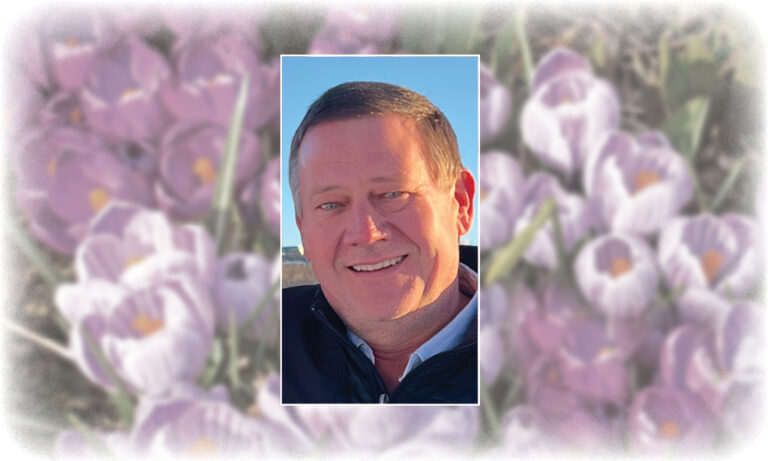
It is with heavy hearts that we announce on July 24th, with his wife Christy, daughter Larissa and two kittens Clover and Peanut by his side, Rick lost his second battle with cancer. He was born on September 17, 1965 on Salt Spring to Dennis and Lyn (Akerman) Andrews. He had a great life full of love, laughter and friendship and will be dearly missed by all who knew him.

We would like to thank all the healthcare professionals who helped Rick and made his cancer journey bearable, we couldn’t have done it without you. We would also like to thank everyone for their love and support during this time.

A celebration of life will be held for Rick on September 20th from 1pm to 3pm at the Community Gospel Church located at 147 Vesuvius Bay Rd. This event will be all about Rick so the formal part will be kept short so that there can be lots of visiting afterwards. Tea/coffee, cookies and some of his other favourite “treatsies” will be served. Rick would want you to come dressed in whatever your normal everyday attire is, nothing fancy unless that is what you normally wear.

We kindly request that any floral tributes be replaced with donations to Cats of Salt Spring, the Canadian Cancer Society or the Heart and Stroke Foundation of BC.

Survey suggests Trust should trim next budget

0

Island residents’ broad dissatisfaction with the Islands Trust was in sharp focus as results from a springtime survey came in last week — even as many support the organization’s mission, staff and individual trustees.

During May and June, the Islands Trust opened up a public survey as part of a new pre-budget consultation process, designed to get public feedback in time to meaningfully consider it during the run-up to the annual budget cycle. Through print ads, social media posts, the Trust’s newsletter and their website itself, word was spread and almost 350 responses were received — answering questions about funding levels for long-range and current land use planning services, bylaw enforcement, quarterly meetings and programs, as well as the Islands Trust Conservancy.

At the Trust’s Financial Planning Committee meeting Wednesday, Aug. 20, trustees heard that the Conservancy received the most broadly positive comments — despite what staff characterized as a “mix of support and skepticism” — with nearly 60 per cent of respondents saying the land conservation branch of the Islands Trust should receive the same or more funding in the future.

But current and future planning services were more roundly criticized, with roughly the same percentage of survey respondents (61 and 60 per cent, respectively) indicating they would prefer those services receive the same or fewer tax dollars in the future. The staff report summarized input offered in the comments sections, which “revealed concern about the Islands Trust’s effectiveness, efficiency and spending.”

“Some see planning processes as overly complex, duplicative of other regional services and disconnected from local community needs,” read the report. “Some respondents expressed frustration with constant revisions to community plans (OCPs) that often lack clear implementation or enforcement, while some question the Trust’s relevance altogether.”

Saturna Island trustee Mairead Boland noted the result was similar to the last survey they’d done, with most thinking funding should be the same or decrease.

“But we don’t actually achieve that each year, and we don’t focus on it,” said Boland. “People are not happy with the budget going up and up, or they’re not happy with the services provided for that money.”

Staff did note that respondents who wanted to see funding for long-term planning sustained or increased indicated they wanted to see a “clear focus on environmental protection and climate adaptation,” while others would prefer budget cuts, citing “poor results, staff bloat and overreach into areas outside the Trust’s core mandate.”

And despite significant trustee focus in recent months on improving bylaw enforcement, feedback there was divided, with respondents feeling largely that bylaws were “inconsistently or ineffectively enforced” and “overly bureaucratic,” according to staff, with concerns including “under-resourcing, long response times, unclear jurisdiction and lack of transparency.”

Respondents were even less supportive, at least in terms of spending, for Trust Area-wide programs like stewardship education and advocacy, with 67 per cent preferring the budget in that area stay the same or shrink. 

Staff indicated it seemed respondents broadly felt the Islands Trust should return to its core mandate of land use planning and environmental protection — with less focus on advocacy, First Nations engagement, public education and external partnerships, which some saw as duplicating provincial or federal work already underway.

“However, others praise specific initiatives like ecosystem mapping and stewardship webinars,” according to the report, “advocating for their continued or increased funding.”

A question about Trust Council’s quarterly in-person meetings — which typically cost around $30,000 each, according to staff — found perhaps the strongest public preference for budget cutting, with just 18.5 per cent in favour of continuing to hold all four annual gatherings face-to-face. More than half preferred one or two in-person meetings with the rest held online, with just 11.5 per cent supporting holding all Trust Council meetings online. This Trust Council has twice voted against reducing the number of in-person meetings. 

Respondents did give individual trustees and staff high marks for their “professionalism and helpfulness,” according to the report, with many valuing the Islands Trust’s “preserve and protect” mandate and crediting it with “preventing overdevelopment and maintaining the character of the islands.”

Staff pointed out the level of response, while nearly as high as past surveys, remained “not statistically significant,” although trustees noted such engagement at municipal levels rarely was.

Among the 343 responses, the largest number came from residents who said they felt “most connected” to the most populous island in the Trust Area, Salt Spring — roughly 20 per cent — closely followed by North Pender at 12.5 per cent and Gabriola with 12 per cent. The staff report noted 77 per cent of respondents said they were full-time residents, with over half of them reporting they had lived or owned property within the Trust Area for more than 20 years; almost 63 per cent indicated they were over the age of 65.

The committee forwarded the report to the Trust Council for consideration during its next quarterly meeting on Gabriola Island Sept. 16 to 18.

Viewpoint: Bowls

0

By Celia Meade

These days I drink coffee from a fluted mug, and I love the feel of the ridges against my fingertips. Today it took me back to when we were first married. We drank café lattes from fluted French bowls, the coffee percolated on the stove, topped with milk scalded in a saucepan — so continental. Most of our dishes — a collection of chipped, mismatched porcelain — came from the Salvation Army, but those bowls we bought new, to savour our coffee ritual.

I loved those steaming bowls of latte. We’d sit on concrete planters outside The Roasterie with dogs underfoot and savour this coffee with friends, on Saturdays, on the busy road. I had an art college friend who wanted to start a business to support herself after graduation and she decided against opening a coffee shop. She said coffee had peaked. Instead, she opened a stationery store, she painted all day, and hired someone to man the store.

Those were the days before cell phones, before Starbucks, when people mailed letters to each other. Still, the stationery store was successful, even if her crystal ball was wrong. She quit painting after 10 years anyway. No gallery would take her large canvases, even though they were striking and memorable.

I especially loved one canvas she painted of a cow being lifted by a crane. The implied violence to the cow would’ve precluded me from hanging it in my house, even if I could afford it back then. Not that art has to be decorative or easy to live with.

My friend herself was not easy to live with. She did live with someone, but she always wanted a little extra on the side. She grew depressed with the artist grind, with her collection of canvases gathering dust, and became a sports agent, abandoning her own creative work.

Bowls. Bowls that are empty and bowls that are gathering dust. What do my friend’s actions say about her in relation to bowls? She was a person with unslaked desires. You could say her bowl was never full enough, she didn’t get enough attention for her art or feel her partner was enough either. (I wonder whether being an agent helped in that regard.)

I don’t have the answer, of how to manage this desire, how to create something in the face of society’s disregard to your efforts. It’s hard to do something challenging like painting, or writing, and find it unrewarded remuneratively, even if you run a business on the side to feed and house you.

There is a bowl, however, that needs filling in us, that is filled by the creative act. The trick is how to keep filling this bowl, to let it fill up and spill over. Filling the bowl will give you that satiated glow that comes of being in the creative state, in what psychologist Mihaly Csikszentmihalyi termed flow. But this bowl is so fragile, it has to be handled carefully, and the creative juice that spills over has to be allowed to seep away.

I know it feels wasteful to go to all that effort, but it’s all right, it’s alright. Keep yourself feeling good, feeling full of the act of creation. This is your own imaginary bowl. Grind your beans, scald your milk. Just use it to make yourself feel good. It’s enough to feed yourself.

The Salt Spring writer and painter’s most recently published book is the 2024 poetry collection called Anatomy of the World.

Salt Spring Nature Academy school opens

0

The site of a longstanding independent school that closed in 2024 will be filled with youthful energy once again as the Salt Spring Nature Academy (SSNA) embarks on its first year.

SSNA is not affiliated with the Salt Spring Centre of Yoga as the Salt Spring Centre School had been, but it is using the former school’s building and grounds for its new program accommodating 24 children aged five to nine.

A small program serving six children did run there last year, and SSNA grew from those small roots and what several local families indicated they wanted in a school for their children.

“This really was something built from the ground up with a group of parents,” said school co-founder, volunteer administrator and parent Kristen Frampton. “This parent collective rose up and said, ‘Let’s do this together’ . . . It’s amazing what parent motivation can achieve.”

Other available alternative education programs didn’t seem to meet those families’ needs, so they set about creating a new one that did.

“So many families on Salt Spring are really looking for a learning environment that keeps their children deeply connected to the earth, and really fosters curiosity and critical-thinking skills and relationship skills, and brings in the academic piece as well,” said Frampton. “So it’s a very holistic program.”

Minette Moolman is the school’s co-founder and primary grades educator, and Tyler McClaron leads the kindergarten-aged group. Sam Schuette is the education assistant.

Moolman has more than 20 years of experience in education and has been program director and lead educator at Little Red Schoolhouse, Salt Spring’s nature-based early years program, for the past five years.

She said, “We’re going to be collaborating, or co-teaching, quite a bit — myself, Tyler and Sam. So that’s really exciting, and it really provides the idea to have a multi-age learning space to create more of that village mentality of the older kiddos being the mentors to the little ones, and the little ones looking up to the older kiddos and so on.”

McClaron has worked as a theatre instructor, led forest play programs for kids aged four to six and worked as a professional interpreter for both Parks Canada and Alberta Parks. Schuette has been an EA in School District 64 and camp coordinator at Bullock Lake Farm Camp.

SSNA will follow the School District 64 calendar with a Monday to Thursday schedule and the same holiday periods.

The process to become an independent school accredited and funded through the provincial Ministry of Education is not straightforward, and while Frampton said that is an ultimate goal, it won’t be achieved quickly. That means SSNA is for now funded solely through fees and fundraising, and parents will also provide support through volunteering.

While the school is currently at the desired enrolment level for this fall, anyone wanting to register their interest should spaces become available or for next year can do so by emailing Frampton at admin@saltspringnatureacademy.com. Much more information about the school is available at saltspringnatureacademy.com.

Policy Statement town hall set for Sept. 10

0

The first public engagement event for the Islands Trust’s Policy Statement revision project has a time and date — and it’s going to be online.

Trustees and staff hope that a virtual town hall set for 6:30 to 8:30 p.m. Wednesday, Sept. 10 will give them a chance to explain what’s new in the draft Policy Statement, how it came to be and how the document will eventually guide land use planning in every Local Trust Area.

In addition, attendees will be able to ask questions and share comments in a dedicated “Q&A” session, with pre-submitted questions being addressed first.

“The multi-year process to amend the Policy Statement marks the first comprehensive update in over 25 years,” read the broadly distributed invitation to the town hall, “and we want to know — have we got it right?”

The draft Policy Statement can be read online at islandstrust.bc.ca/programs/islands-2050. The document has not seen meaningful revision in three decades, with the current iteration described as an attempt to address shortfalls in the document — such as addressing the climate crisis, growing housing needs and a commitment to reconciliation with local First Nations. 

A pair of staff-led in-person community information meetings will take place in October at Salt Spring Island’s All Saints-by-the-Sea from 3-5 p.m. Saturday, Oct. 18 and at Fulford Hall from 6:30-8:30 p.m. Wednesday, Oct. 22; other islands will hold in-person events in September, October and November.

Registration is required to attend the virtual town hall; visit islandstrust.bc.ca/event/islands-trust-draft-policy-statement-town-hall. Questions can be sent to islands2050@islandstrust.bc.ca before Friday, Sept. 5 to be among the first asked at the event.

Horse association improves arena and fosters connections

SUBMITTED BY THE GULF ISLANDS HORSE ASSOCIATION

The Gulf Islands Horse Association (GIHA) is a non-profit organization based on Salt Spring Island, committed to supporting the local equestrian community and maintaining the public riding arena in Mouat Park next to the Farmers’ Institute property. 

The goal of GIHA is to provide the Salt Spring Island horse community with a well-maintained riding space and to foster connections within our community. It is easy to become a member — visit our website for more information at giha.ca.

GIHA proudly hosts the annual Horse Show at the Fall Fair and provides an inclusive, welcoming space for riders of all ages and skill levels. GIHA members are invited to use the arena for training, lessons, practice or simply enjoying time with their horses. 

GIHA is powered entirely by the dedication of volunteers and the generous support of sponsors. We are especially grateful to Horse Council British Columbia (HCBC), one of our major contributors, for awarding us a generous grant this year to support our operations.

One of the ongoing challenges we face is maintaining the arena footing to keep it in the best condition for its users. Thanks to HCBC’s donation, we were able to purchase a lawn mower that helps us maintain the surrounding grass areas and harrow the footing. This has significantly improved the usability and preservation of the arena, benefiting all equestrians in our community.

Many additional thanks to all of the local businesses and other donors who generously support our organization. We look forward to seeing our local arena continue to improve and be used and celebrated by community members.

Nobody Asked Me But: A trip on the Air BC Ferries Coastal Cancellation luxury liner

0

In the past few weeks, our very own B.C. ferry corporation has come under much scrutiny and criticism. The latest shot across the bow arises from the fact that the contract for building the next additions to the ferry fleet has been awarded to China instead of keeping the project and financial benefits in domestic hands. BC Ferries definitely does not need more bad press. In light of these developments, management is considering overhauling the traditional image to make the marine transportation system look much more like the high-profile, international airline carriers such as our respectable Air Canada/WestJet models.

How would this look? For starters, each time you book a sailing, you would accumulate sea miles (or should we call them sea knots)? How about “Frequent Floater Points (FFPs)?” Five hundred FFPs would entitle you to a free sailing to Saturna Island. Ten thousand FFPs gives you the privilege to climb up to the ship’s bridge and single-handedly dock the ferry in its berth.

Another perk under the new ferry makeover would be the allowance for both seat and lane selection. No longer would the placement of your vehicle on the car deck be at the control and whim of the deckhand. No, for a few shekels more, you can park at the front of the line in the middle lane.

Throwing down a little extra when you purchase your boarding pass will not only allow you to choose your seat on the boat, but also the lounge which best suits the atmosphere you desire. You may crave the silence and introspective vibe available in the Meditation Lounge or the “party hardy till you drop” dance temple groove reverberating from the Beat Goes On Lounge. If neither of these turn your crank, you may choose from almost every ambience in between.

Let’s do a little simulated exercise for a foot passenger day trip aboard one of the Air BC Ferries luxury liners, The Coastal Cancellation. First, after arriving at the ferry terminal, you purchase your boarding pass from the automated self-serve ticket dispensers. To your surprised delight, along with your ticket and boarding pass, a bag of salted peanuts comes sliding down the dispenser’s chute. Next you are directed to the scales to weigh your baggage. If you are not travelling with baggage, you can skip this step. If you do have some luggage, you can skip this step too because, like everyone else, you can shlep your seven bags and suitcases onto the boat as carry-on and try unsuccessfully to fit them in the new overhead compartments.

At this point, you make your way to the departure lounge and wait along with everyone else for the announcement that the crew is ready to welcome you aboard. Eventually, you get the signal from the deckhands . . . sorry, I mean float attendants . . . to proceed up the ramp onto the ferry. By the way, the float attendants have discarded their khaki uniforms and day-glo armbands in favour of neatly tailored tunics sporting Air BC Ferries commemorative logos. (And they do indeed welcome each one of you aboard with a smile and a nautical salute.)

Once you are seated, the captain’s soothing voice comes over the intercom to thank you for choosing this sailing and for the patience you’ve displayed during the somewhat chaotic boarding procedures (the algorithm on the automated boarding pass dispensers had sold more fares than the ferry could possibly hold without sinking), but the sticky situation had somehow been ironed out and it is now “all engines go.” Excess passengers are given free tickets to ferry destinations that may or may not exist. You are informed that the ship will be travelling at an altitude of about . . . er, sea level, and is scheduled to arrive on time, if only your destination belonged to a later time zone.

Finally, the float attendants take you through hurried emergency safety instructions. They point to the exits, the lifeboats and the self-deflating flotation devices. Should the lounges become depressurized, your overhead compartment will open automatically and down will drop heavy scuba tanks, which you should avoid hitting with your head. Next to drop down will be a pair of water wings and nose plugs. Lastly, falling from above will be those little white hot wet towelettes that you can use to freshen up before going into the drink. Unfortunately, the stock in these white towelettes has decreased recently, and therefore you may find raining down on you wet brown paper towels that originated in the dispenser of the washroom for the disabled. (I have promised myself to not make any mention of the ludicrously thin washroom toilet paper which is totally useless because it has less absorbency than black slate wrapped in wet moss, so I won’t.)

Nobody asked me, but perhaps we are looking at this ferry remodeling issue back-asswards. After all, haven’t we just had our knickers put in a knot because of the Air Canada flight attendants’ job action? Maybe we should be tweaking the airline industry so it operates more like BC Ferries. Talk about experiencing a little turbulence! Of course, the aircraft will have to be considerably larger so you can drive your vehicle aboard. Your special meal will be your choice between the “all you can eat” buffet in the Sunset Wing Tip Lounge, or the Captain Hook’s Surf&Turf combo packaged in a cardboard pirate ship.

One more word of warning on this proposed flight aboard the newly conceived Air BC Ferries hybrid enterprise. The last announcement you may hear could sound something like this: Passengers. If you unbuckle your seat belts, return your seats to the upright position and move to the port side of the plane, you will see an eagle soaring below us. No, not everybody at the same ti . . . .

Iranian-Canadian artist Shakiba Sattar Boroujeni up next on Showcase stage

BY ELIZABETH NOLAN

Artcraft Manager

Gallery visitors are invited to go “Beyond the Border” in Artcraft’s final Showcase exhibition in 2025, an exciting exploration into the deeply human traits shared between all peoples and cultures, featuring Iranian-Canadian artist Shakiba Sattar Boroujeni.

“My journey as an artist has been one of movement across lands, cultures and realities,” Sattar Boroujeni said, adding that living between two worlds shapes her identity and art. Beyond the Border reflects this borderland space, where the self is torn between memories of home and the search for freedom.

Sattar Boroujeni takes the human body as her primary subject but treats it as a vessel for creativity rather than an object or even a subject to be reproduced. She paints abstracted portraits that can encapsulate a wide range of emotions, cultural motifs and sometimes genders within a single figure. Although her recent work incorporates elements of Iranian culture such as the Simurgh (a mythical bird), symbolic animals, and native flowers and trees, she is ultimately most interested in the things that all humans share.

“I dislike borders because they divide people,” Sattar Boroujeni said. “I believe the world is one, and people everywhere are more alike than different. We may have different cultures and lifestyles, but the things we seek — love, happiness, connection — are universal.

“I named my exhibition Beyond the Border not only because these works were created in Iran, Turkey and Canada, but because I want my art to cross over all limitations — geographic, political and personal. Whether you live in a so-called free country or under restrictions, real freedom is something that exists beyond place, beyond the border.”

Sattar Boroujeni has been passionate about art ever since childhood. She studied graphic arts in art school, later earned a bachelor’s degree in painting in Iran, and pursued her master’s degree in visual arts and communication design in Turkey before transferring to studio art at the University of Manitoba in Winnipeg. She faced challenges along the way, both simply by being born a woman in Iran and because of her preferred subject matter.

“Due to the restrictions, you are not allowed to represent the naked human body. My art has always been about the human forms and feeling, so it was hard to represent,” Sattar Boroujeni explained. “Because of these restrictions, I started creating differently. I wanted to go beyond gender and create figures that could be anyone — forms that focus on the inner essence rather than the outer appearance. That’s why, in my work, you often can’t tell if a figure or portrait is male or female, or even if it’s strictly a body. I deform, exaggerate and transform the form so it speaks about being human, not just about physical identity.”

If social circumstances have influenced Sattar Boroujeni’s style, so have her own artistic interests. She started depicting forms without faces, but over time became fascinated by how much emotion can be expressed through the eyes, even in a single glance, and has since included those features more often. Her time in Canada has also influenced her style. When working in Iran she painted mostly in neutral tones — blues, greys, blacks, browns — but she recently realized her palette has since become brighter and more energetic. Being away from home has also caused her to embrace some traditional cultural motifs, which she melds into the human forms.

In her current series, Sattar Boroujeni also drew inspiration from some of Iranian poet Ahmad Shamlou’s powerful collection, “I wish I could be what I want to be.” A core inspiration for this body of work was Shamlou’s poem “If Only I Were Water.” Sattar Boroujeni has designed and illustrated Shamlou’s poetry books, which will be represented in the exhibition along with mixed media paintings on paper.

“The imagery of those poems often enters my work, especially in pieces where nature and the human form merge,” Sattar Boroujeni noted.

Beyond the Border opens at Mahon Hall Friday, Aug. 29, with everyone welcome to attend the opening reception taking place from 6 to 8 p.m. An artist talk with Sattar Boroujeni is set for Sunday, Aug. 31 at 2 p.m. The showcase will run daily during Artcraft hours through Sept. 21.

Outdoor Baroque fest returns

SUBMITTED BY SALT SPRING BAROQUE

Salt Spring Baroque is pleased to present its fourth annual Summer Baroque in the Trees festival. 

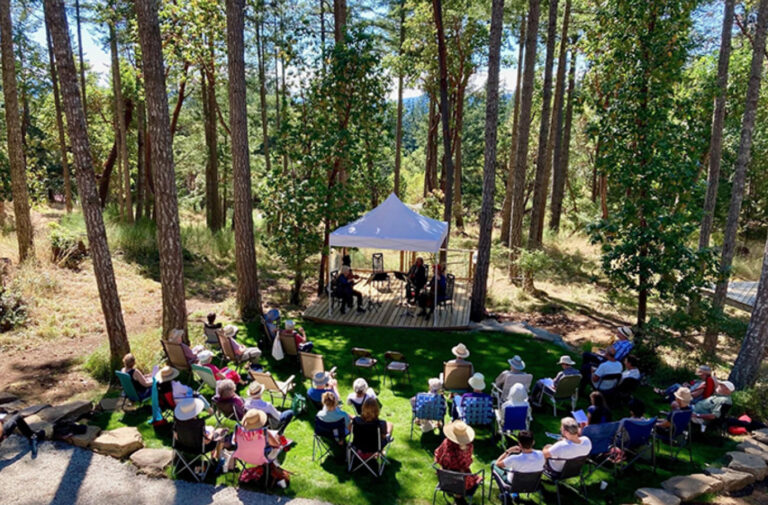
Summer Baroque in the Trees started as a way to keep the music going during the Covid-19 pandemic, when gathering outdoors felt like the safest option. Now, it’s a two-day festival set among tall arbutus and Douglas firs, where you can watch deer wander past and soak in some gorgeous baroque music.

Kicking off the festival on Saturday, Aug. 30 at 2 p.m. is the lively Gay4Nature Collective, who will present Bach’s Coffee Cantata, among other works. This innovative ensemble incorporates a rich tapestry of Western classical music, contemporary dance, film and theatre — all seen through a queer and ecological lens. Their work explores themes of queerness, connection and nature. In 2024, they toured four B.C. venues with their bright, original spin on the Coffee Cantata — a mini-opera about staying true to yourself and, of course, loving caffeine. Attendees can expect an engaging performance under the direction and costume design of Loretto Espinoza. The result is energetic, joyful and as satisfying as a shot of espresso. You will hear baritone Alex Chen, soprano Anna Bigland-Pritchard, tenor Tim Carter, Perri Lo on harpsichord, Maria Wang on baroque cello and Mikyla Jensen on baroque flute.

In addition to the Coffee Cantata, Gay4Nature will perform excerpts from the Lully opera Atys, La Musette cantata by Pierre de la Garde and other works by J.S. Bach.

The festivities continue on Sunday, Aug. 31 at 2 p.m. with the renowned Banquo Folk Ensemble, a staple in the Victoria, B.C. music scene since 1998. This ensemble embraces over eight centuries of music, seamlessly blending written and oral traditions with an array of instruments including recorders, hurdy-gurdies, citterns, shawms, bagpipes and a variety of percussion. Their own arrangements bridge the worlds of “art” music and folk performances, and honour the age-old tradition of the minstrel, delivering energetic and tuneful music that spans generations. The program, titled Things That Do Sound So Fair (Banquo in MacBeth, Act 1, Scene 3), features music ranging from the 13th to 18th centuries: medieval songs, traditional folk tunes, Elizabethan songs and lively dance music, ensuring a dynamic listening experience that captivates the heart and soul.

Banquo is Penny Reiswig, Amy Reiswig, Bill Jamieson, Gwendolyn Jamieson and Linda Donn.  Salt Spring audiences will know Gwen and Linda from their appearances with Bach on the Rock.

A few things to know: please bring a hat or umbrella and your own lawn chair (we’ll have a few extras if you need one). Park on the cul-de-sac unless you have limited mobility — there’s some closer parking, just check with the attendant. No dogs, please. An intermission will provide an opportunity for refreshments and mingling.

Tickets and venue details are available at saltspringbaroque.com.