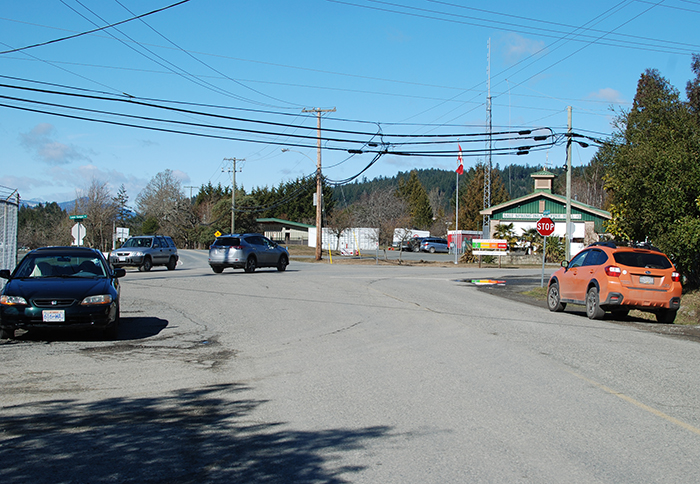
The intersection at Central is back on ICBC’s most ignoble map, as data updated Monday, June 2 for Salt Spring Island noted it once more saw the highest number of vehicle-related crashes in 2024 with six.
The four-way stop — where Lower Ganges Road, North End Road, Upper Ganges Road and Vesuvius Bay Road all meet — technically hasn’t stood alone as the island’s “crashiest” since 2021, when it tallied five, although in 2023 it shared a three-way tie for first place tallying four crashes alongside the Fulford-Ganges Road and Seaview Avenue intersection and one where Hereford Avenue, Lower Ganges Road and Purvis Lane meet.
Central’s intersection had three crashes in 2020, according to ICBC, two in 2022 and four in 2023.
The runner-up in 2024 was the south-end intersection of Fulford-Ganges Road and Morningside Road, just outside the BC Ferries landing, with five crashes; in 2023 that intersection hardly registered on the list with just one crash.
The title of third worst on Salt Spring was shared — with four each — between the intersection at Crofton Road, Lower Ganges Road and Park Drive, and two stretches of Fulford-Ganges Road, with those totals combining several intersections and driveways.
Unsurprisingly, none of Salt Spring’s intersections reached the top-10 for the Vancouver Island region; the worst regionally was where Douglas Street and McKenzie Avenue meet — inclusive of the on and off ramps to the Pat Bay Highway — with 87 crashes reported in 2024.
ICBC’s crash data are current as of March 31, 2025, and include both casualty crashes — resulting in an injury or fatality — and property damage only crashes. The data set excludes any that took place in parking lots and involving parked vehicles.
An invasive plant species never seen in Canada before it was discovered at Salt Spring’s Ruckle Provincial Park in the 1990s is cropping up again in the heart of Ganges — and biologist Kathy Reimer warns it could make Centennial Park ground zero for a new botanical outbreak.
Volunteers are working to remove carpet burweed, or Soliva sessilis, found growing in large patches on the hillside approaching the wharf. A winter annual native to South America, the plant’s discovery at Ruckle Park in 1996 sent alarm bells through the conservation community, as the inconspicuous dense groundcover can rapidly out-compete native species — and produce as many as 200 sharp, spiny seeds per plant.
Reimer and a handful of volunteers have been helping keep Ruckle Park’s carpet burweed at bay, protecting threatened species through an ongoing effort to identify, dig up and dispose of the tenacious plant. Carpet burweed spreads via its often-painful spiked seeds, hitchhiking on animals, clothing, blankets and even leather shoes.
On June 10, while the week’s Tuesday Farmers’ Market carried on in the background, Reimer and volunteer Tristan Haenep again walked methodically through Centennial Park, carrying plastic bags and butter knives, their eyes decoding the subtle differences between carpet burweed and less noxious “imposters.”
Another introduced plant, pineappleweed (Matricaria discoidea), looks a lot like carpet burweed; the giveaway, according to Haenep, is that only one of them smells like pineapples when crushed between fingers.
For a closer inspection, Haenep knelt with a knife, loosening the surrounding dry soil to pluck likely offenders out whole. Reimer raised her hand to show a tiny burweed seed that had pierced the skin, hooked into her thumb.
“They’re getting revenge on you!” laughed Haenep. “It’s so rough on pets’ paws, too. They’re super effective at hitchhiking to somewhere else — then wherever you pick it off, it starts growing there.”
Patches of burweed are too low to the ground to be effectively controlled with a mower. Reimer said she warned parks crews that mowing only spreads the seeds faster. The plants can be pulled out or — when the ground is wet — burned with a torch, ideally when it first pops up in spring. The shallow roots are relatively easy to remove without leaving anything behind, but the little seeds are eager travellers. Reimer advises parents to check their children’s clothes after visiting Centennial Park, as well as blankets and shoes.
“People think they’re looking for a little thing like a burr,” said Reimer. “But it’s got like a fishing hook.”
Reimer credited her visiting son James for the recent discovery of the plant in Ganges. His experience, she said, “following mom around” to pull out carpet burweed at Ruckle Park paid off.
“I don’t get why it was missed all these years,” said Reimer. “But these are some of the biggest plants I’ve encountered.”
Haenep said conditions at Centennial Park were likely ideal for larger plants to grow, considering the park’s broad sunlight and irrigation. Reimer said she doubted the seeds of this carpet burweed outbreak came directly from Ruckle Park, at least not recently, as the problem weed has been well managed there.
“I think we averted a terrible thing by getting on much of this before it all went to seed, because this is the farmers’ market,” said Reimer, gesturing back toward the tents. “They could end up with it on their farms.”
Reimer, Haenep and a small group of volunteers — largely drawn from the ranks of the Island Stream and Salmon Enhancement Society — stepped up on an ad hoc basis, and have already removed several large trash bags’ worth of carpet burweed from Centennial Park by hand. Capital Regional District (CRD) senior manager Dan Ovington said the CRD’s invasive species coordinator had been notified, and Reimer said they were hopeful a grant from BC Parks would help facilitate a detailed, accurate GPS map of the outbreak.
In the meantime, society members are out in small groups whenever they have time, digging, bagging and counting the plants — and, Reimer said, they wouldn’t turn down a little help, financial or otherwise.
“I saw the volunteer broom cutters from Ruckle come with their canes,” chuckled Reimer. “Everybody’s getting old! We’d appreciate anybody who wants to help us get back to doing our work on the creeks.”
To join the effort, email saltspringsalmon@gmail.com; for more information about carpet burweed visit crd.ca/media/14145.
As the upcoming second annual Indigenous Peoples Weekend will demonstrate, First Nations presence on the Gulf Islands is vibrant and very much alive.
More than 20 different arts, culture and community-building events are planned mainly for Salt Spring Island from June 20 to 22, but with others taking place on Pender, Galiano and Saturna islands.
Things kick off with an opening ceremony and teepee raising on the lawn at ArtSpring on Friday, June 20 at 1 p.m., with Metis Elder Bruce Dumont among the speakers. Further cultural events will take place there that afternoon and on Saturday. The United Church Meadow, Centennial Park, Mahon Hall, library and Mateada are among other major activity sites.
Basic information is available on our What’s On calendar on page 8, but more details and the latest schedule of events are available on the gulfislandevents.com site. To volunteer, billet a visitor, provide financial support or get more information, contact Jon at indigenouspeoplesweekend@gmail.com.
Indigenous Peoples Weekend follows the recent launch of a fundraising campaign to help the Tsawout First Nation purchase a 2.17-acre parcel of land next to its reserve on the south end of Salt Spring Island. As of June 16 the SȾÁUTW̱ (Tsawout) Land Back Campaign had raised $254,947 of the $600,000 needed to cover the costs. The Salt Spring Island Foundation is collecting funds and issuing tax receipts, and has also contributed $50,000 to the total.
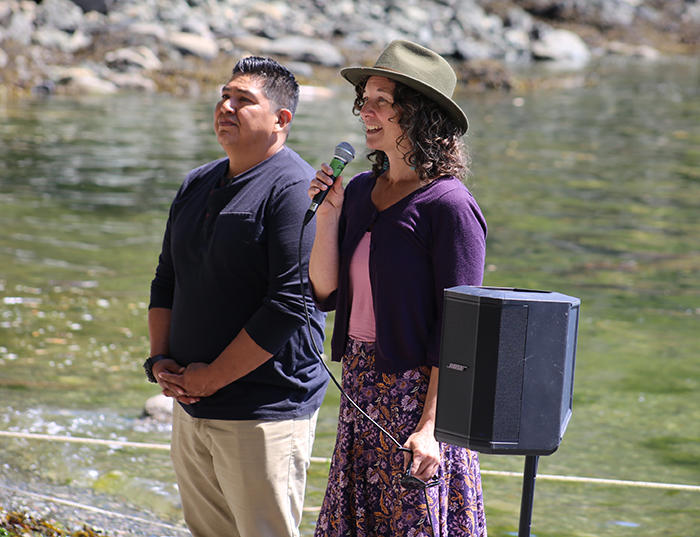
SȾÁUTW̱ Chief Abraham Pelkey and Salt Spring Island Foundation executive director Shannon Cowan at the June 3 SȾÁUTW̱ (Tsawout) Land Back Campaign launch.
Those attending the June 3 launch event heard how the path to the purchase really started through discussions between Salt Spring resident Briony Penn and nation members who talked about wanting to spend time on their reserve but had nowhere to stay in order to do that.
“So not being able to come and visit this reserve and not being able to stay here seemed to me one of the biggest things that we could do as our first step to Land Back. So I’m hoping that we can continue to [work together] so that elders can come and stay here and relax and get their health back,” said Penn.
She and others pointed out how helping with the purchase is a way to thank the SȾÁUTW̱ for allowing public access to the trails and beaches on their 50-acre reserve for so many years.
People can donate to the campaign through the ssifoundation.ca website, or phone executive director Shannon Cowan at 250-537-8305.
The Land Back subject also arose when Penelakut Tribe council member Kurt Irwin was the guest speaker at the June 12 annual general meeting of Restorative Justice Salt Spring Island. Irwin told the group that one area of focus for the First Nation is acquiring a piece of land on Salt Spring, the northern half of which is part of their core traditional territory.
Land is desired primarily in order to create a burial spot for the remains of their ancestors that continue to be found on and around Salt Spring Island, and to facilitate economic opportunity for the band, he said.
Irwin organized a visit by Penelakut Tribe elders and members to a Truth and Reconciliation Day event in Fernwood on Sept. 30 last year, which he said will take place again this September. He also facilitated a recent gathering of parties with interests in an application to control erosion on Baker Beach, noting that the Penelakut have shellfish harvesting rights in the area that no one considered.
Each local government body should have an “action plan” when it comes to dealing with First Nations issues, he stressed.
In addition to having use of part of Burgoyne Bay Provincial Park at Xwaaqw’um, the Quw’utsun people have been able to purchase a 10-acre parcel nearby. For more about that effort, visit stqeeye.ca/land.
The notion that “everything costs more” is a familiar one, and between staff, food, supplies and veterinary fees a budget shortfall was believably inevitable. And there is a similar consensus that Animal Care Services do important work, both in helping lost dogs find their way home and in finding new homes for animals who don’t seem to have safe ones.
But the latter now represents more than half the number that come into the shelter, according to CRD staff, a percentage that is rising versus the licensed dogs impounded each year. Unclaimed animals, for obvious reasons, produce no opportunity to collect revenue from their owners; instead, the program’s funding comes largely from licences, paid by responsible pet owners, and impound fees — often paid by those same owners when something goes wrong.
Before this week, it was difficult to imagine dog owners becoming any less incentivized to licence their animals, rules notwithstanding, but here we are.
Apart from a charitable desire to help wayward animals, the biggest selling point of the “dog tag” has been that licensed dogs have an opportunity to be brought home rather than impounded immediately — presumably avoiding shelter fees should staff be able to quickly connect with the licence holder. And, as staff made clear, the likelihood for a bylaw enforcement action once that dog is brought home remains, as any wandering animal’s “improperly controlled” designation would seem nearly indisputable.
Animal Care Services deserve more funding, and it is reasonable to expect a fee increase for virtually any service that hasn’t implemented one in a dozen years. But it is far less reasonable to saddle only the more conscientious subset of dog owners with the financial burden of caring for all lost and abandoned animals. A 60 per cent administrative increase to avoid an inarguably smaller property tax increase — to provide an important underfunded service that benefits everyone — is politically expedient, and wrong.
Dark smoke from a burning camper rose startlingly high above a Walkers Hook area neighbourhood on northern Salt Spring Island this weekend, but officials said the fire was contained to just that RV — and did not spread to surrounding properties.
Firefighters were dispatched to the 200 block of Main Street just after 5 p.m. Saturday, June 14, according to Salt Spring Island Fire Rescue (SSIFR) Assistant Chief Ken Akerman, who said the camper was “fully involved” by the time fire crews arrived. Akerman said he saw the smoke plume all the way from Ganges Hill some four kilometres away, as he drove to meet other responding firefighters at the north-end address.
“It looked a lot bigger [from there] than when we arrived,” said Akerman. “Fortunately, the fire didn’t extend past the area of origin.”
Akerman said 18 SSIFR members worked to contain and extinguish the fire, bringing seven apparatus and using roughly 2,500 gallons of water — carried to the scene via tender trucks, as the neighbourhood is not served by hydrants. Firefighters spent about three hours at the property, according to Akerman, with BC Ambulance, RCMP and BC Hydro also attending. No cause has been determined.
As of Monday, June 16, SSIFR’s local fire hazard level remains at “high,” although that could change; the BC Wildfire Service warned a warming trend would be returning to the province this weekend, with conditions stretching into the beginning of next week, possibly increasing fire danger to “extreme.”
Burn restrictions are still in effect across Salt Spring Island; for up-to-date fire hazard conditions visit saltspringfire.com.
This story has been updated to reflect Assistant Chief Ken Akerman’s new title in the department.
Whether by fact, legend or self-appointment, Salt Spring is often referred to as the “Artistic Capital of Canada” (artist density per capita) and some now say the “New Age Capital of Canada.” It’s a place to heal, rediscover yourself, express and connect.
On Friday-Saturday, June 28 and 29, these two signature Salt Spring communities of creativity and spirituality are destined to collide at ArtSpring with the premiere of an original genre-defying musical comedy called Hereafter: A Cabaret of Divine Love. Boasting 24 local artists and musicians, from well-known professionals to emerging newcomers, the production boldly celebrates the island’s mystical creative spirit, the depth of its homegrown talent and its distinct sense of humour, including laughing at ourselves.
It is the brainchild of ArtSpring’s technical director Cimmeron Meyer, who after a long career behind the scenes creating new work with theatre companies including One Yellow Rabbit and The Old Trout Puppet Workshop in Calgary, finally decided to lead the creation of her own show.
“During Covid and a bit of a mid-life crisis, I moved to Salt Spring, the one place in which I have found solace from the world,” said Meyer. “It inspired me to tap into some big themes and create a project that helped me navigate changes in my life that should resonate with others — with heart, humour and involving the wonderful artistic misfits I have come to discover in our community.”
It was also an opportunity to work with her daughter Eve Marie, a budding musician who will be performing several original songs, and the provocative, award-winning Indigenous theatrical powerhouse Cliff Cardinal, who opened ArtSpring’s 2024/25 season. Having worked with Meyer previously, Cardinal enthusiastically came aboard as a co-director, contributor to the story, and provided mentorship and workshops. He will be in attendance at the performances.
In true cabaret variety show format, the show promises to be a “cosmic riot” of love stories, original music and familiar torch songs, spontaneous outbreaks of dance, loaded comedy, inside local jokes skewering the new age movement and a mythic story arc towards enlightenment. Come for the laughs, leave with the transformation.
At its core, Hereafter is about a young man named Joseph (played by Roy Val Clery) who flees a criminal past by escaping to Planet Chiron run by new age gurus. Those who are up on their Greek mythology, astrology or Jungian practice will know Chiron is often called the “wounded healer” and represents deep seated wounds, trauma and how we navigate healing and personal growth.
In this new age world, Joseph, in an attempt to save his soul, makes a deal with top guru Pa (Michael Bean) who demands chastity. The snag is Joseph falls in love, making that deal point a challenge. A bevy of other mystics, divas and even Earth Goddess Lilleth herself (played by an eight-month pregnant Moonie Garner) weighs in on the divine nature of love, lust and happiness while bickering about attracting new followers.
Superimpose that on 85-year-old local jazz diva Hannah Brown, who gives what might be her final performance, former ArtSpring executive director and musician Cicela Månsson, who appears as one of the divas, dance sensations Adina Eva and Sashah Sunshine, and singer-songwriter Blair Francis as one of the players, while he and Meyer tag-team running the tech booth.
Punk, jazz, folk, torch, comedy, revelation, mythology, mysticism, mischief, cosmic mayhem — whatever this maelstrom of creative madness is — Hereafter is an opportunity to be part of a wildly ambitious, slightly off-the-rails, almost dangerous, theatre experience.
How very Salt Spring.
Tickets ($35 for adults and $20 for seniors or students) are at artspring.ca.
After 12 years without an increase, the cost of a dog licence within the Capital Regional District (CRD) Electoral Areas is going up — as are impound fees charged for wandering animals picked up by Animal Care Services.
Next year, dog owners will pay $40 to license a spayed or neutered dog and $60 for an “unaltered” animal, per a new bylaw adopted by the CRD Board Wednesday, June 11, up from $25 and $45 respectively. The late fee is also doubling — from $10 to $20.
The last time dog licence fees increased was in 2013, when they went up by $5. The CRD plans to continue to offer the $5 discount per dog for early tag renewals — as well as a free licence for the year a dog is spayed or neutered.
Those higher fees come alongside increased charges for impound and daily shelter fees for dogs and cats, as well as several listed animals, including goats, sheep, horses and pigs.
“Dog owners have had a fee holiday for a number of years,” said Southern Gulf Islands Electoral Area director Paul Brent, as the new bylaw was being discussed at the Electoral Areas Committee earlier in the day. “I look at the pet care industry, and the billions and billions of dollars spent, and I don’t have a problem with it. I mean, this isn’t Iran, where they’ve made the walking of dogs illegal now.”
Both licence and shelter fees supplement Animal Care Services programming, including proactive education, outreach and the shelter itself, which sees about 500 animals annually, according to staff — from dogs and cats to reptiles and livestock. Impounded animals are reunited with their owners where possible, states a staff report, and if not claimed are adopted into a new home or transferred to other rescue agencies for medical assistance or rehabilitation.
The shelter actively avoids euthanizing animals unless they are too ill, injured or aggressive to be rehomed, according to senior Protective Services manager Shawn Carby, noting the department’s national recognition as having among the highest rehoming rates in Canada.
Carby said some 12,450 dogs are currently licensed in the CRD, and having the tag on your dog’s collar will help it get home if lost — and could save money as well.
“We’re able to identify who the owner is; we make a phone call,” said Carby. “And if that owner is home and is able to be reached, instead of going to drop the animal off at the shelter — which would incur an impound fee — we would just take the animal to the owner.”
If there was an indication the animal was improperly controlled, Carby said, there may be warnings or fines associated with the dog being at large.
The number of unclaimed animals is rising, according to Carby, and more than half of the animals that come into the shelter are not claimed and require assessment, medical treatment, socialization and training before new homes are found. And with the rising costs of staff, sheltering, training, food, supplies and veterinary fees, the program simply needs more funding.
“The proposed approach will generate the revenue needed from the users of the program — pet owners — without impacting requisition for the taxpayer,” said Carby. “We are confident that the proposed fees are consistent with other regional districts and municipalities of similar size and are necessary to meet the current operational and anticipated capital costs necessary to sustain service and shelter operations into the future.”
The licence fee bump alone is expected to generate about $200,000 in additional revenue, according to staff. Most dog owners will have either already renewed their 2025 licences by now, Carby noted, and will not be affected by the fee change until next year; all current dog licence accounts will have the new fees applied when renewal notices are sent in December for 2026.
In the June 4 article about the weir project, North Salt Spring Waterworks District (NSSWD) hopes to better protect beaver yet seeks to minimize an important environmental issue. Namely, how much the coho salmon, cutthroat trout, resident lake trout and other river species rely on 8.9 L/s minimum flow mandated for Duck Creek.
In a recent report about flow rates in the creek, hydrologist Dave Gooding wrote, “Both sea run and resident lake trout spawn in January/February when adequate flows are usual. Salmon fry emerge in May to out-migrate, trout later in June. Low flows during these times can limit the ability of fry to out-migrate to the ocean, and their health and size. Low flows during the period when fry are in the stream (a year for both coho salmon and lake run trout fry) results in lower oxygen levels, higher water temperatures and less food availability, with the result of reduced fry health or even mortalities. The lack of a consistent fresh water flow to the estuary affects the biologic function of that habitat, and therefore the size and health of smolts leaving to the ocean.”
NSSWD applications to reduce the minimum flow on Duck Creek began at least 10 years ago. For example, in 2015, NSSWD applied to the federal Department of Fisheries and Oceans for permission to reduce the minimum flow by about half. In September 2024, NSSWD published the Water Master Plan (WMP), which supports their effort to significantly increase water service connections. In it, the district questions whether Duck Creek requires 8.9 L/s and suggests 4.0 L/s instead.
The district has shared their plan to commission a study on the topic. The WMP relies on about 900 pages of studies NSSWD commissioned over the past 10 years. One of these directly addresses how low-flow conditions degrade aquatic habitat. In 2018, NSSWD paid Ecofish Research Ltd. to study environmental flow needs (EFN) in Duck Creek. The result is available on the NSSWD website. Written by Todd Hatfield, the 145-page study focuses on the commonly acknowledged relationship between flow rates and aquatic health.
In order to figure out EFN, environmental managers divide the mean annual discharge (MAD) by 10. The general acceptance of this “10 per cent of the MAD” to determine healthy fish flow extends across the continent. Table 7 of the Ecofish study shows that compared with 8.9 L/s, a 4.0 L/s flow rate degrades fish habitat quality by two thirds and at a 2.0 L/s flow rate, habitat is degraded by 90 per cent.
Since May 11, Duck Creek flow rates fell below 4.0 L/s at least eight times. On four of those incidents the flow rate measured less than 2.0 L/s. Sometimes, when the flow rate falls short of the mandated minimum, volunteers restore flow by removing some of the blockage. This takes about 10 minutes.
In the article, NSSWD board chair Brian Pyper states that on average, the total consumption of NSSWD customers is about 17 L/s. He then compares that consumption with Duck Creek EFN of 8.9 L/s and laments, “roughly half of our entire consumption is mandated for summer flow.”
More to the point, how does the volume of water leaking from the NSSWD distribution system compare with EFN? The NSSWD water audit showed that in 2016, unmetered losses added up to about 20 per cent of annual output, or about 4.0 L/s.
Another perspective is to look at how these withdrawals affect lake levels. The 2016 unmetered losses work out to about seven cm of St. Mary Lake depth. That is a lot more than the five cm of lake depth required to maintain EFN in the dry months. For comparison, during the four dry months, the total St. Mary Lake drawdown, including evaporation, human use and EFN, is about 60 cm.
Out of the blue 15 months ago, the province allocated $10 million to increase the water storage capacity of St. Mary Lake and allow for the required EFN in Duck Creek. In the WMP, NSSWD continues to ask nature to make do with less than half of EFN. Wouldn’t it be better to fix the leaks in the distribution system first?
Salt Spring Island’s Restorative Justice (RJ) group marked a busy year at its annual general meeting at the library on June 12, hearing from a special guest and sharing successes along with delicious food.
While RJ has been part of the island in some form since 1996, it only became a registered society in 2022.
Program coordinator Jessica Terezakis reported how the organization went from having zero cases two years ago to having 10 people reach out for RJ support, two RCMP referrals and doing 11 community circles. A total of 162 people were directly supported, for “a wonderful impact on our community,” she said.
RJ is a practice with Indigenous roots that brings affected parties in a conflict together to seek understanding, resolution and healing. Salt Spring’s group has a number of trained volunteers who can facilitate talking circles and provide service.
Terezakis reflected on learning how true healing takes time. Many conflicts don’t result from “malice,” she said, “but from a deep, systemic absence of empathy . . . I find we often individualize harm. We say ‘this is the bad person and this is the good person, and this person did a bad thing,’ but it’s actually the systems that are really causing a lot of harm.”
The RJ process needs to hear from people and how systems have failed them, she said, in order to “really get to the bottom of how we can support them in a deep and sustainable way; in a way that’s not a quick fix or an ending.”
Terezakis also told the approximately two dozen people attending that RJ Salt Spring was only one of six RJ groups in the province to receive $35,000 from the B.C. Civil Forfeiture Grant Program for the coming year. A CRD grant-in-aid is also appreciated. In the last fiscal year, the society operated on just over $22,000.
As a result of the extra funds, Terezakis said they hope to do more work with seniors and youth, increase the number of trained RJ volunteers and apply for registered charity status. An introductory volunteer training session is in the works for July, followed by a casework workshop in August.
“Because we have such an increase in cases we really want to grow our team and have more community collaboration and partnering on projects,” said Terezakis.
Board chair Laura Dafoe touched on the group’s origins with Irene Wright leading what was then called a “diversion program” to keep youth offenders out of the criminal court system, and noted involvement by Roberta Temmel and Charles Kahn in the early years. Temmel has remained active in the group and Kahn has returned this year as a volunteer. She also expressed gratitude to Terezakis’ predecessor Darlene Gage, who “walked us through the process of becoming our own society,” and Gayle Baker for making space for RJ circles at ASK Salt Spring on the second Friday of each month (except for upcoming summer months).
“The Restorative Justice group is able to serve our community well because of the knowledge and dedication of its active members,” concluded Dafoe. “Like other not-for-profit organizations, it depends largely on volunteers, and you are here at the AGM because you share our desire to realize a better world, a world where everyone matters, and so we thank you for your interest.”
Penelakut Tribe council member Kurt Irwin was the AGM’s guest, and spoke about the desire for the Penelakut to acquire a parcel of land on Salt Spring Island, with the northern part considered their traditional territory, and other activities he and fellow band members have been involved in. Irwin also brought cold-smoked salmon to add to a table of food and punch prepared by Temmel.
Two new board members were welcomed: retired family law practitioner and mediator Leith Martin and Island Community Services youth and family substance use worker Shae Houston. They join Dafoe, Temmel and Kaylie Maughan, who has years of experience with RJ on the mainland and has been instrumental in the group’s recent development, on the board.
On May 30, a group of retired Islands Trust trustees wrote to the Minister of Housing and Municipal Affairs to promote an incorrect interpretation of the Islands Trust mandate.
On June 15, together with a number of other former trustees, we sent the minister our own letter to correct the record.
We pointed out that it is a misreading of the legislation to claim the Islands Trust’s “primary duty is protecting the natural environment and ecosystems.” A November 2024 legal opinion (see link below) on the Islands Trust website explains that Section 3 of the Islands Trust Act grants the Islands Trust broad discretion to adopt policies that strike a reasonable balance among the inter-related, but different, objectives of preserving and protecting “the trust area and its unique amenities and environment” (emphasis added). That is, in addition to protecting the environment, working to support the well-being of Trust Area residents is also an important component of the mandate.
Trust Council relied upon this analysis when it issued its September 2023 statement on the scope and meaning of the mandate. In doing so, Trust Council was not seeking to redefine the mandate, but following the 2022 advice of one of the minister’s predecessors that Trust Council use its existing authorities to address the findings of the March 2022 Governance Review. One of those findings was that the ongoing failure to articulate a clear understanding of the mandate was a “fundamental – not to say existential – challenge” to the organization because it provoked endless internal disputes over the nature of its role. As we say in our letter to the minister, it is urgently necessary to put an end to the misconception that the Islands Trust exists solely to transform the Trust Area into an ecological preserve that only a privileged few may enjoy.
We do not know why in writing the minister the retired trustees chose to not even mention the November 2024 legal opinion that contradicts their position. We do know it is unreasonable to ignore the plainly expressed intentions of the provincial legislature, and unfair to Trust Area residents to take an extreme position that is indifferent to their needs and those of their communities.