Home Blog Page 88

Training set for new visitor centre volunteers

0

New volunteers at Salt Spring’s Visitor Information Centre are promised a warm welcome when they take the first Destination BC course of 2025 offered on Tuesday, Jan. 21.

The course consists of both online modules and local orientation.

Visitor centre volunteers welcome visitors from around the world and offer them creative ideas for spending time on the island, from visiting artists’ studios to hiking on mountains or just enjoying the town of Ganges.

Local people also come into the centre for bus or ferry schedules, or when they need information to help their own visitors make the best time of a visit to the island.

For further information or to sign up for the volunteer training, contact the visitor centre  at 1-250-537-5252.

May says federal election outcome not preordained

0

 There’s no inevitability in a democracy, according to one elected official –– and the greatest power remains rooted in each vote. 

Responding to questions at a Salt Spring Island town hall event, Saanich-Gulf Islands MP and Green Party leader Elizabeth May warned widespread framing of gains by Conservatives in the upcoming election as “preordained” risks suppressing voter turnout. 

“The media is not helping us here,” said May. “They are creating the impression of a Conservative win as inevitable, like it’s all done already.” 

The comments came during the first of a series of planned nonpartisan meetings with her constituents held Saturday, Jan. 11 at the Gulf Islands Secondary School. More than 100 islanders turned out to ask questions and visit with the popular MP, who won her party’s first federal seat in 2011.  

The impact of telling voters an election is already decided is that it encourages people to stay home on voting day, May cautioned, citing examples like the 2022 provincial election in Ontario. During what she called a “steady drumbeat” that Premier Doug Ford was on track to win re-election, voter turnout was — “horrifically,” said May –– 44 per cent, a record low for that province. 

“Because they’ve been told everything’s already decided,” said May. “It’s preordained. Why would you bother to vote?” 

May lamented the “deeply eroded” resources of the news media, saying that if pollsters were “deciding the elections before voters get to pick up their stubby little pencils, we have to fight back against it any way we can.” 

“It’s really critical that everyone with the right to vote, votes in the next election,” said May. “However they want to vote, we need to get the turnout up –– because otherwise we get a quite diminished democracy.” 

May came to Salt Spring fresh off a recent round of social media popularity, as various online users shared video clips from a Jan. 3 Parliament Hill press conference –– where, among other jabs, she offered U.S. President-elect Donald Trump a counteroffer to his Canada-as-51st-state rhetoric, suggesting “maybe California would like to be the 11th province.” 

Saturday afternoon May called Trump an “enemy of democracy, and an enemy of climate.” Asked whether there might be any “silver lining” to his election, she said in her discussions with other party leaders and provincial premiers, she saw positivity –– and perhaps the potential for an increased national solidarity. 

“Trump’s threats might have the effect of bringing Canadians together in a way that we haven’t felt,” said May. “As proud Canadians [who] stand up and sing ‘O Canada’ as if we meant it.” 

The 90-minute discussion ranged from personal observations, such as an entertaining retelling of deputy prime minister and finance minister Chrystia Freeland’s resignation (“I looked at her letter and thought, ‘Is this a really clever spoof? I mean, it looks like her stationery!’”) to serious public policy matters like Arctic defence and the critical need for public housing.  

In response to a question about how youth might manage growing anxiety about the future of the planet given the climate crisis, May pointed to the power of their votes. 

“It’s both encouraging and sobering to know how many of our kids can’t sleep at night,” said May. “But we have to make sure that our kids know that for agency, if they’re over 18, they can vote.” 

May cited data suggesting the 18 to 25 voter demographic had among the lowest levels of voter turnout –– made more tragic, she said, by the understanding “they have the most to lose.” 

“So if you have friends in that age group, or kids or grandkids,” said May, “it’s not about pitching to vote one way or another; the most important thing is that people vote.” 

See May’s website at elizabethmaymp.ca for more January community meeting dates and details.

Farmland Trust celebrates gratitude and growth

By the SALT SPRING ISLAND FARMLAND TRUST

How can we serve you in 2025?

This is the question that thumps in our hearts and occupies our minds as we plan significant leaps towards being a resilient, food-secure island.

We, the Salt Spring Island Farmland Trust, are in this fortunate position — to be bold in our dreams — thanks to immense support from our beautiful and diverse community through 2024. The number of people and organizations we owe gratitude is humbling.

At The Farm

Our new manager energized everyone and oversaw much-needed initiatives like Phase 1 of the Water Drainage Improvement Plan. Thank you, Bayan, for becoming a pillar of the precious resources we steward.

Thank you to 46 enthusiastic volunteers who showed us the power of unity. You cleared plots, assisted gardeners, held workshops and brought priceless permaculture principles to life. Because of you the farm has a 1,000-litre compost tea tank that blends nutrient-rich plants like comfrey and nettle to boost the vitality of soil across the farm. Because of you, many Salt Springers now carry the knowledge of how to burn organic waste to make another super powerful and climate-friendly soil amendment known as biochar.

The farm received crucial money, too. Thank you, Canada Summer Jobs, for funding staff time to improve maintenance. Thank you Investing in Canada Infrastructure Program for funding our composting toilet.

At The Root

Who would we be without the soulful entrepreneurs who grace our food hub with their clear vision, fine skills and reliable work ethic?

Thank you, Nance Bakes, Sweetgrass Food Co, Ox Eats Grass, Hidden Realm Hot Sauce, Salty Burgers, Local Salt and Free Rangers. You are making our land, kitchen and barn buzz with yummy goodness.

We’ve also been fortunate to witness entrepreneurs outgrow our space and spread their wings to serve even more happy customers. Thank you, Salt Jar Refillery and Salt Spring Flour Co., for proving us to be a valuable incubator, and for inspiring us to continue our own growth. May you always prosper.

To our non-profit friends, a deep bow is in order. To the Seed Sanctuary Society for being the keepers of our treasured seed bank and, along with Farm Folk City Folk, thank you for providing seed cleaning services to all the amazing, dedicated farmers who need it. You are anchoring our island’s resilience.

Moe Wendt: your deep wisdom and effort to grow and shape an educational permaculture garden, along with your financial generosity to donate fencing and garden tools, blows us away. Thank you for being with us. And thank you, Nigel, for all your hard work alongside Moe.

And to the Salt Spring Island Foundation for funding our storage container, REDIP for funding our water system, and Canada Summer Jobs who again helped us with important staffing costs — thank you, thank you, thank you.

With the Food Share Program

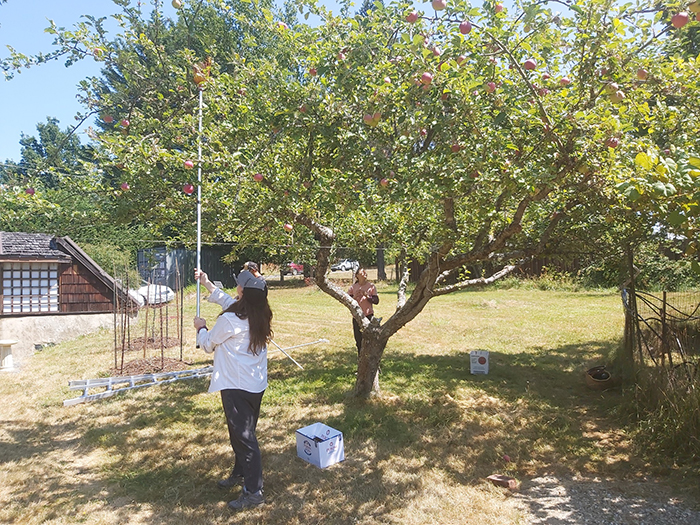
How many fine souls does it take to harvest 15,092 pounds of fruit? Answer: 80, and we love you all (pickers, treeholders and organizers combined). Thank you for making our inaugural gleaning program such a spirited and productive affair. You filled the Salt Spring Food Bank, nourished Gulf Islands School District, IWAV, the Women’s Institute and the Christmas With Scrooge community production — ha! You also brought smiles to countless individuals who picked up free apples from our farm stand.

The energy at our community apple-pressing days was incredible. Many of you spontaneously joined in the making of our apple juice commercial. So good to be with you all.

At the core of what we do is feeding each other, breaking bread together. Thank you to every gardener who showed up with fresh produce and homemade goods for others to share in and receive during our weekly food exchanges. Your abundance was so great, we were also able to support the devoted staff and patrons at Gabriel’s Kitchen.

It’s true to say that the assistance from First West Foundation and Victoria Foundation for staff time and harvest equipment, and from the Red Cross for volunteer development, was used to its fullest.

Inaugural Learning Series

It’s not just food we share, it’s a way of life. It’s the opportunity to be more harmonious with the earth.

Thank you Linda Gilkeson, Karen Cairney, Kayla Stratford, Cheyenne Sawchuk, Kerrie O’Donnel, Eland Bronstein, Brian Smallshaw, Ben Corno and Kaleigh Burton. With your guidance we learned a full cycle of natural collaboration — from arts of soil health, to seed starting, gardening in and out of a greenhouse, cooking and canning, and back again.

Governing Allies

Running an island, especially in transformative times, is a monumental and complex job. Thank you to the Capital Regional District, the Islands Trust and the Local Community Commission for improving bylaws, donating funds and helping us begin to realize our vision on The Farm, at The Root and through our programming. We honour the stress you bear by being central to a wealth of activity on our island. It’s no small task to hear and digest and navigate competing opinions and desires of our population. Thank you for holding this great responsibility and for doing your best to set us up for success, as we all learn to come together.


Excitement for new Met Opera production of Aida

BY KIRSTEN BOLTON

FOR ARTSPRING

On New Year’s Eve, the Metropolitan Opera unveiled its first new production of Verdi’s Aida in almost 40 years.

As one of the most epic works in opera’s classical canon, Aida’s Live in HD broadcast at ArtSpring on Saturday, Jan. 25 has already attracted the highest volume ticket sales since well before Covid, with good reason.

For his state-of-the-art take on Verdi’s monumental drama, director Michael Mayer embraces the work’s grand scale and opportunity for spectacle, filling the stage with towering ancient scenery of gilded tombs, lavish costumes and colours, and animated projections to bring ancient Egypt to life.

Caught in one of opera’s greatest love triangles, American soprano Angel Blue headlines as the captured Ethiopian princess torn between love and country. Polish tenor Piotr Beczała stars as Radamès, the valiant soldier she desires, and Romanian-Hungarian mezzo-soprano Judit Kutasi is the Egyptian princess who is Aida’s rival for his affections, all with a sinister priestly class pulling the strings.

Beloved Met music director Yannick Nézet-Séguin takes the podium once again to conduct. As a Canadian, he often gives his signature shout-out to Canada as part of real-time backstage interviews during intermission. Watching behind-the-scenes coverage of set changes, production design and interviews with the stars is part of the added value of the Live in HD experience for audiences watching from outside New York.

Aida was the fulfillment of a long-time dream of Isma’il Pasha, Khedive of Egypt, who had spent years trying to convince Verdi to compose a work for the Khedivial Opera House, after it had opened with a performance of Rigoletto in 1869 to coincide with the completion of the Suez Canal.

It took the intervention of French archaeologist Auguste Mariette to propose the subject that ultimately captured the composer’s interest. Having discovered a number of significant tombs and established the famed Egyptian Museum, Mariette combined his knowledge of the ancient world with a bit of theatrical licence to fashion a story that contained all the hallmarks of a great operatic tragedy: warring kingdoms, bloodshed, a love triangle and treachery at the highest levels.

Verdi saw the potential for “a work of vast proportions,” and after enduring delays due to the outbreak of the Franco-Prussian War, the opera eventually premiered in Cairo on Christmas Eve 1871 — with Mariette himself supervising the scenery and costumes.

Mariette and Verdi’s vision of ancient Egypt is not without its fair share of anachronisms and inventions, but for director Mayer, these are all part of Aida’s charm. This is acknowledged in his framing of the opera with a team of 19th-century archaeologists who unearth a tomb not seen for millennia. As they sweep away the cobwebs and cast lantern light onto rows of crumbling hieroglyphs, the faded images and symbols begin to glow and leap from the walls. The room takes on colours of lapis lazuli and gold, and the story is set in motion.

Audiences can look forward to The Triumphal March, one of the most popular pieces of classical music in the world, as well as the intermission warm quiche, coffee and cookies in this Saturday opera tradition at ArtSpring.

Met Opera’s Live in HD series was launched in 2006 and has expanded to 66 countries, attracting millions of people around the world to sit down to experience the same live performance in real time, using up to 10 HD cameras to capture on-stage close-ups and back-stage interviews and activity.

Tickets are on sale at artspring.ca or the box office for $25 adult, $20 senior and $15 youth.

In Response: Our community needs empathy, not attacks, to solve its problems

0

By JASON MOGUS

Last week’s paper held an interesting snapshot of life on Salt Spring in early 2025. 

The lead story was how the median home price is now $850,000, which has stayed pretty stable the last three years. Great news for us homeowners, I guess, but it’s worth stopping for a minute and taking that in. What was the average price when you moved here, or your parents did? For me, 11 years ago, it was about half what it is today, and we could only pull off our home with a monster-sized mortgage my off-island job could just barely cover. If you moved here as a hippie, artist or even middle-class retiree from an older generation, would you have been able to afford it at today’s prices? 

The second article was a lovely piece by Bryan Young of Transition Salt Spring, on how collaboration, positive organizing and moving beyond division to find unifying issues was bringing great benefits to our community. Transition Salt Spring is a shining light on what a visionary, solutions-oriented yet practical environmental non-profit can achieve when it is centred around both people and the planet. I’m always impressed by them.  

Then we get to the letters section, where two of Salt Spring’s leading anti-housing activists felt the need to lay into the recent work of community volunteers and one elected official (it’s always the same one) who work on affordable housing.

Perhaps you’d seen Salt Spring Solutions’ submission, or read trustee Laura Patrick’s in the Jan. 1 edition of the Driftwood. Maybe you learned that almost 700 people had been listened to, including those who work full-time keeping our community running but are forced to live in vans, campers or boats. Maybe you felt some shock or compassion for how so many fully employed people with families have to live here today. 

But Frants Attorp and Ron Wright see not careful listening work around an important community issue but deception, another scam in a long snow job plotted by unethical anti-environmental actors. Mr. Wright even suggested a new hidden motive: people working on housing, for in some cases almost a decade, are really doing it to make money. As if social justice work is the new bitcoin, with a big payday just around the corner. A really, really, really . . . really long corner. Sarcasm aside, this kind of character attack hurts, and is kind of cruel. 

They represent a small minority, but are a highly organized one. You should know about the groups they help run. Keep Salt Spring Sustainable, Positively Forward, Friends of the Gulf Islands and the Water Preservation Society have done a lot of work on housing: they’ve hired lawyers, threatened trustee Patrick with lawsuits, phoned the Islands Trust staff on a regular basis, organized countless letter writing and town hall stacking campaigns, and as any reader of the Driftwood is aware, written many letters to any news site that will take their submissions, all with the same core message: don’t trust housing ideas, or the people proposing them. 

Working people and young families I speak with tell me when they read articles like these, or see policies they were excited about being defeated, they feel unwelcome in this community. Many see something more stark: homeowners who bought cheap decades ago who lack empathy for how the world has changed. Their endless “stop growth” advocacy mask a simple truth — that they’re denying others the same basic rights they have freely enjoyed. 

I know there is much more nuance to it than this, and I actually don’t doubt these groups’ intentions in wanting to protect this special place from the ravages of late-stage capitalism. In a free society you are allowed to organize to build the world you want to live in. But how democratic is it that a small group of people can block something that thousands of housing insecure community members and their allies have consistently asked for and voted for?

We are measured not by our intentions but the impact of our actions. Our housing crisis was not caused by local opposition, but local opposition, combined with our dysfunctional form of government, is stopping us from doing anything about it.

That’s the “anti-housing movement” these activists deny even exists, and unfortunately it’s making people’s lives worse. 

If you’re worried about our community losing its diversity, if you want to “Keep Salt Spring Weird,” or feel empathy for the struggles of today’s working-class and young people, the thing you can do is stop believing the outdated, black-and-white thinking that is blocking a mature conversation about a reasonable path forward. You can lean in, as many are, to the exciting, intelligent, integrated solutions where environmental stewardship and housing needs can coexist. 

These problems are hard, but they’re not going away. At the very least, Salt Spring needs empathy and understanding on this issue, not attacks on the people working to address it. 

LCC budget presented at town hall

0

Salt Spring’s Local Community Commission (LCC) held its second annual presentation on the upcoming year’s budget, offering an opportunity for taxpayers to sound off about 2025’s plans. 

The provisional tax requisition for Salt Spring, including its contribution to the Capital Regional Hospital District, is $9.2 million, officials said –– 13.2 per cent above last year. More than half of that –– about $5 million –– is specific to services now delegated to the LCC, such as parks and recreation, transportation and transit, liquid waste, the library and its grants-in-aid program. 

But despite a double-digit hike and favourable weather, the gathering Thursday, Jan. 10 was best described as intimate –– with about a half-dozen islanders turning out to the Salt Spring Island Multi Space (SIMS) board room. LCC chair Earl Rook opened the meeting noting that this year’s budget for Salt Spring was examined at breakneck pace, as commissioners first saw the initial provisional budget document in September.  

“And we had to get back to them with a [provisional] approval by the end of the day,” chuckled Rook, “so that was a nine-hour meeting. That’s one of the things, process-wise, we have to work on; we need to get ahead of the game, start earlier, and get our input in earlier.” 

That pace isn’t set to ease off; the current version of the provisional budget was approved in late October by the broader Capital Regional District (CRD) board, who plan to finalize their budget by March. To make that deadline, the LCC’s final budget decisions will need to be made at a special meeting on Thursday, Jan. 30 –– so time for community input, should any more be forthcoming, is running out. 

Commissioners agreed the presentation Thursday night was mostly a summary of the tax requisition’s contribution towards paying for local and regional services. Not included in those dollars were user charges –– like pool entrance fees, which commissioners have said would be rising slightly –– or grant funding; the idea Thursday was to present a notion of how much someone’s property taxes might be going up and give the public an opportunity to respond. 

To that end, commissioners presented examples of an “average” property tax bill on Salt Spring –– with an average residence valued at just over $1 million. That property’s owner will be paying just under $1,400 in 2025, up from $1,238 last year. As a monthly cost, that taxpayer will be budgeting $117 for CRD services this year, or $14 more each month than in 2024. 

“We’re just one part of the total budget for Salt Spring local government,” said Rook. “The other components that play a major role include the Islands Trust, and the improvement districts –– for many of us, the North Salt Spring Waterworks District (NSSWD), and then of course the fire district.” 

The Islands Trust has said it anticipates a 7.3 per cent budget increase for local Trust areas next year, with the Salt Spring Fire Protection District planning a 9.9 per cent hike. Ratepayers within NSSWD will not see a parcel tax rate increase in 2025, although some smaller districts will see parcel tax bumps, such as CRD-managed Fulford Water (three per cent) and Beddis Water (10.8 per cent). 

Amounts for schools, policing and other provincial government services in a “rural” area are also part of the overall property tax mix.

For the LCC, its jump in tax requisition was largely driven by familiar factors, according to CRD director Gary Holman –– such as inflationary pressures and salary costs. 

“Increases for CRD staff are in the four to five per cent range,” said Holman. “All local governments are competing for competent staff, and part of that competition results in negotiated wage and salary increases.” 

In addition, the creation of a new senior-level general manager position –– while shared between the three electoral areas of Salt Spring, the Southern Gulf Islands and Juan de Fuca –– contributes to that, although commissioners agreed having someone with Salt Spring’s interests “at the table” in the CRD’s senior staff operations would be of enormous benefit to islanders. 

Other major factors the LCC cited for the requisition increase included re-opening the pool at the Rainbow Recreation Centre on Sundays, some replenishing of infrastructure reserves exhausted during the start of the pandemic, increasing the allocation to the library to help offset staff costs –– as volunteerism there declines –– and more dollars for local transit.  

Salt Spring’s transit system has long been a point of pride, commissioners said, but as ridership has returned to pre-Covid levels, BC Transit’s costs have risen as well, easily outpacing what might be recouped through fares. 

“Now BC Transit pays half of our [transit] costs,” said LCC member Gayle Baker, “so they do support us very well. But I’m not sure there’s much we can do when they up some of their costs.” 

“They’re facing similar [inflationary and wage] pressures,” said Holman. “The province has said that they will have funding to expand transit within B.C. –– not in 2025, but in 2026 –– but there’s going to be competition for those funds.” 

The full CRD budget is online at getinvolved.crd.bc.ca/2025-financial-plan, with copies available to view at the CRD’s local administration office at 121 McPhillips Ave. in Ganges. 

Viewpoint: NSSWD water master plan is responsible asset management

0

By BRIAN PYPER

NSSWD Board Chair

The North Salt Spring Waterworks District (NSSWD) board felt it was essential to respond to Doug Wahlsten’s misleading opinion piece published Dec. 18, 2024 regarding the district’s recently completed water master plan (WMP).

A WMP is not a proposal or project, it’s an assessment of the infrastructure required to meet current and potential future needs for the community. This is the district’s first WMP and it provides a prioritized list of asset improvements and potential costs to inform the board in asset management decision-making, a responsibility we take seriously. Its most important benefit is that it provides a comprehensive “blueprint” of district infrastructure, capacities and potential limitations.

The costs of $46.3 million cited in the headline of the article, is not an estimate of what we plan to do, not even close. Rather, it’s the cost estimate of implementing all of the upgrades explored within the WMP. The full list of improvements is not financially feasible, nor required. Roughly $30 million of that estimate is for fire-flow improvements, which the district is not required to provide, but as the primary water supplier on Salt Spring Island it’s our responsibility to understand fire-flow limitations, especially within Ganges. We’ve been actively engaged with the fire district and they appreciate us completing this important work so we can better plan for our community and ratepayers.

High-priority WMP items — the Maxwell Water Treatment Plant and upgrades to the Crofton Pump Station — have been regularly communicated to our ratepayers over the past four months, including two open houses in October. These priorities are imperative to our budget planning and show funding agencies that a plan is in place for our community. In turn, our detailed WMP and hydrology studies allowed staff to recently (and rapidly) submit a $6.7-million application to the Canada Housing Infrastructure Fund, a huge funding opportunity for the district and its ratepayers.

Lastly, the article falsely states that the district has “abandoned” its water moratorium. What we’ve actually done is conduct 10 years of hydrology studies, data collection, peer review and defensible scientific evaluation of climate change. And then we took all that and recommended a very cautious and limited “partial lift” to the moratorium on the Maxwell Lake system. And all aspects of this decision-making process will be open to ratepayers. Unfortunately, we have zero mandate or jurisdiction to dictate how additional connections are used. Nor can we account for, or consider, population growth. The proposed lift we’ve stated is a water volume equivalent to 300 multi-unit dwellings (hopefully to support the affordable and workforce housing needed in our community). Our best guess based on housing statistics would be an additional 660 residents in the Ganges village area, not 1,320 as described in the article. But again, that’s not our place. And so…

In every interaction we’ve had in the last year with the Islands Trust, CRD, LCC, fire district and community groups like Transition Salt Spring and Salt Spring Solutions, it’s been abundantly clear that the focus is on making this island better for all. Really motivating. Perhaps incorporation someday will make that easier, if we trust in our vote. For now, community pressure needs to be on the Islands Trust for the type of development approval you want to see.

And I want NSSWD ratepayers to know that the staff we have are incredible, period. If you have any feedback for the board, please contact us at board@nsswaterworks.ca.

Pine siskin tops 2024 Christmas bird count

BY TIM MARCHANT

SSI CHRISTMAS BIRD COUNT COORDINATOR

On Dec. 15, 2024, we held Salt Spring’s 36th Christmas Bird Count in lovely weather. This year is the 125th Birds Canada/Audubon Christmas Bird Count since the original count on Christmas Day in 1900 by two counters in Canada and 25 in the U.S.

The list below is sorted in accordance with the latest American Ornithological Union (AOU) taxonomy, Clements 2024, which is also used by eBird. Exceptions are the six species listed in lighter print, which are “write ins” — species not commonly sighted during our Christmas counts. This list is a combination of counts done in 12 zones covering Salt Spring and Prevost islands, and which are reported to the Audubon database.

This year our total count came to 16,146, just above last year’s 15,673. But with 92 species this year, we didn’t quite match last year’s 96.

As is their habit, the birds did what they wanted, and so surprised us in a few ways.

1. Not a pigeon to be seen during the count. With the road construction, it’s been a couple of weeks since I’ve been to Ganges, but I’ll bet they’ve re-appeared. In the past 35 annual counts, a count of zero has happened once before.

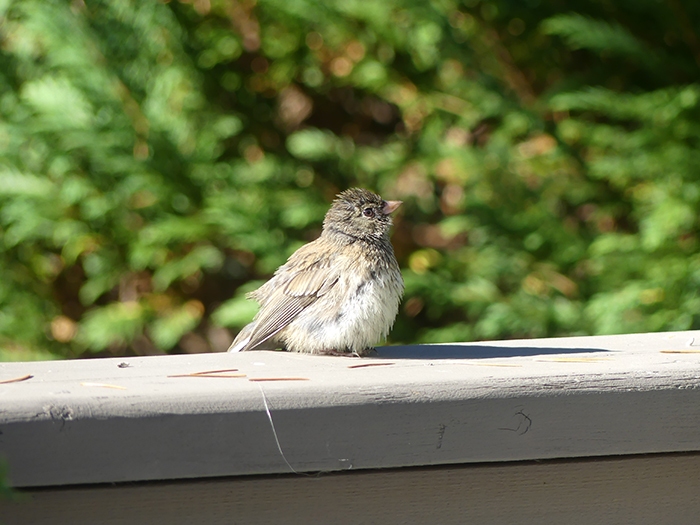
2. Our #1 species this year was the pine siskin. After a couple of quite low counts in 2022 and 2023, they outnumbered even our perennial top species, the dark-eyed junco, by 2,804 to 1,544. Like many species, their count varies widely with factors such as available food. They were counted very high in 2020, 2012, 2007, 2001, 1993 — so every few years we see a peak.

3. Much like the pine siskin, the red crossbill did very well this year with 522 counted. They also have peak years spaced a few years apart. Non-peak years average around 40 counted, so one-tenth of what we counted this peak year.

4. Our “most improved” species this year has to be the western grebe. It’s been 21 years (2003) since they counted this high — 725 of them this year — after averaging 55 per year since 2004. Peter McAllister, co-ordinator for North Salt Spring, commented: “Might this be a precursor for a more upscale herring run?” That would be good.

5. Although we welcome only a few to our waters, our largest native waterfowl, the trumpeter swan, seems to be doing better in the past few years after a weak decade. In fact, with sightings each year in the past six counts, that is the longest continuous run for them since we started counting in 1989.

6. Siskins and crossbills may have had lots to eat this year, but American robins must not have — a low year of 452 counted. In half of the past 20 years, robins counted over 1,000 individuals. But they’ll be back.

7. Great horned owls counted way above average this year with 22 individuals. Two years ago we counted 14, but usually we only count two to eight of them in a year. We’ve certainly heard them in the woods around our house this past year.

8. Highest European starling count in the last 25 years, with 1,038 this year while a typical year may be 200to 600, so whatever affected the pigeons certainly didn’t affect the starlings.

9. And a note about the two most recent arrivals to Salt Spring: (1) Anna’s hummingbirds have been counted every year from 2004, 21 years now. They seem to have stabilized around 200 per year with 190 counted this year. (2) Eurasian-collared doves were first counted in 2011 and are running 10 to 20 per year now (19 this year).

Dec 15 CBC Top Ten Species

Siskin, pine, 2,804

Junco, dark-eyed, 1,544

Starling, European, 1,038

Bufflehead, 963

Grebe, western, 725

Chickadee, chestnut-backed, 697

Goose, Canada, 532

Crossbill, red, 522

Towhee, spotted, 434

Merganser, common, 388

We’d also like to highlight the CBC4kids — a Christmas Bird Count for children — held at Beddis Beach on Dec. 30 with children this year from ages six to 15. A total of 165 birds were counted of 21 species. That’s more than double the 69 of 17 species in 2023.

CBC4kids Top Five Species

Robin, American, 36

Blackbird, red-winged, 33

Siskin, pine, 27

Merganser, red-breasted, 17

Gull, glaucous-winged, 10

Thanks — as every year — go to the 159 counters who spent 230 hours counting, and to Kathleen Maser and our zone captains.

Thanks also to Nature Salt Spring and to Peter McAllister for sponsoring this year’s pre-count get together at the golf club. I’ve been doing this for 15 years now and every year is fun, so thank you for another one.

Reimagining a healthy community within healthy ecosystems

0

BY DAVID RAPPORT

In a Dec. 16, 2024 piece published on the Salt Spring Exchange, Kerrie Proulx, a board member of Salt Spring Solutions, suggests abandoning the use of buildout as “the main braking mechanism” for protecting our island’s environment.

She argues that the notion of buildout has no ecological currency; that it simply reflects the estimated population if all lots on the island were fully developed. In a follow-up letter in the Dec. 18 Driftwood (“Environmental Values or Economic Exclusion”), she goes further, stating that “zoning was never about environmental protection” but rather about creating enclaves for the wealthy and forcing the less well-off into “precarious, often environmentally compromised housing situations.” She concludes that environmental values should take the back seat for the sake of economic inclusion, and that the notion of buildout is not useful because it is a planning concept divorced from ecology.

That last point is the one thing on which I can agree with Kerrie: the maximum number of people that the currently allowable housing will support is not by itself an indicator of our impact on the island’s ecosystems. That, however, in no way means that we should abandon all restraints to development on Salt Spring! Rather, we need more appropriate ways to measure our impact. The real measure of our impact lies in the combined influence of our numbers (population), our consumption and our use of destructive technologies that have the capacity to degrade ecosystems even in places where population densities are very low.

In a 2007 paper commissioned by the Trust titled An Ecosystem Health Perspective Relevant to Salt Spring Island’s OCP Review, I argued that ecological impacts should dictate the real limits to development in the Trust Area. And I suggested that, regardless of any degree of buildout, we are at (or past) the point of sustaining the health of our ecosystems, and that this situation calls for a moratorium on further development until such time as the ecological damage we have inflicted is rectified.

In other words, the limits to growth are set by our total impacts on our shared environment. Those impacts show up in the form of over-stressing our ecosystems: reduction of habitat and biodiversity, spread of invasive species, loss of the few remaining stands of mature forest and increasing dominance of young, far more flammable forests, deterioration of freshwater quality and quantity, and so on.

This is not just being a “greenie.” Our community health and wellbeing and the health of our ecosystems are intimately interlocked. Wherever the health of ecosystems becomes compromised, it poses palpable risks for people. Anxiety rises and mental and emotional health decline. Nor can people thrive economically in a degraded environment.

In a situation in which our main ecosystems are already heavily compromised, pulling back on the human activities that are causing the destructive pressures is an essential and necessary step towards regaining health of people and the environment. Spurious arguments pitting our economy against our ecology only serve to keep our heads buried in the sand. Degrading the land to accommodate economic goals is self-defeating and, in the end, destructive of both nature and culture.

The B.C. government has come to similar conclusions in embarking on its new flagship initiative to restore health to ecosystems across the province — the Biodiversity and Ecosystem Health Initiative — in partnership with First Nations. Far from calling for more unrestrained development to the cost of the health of our ecosystems, and ultimately of the health and wellbeing of islanders, a positive way forward would be for our community to lend its support to the province’s initiative.

The challenges of carrying this out are undeniably daunting. Achieving real progress will require a dramatic rethink of our place in the web of life, and the recognition that our future hinges vitally on our capacity to reinvent our economy in ways compatible with biophysical limits — from local to planetary. We will need to shed the “split-brain” mentality that has enabled us to ignore the fundamental interdependence between the health and well-being of our community and the health of our ecosystems.

Impossible? Not really, if we only realize that making this change is a win-win situation for both the environment and people, while continuing with “business as usual” is a lose-lose proposition. Our most urgent task is to reimagine our community as a part of the natural world, not as apart from it, and do our best to integrate our societal goals within the limits of ecological constraints.

Donations help grow Benson fund

SUBMITTED BY SALT SPRING ARTS

Salt Spring Arts (SSA) is thrilled to announce that the Susan Benson Fund for Visual Artists will continue for another two years, thanks to three generous contributions by community members: two anonymous donors, and Lucy Austin and Adrian Wright.

These donations honour Benson’s remarkable legacy in launching the fund to support women artists on Salt Spring Island who are committed to building their creative careers.

The award was established in 2022 by Benson, a renowned artist and recipient of the Order of Canada, to address the unique challenges faced by women in the art world. Despite strides made toward gender equality, Benson’s own experiences highlight the enduring barriers women encounter in achieving recognition and sustainability as professional artists.

“Throughout history, women have had to justify themselves as artists,” Benson explained. “Though times are changing, these attitudes are still prevalent in many situations. I established the Susan Benson Fund award to give encouragement to women artists and to help them in a practical way. The average income for an artist is low, but the cost of being an artist is high. I am very pleased to see that the support is working for recipients, as they are applying for the award in practical ways that help them achieve recognition in their work.”

Through Benson’s support, fund recipients have invested in their craft, from purchasing specialized materials to create new works, to enhancing their professional portfolio through photography and website development. By alleviating some of the financial burdens, the fund enables artists to focus on what matters most — creating meaningful art and sharing it. Congratulations to the Susan Benson Fund’s most recent recipients: Tessa Tabourel and Medwyn McConachy.

Salt Spring Arts’ Community Project Grants support local endeavours of cultural benefit. In fall 2024, four projects were selected to receive funding. Congratulations to Andrew Doyle-Linden for Salt Spring Music Scene: A Photographic Collection, Nayana Fielkov for Magic of Intuition, StageCoach Theatre School for their Legacy Film and Raf Katigbak for Art in Motion: Exploring Interactive and Generative Media for Artists of All Backgrounds.

The charitable donations that allow SSA to continue the Susan Benson Fund not only honour Benson’s vision but also reinforce the profound impact of supporting local arts. The local non-profit invites community members to join the movement to sustain this fund; donations of any size will make a meaningful impact. Visit saltspringarts.com/donate.

SSA’s next grants and awards application period will open on Feb. 1, with a deadline of March 31. Learn more about these funding opportunities and how to apply at saltspringarts.com.