Organizers have targeted an expansive waterfront parcel at the southeastern-most tip of Saturna Island for conservation –– and say time is running out on a half-million-dollar matching gift that could seal the deal on purchasing the land.
The undeveloped –– and uncommonly large –– property boasts nearly three kilometres of coastline and hundreds of acres of marine ecosystems, old-growth trees and Garry oak meadows, according to the BC Parks Foundation, which says it has secured an exclusive agreement to buy the property. With an unnamed family pledging to match $500,000, that leaves the remainder of the last $1 million left to be raised from the public before a Feb. 5 deadline, according to foundation CEO Andy Day.
“Every single dollar will go towards the purchase and protection of this stunning place,” said Day. “I can’t think of a better way to kick off 2025.”
Day said the features of the property, sandwiched between the ocean and the Gulf Islands National Park Reserve’s Monarch Head Trail area, support several at-risk species, including the blue-listed northern red-legged frog and great blue heron. The 372-acre parcel on two titles lies within the Coastal Douglas-fir biogeoclimatic zone, among the rarest –– and, according to the foundation, least protected –– ecosystems in British Columbia, supporting threatened plants as well. The BC Parks Foundation said species found there include the slender popcornflower, purple sanicle, and the endangered white meconella and Lindley’s false silverpuffs.
The foundation said the family who agreed to sell the property were inspired by their shared childhood memories of visiting it, enjoying the views and peaceful time camping at what’s known locally as Cactus Point –– the rocky tip of the property’s edge –– and cited a cherished moment when they all saw a pod of orcas passing by as a motivator for conserving the area, to honour their father’s memory and his love for the land.
For information about the property or to donate, visit bcparksfoundation.ca/projects/parks-bank/saturna-island.
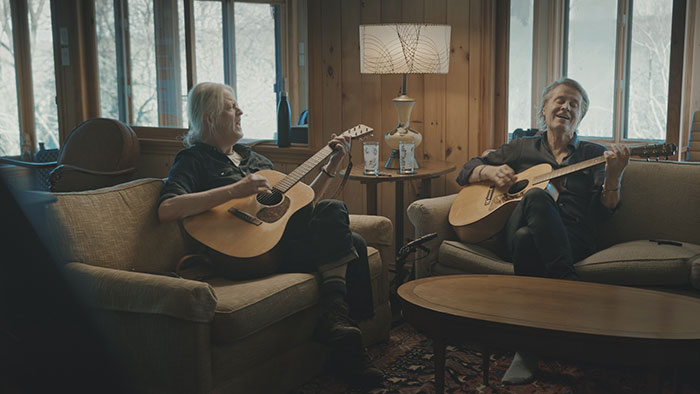
Fans of Jim Cuddy won’t want to miss the award-winning new documentary Blue Rodeo: Lost Together screening at ArtSpring on Wednesday, Jan. 22, as part of the Salt Spring Film Festival’s popular Best of the Fests series.
Blue Rodeo clearly has a rabid fan-base here on Salt Spring, as Jim Cuddy’s performance in April as part of ArtSpring’s 25th Anniversary Festival sold out so fast that a second show was added — which sold out even more quickly.
Guided by the unmistakable voices of Cuddy and Greg Keelor, this electrifying journey into the heart and soul of one of Canada’s longest-running and most beloved bands delivers an unfiltered, often hilarious, and deeply moving account of their 40-year journey.
Toronto’s Queen Street West in the mid-1980s was a gritty, vibrant scene where a band with no label and no fans started making waves. Almost overnight, Blue Rodeo became the talk of the town. They weren’t just making music; they were creating a whole new Canadian music scene.
Rewinding over half a century to North Toronto Collegiate where it all began — when two high school football players sparked a creative partnership and a lifelong friendship — this is the story of how Blue Rodeo defied the odds to become Canadian music legends.
A celebration of the unbreakable bond between high school buddies who formed a legendary musical collaboration and together reshaped the sound of a generation, Blue Rodeo: Lost Together is a must-see for fans and a story that will resonate with anyone who believes in the power of music to bring people together.
Featuring interviews with such Canadian luminaries as Sarah McLachlan and Eric McCormack, this lively retrospective, which won the Audience Award for most popular film at last month’s Whistler Film Festival, is co-presented by Salt Spring Music Events.
The Best of the Fests series continues in February with two more screenings at ArtSpring on Wednesdays at 7:30 p.m.: award-winning Cree filmmaker Tasha Hubbard’s new film Singing Back the Buffalo on Feb. 5; and Fairy Creek, a new documentary chronicling the Ada’itsx Valley anti-logging blockades, presented by filmmakers Jen Muranetz and Sepehr Samimi on Feb. 19.
Tickets are $14 each and available through ArtSpring, online, by phone and at the box office.
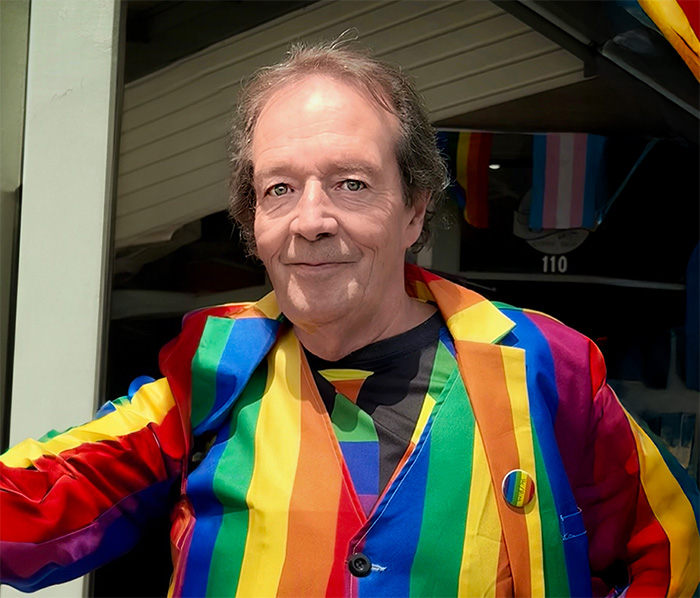
Tim was born in Saskatoon to his mother Willma Popham and father Charles (Pete) O’Connor, and moved with his family to Victoria when he was seven years old. Tim went to Oak Bay High School and graduated from Vic High.
He moved to Hawaii at age 18 where he worked in his cousin’s restaurant for two years. At age 21 he went to UCLA to get a degree in Television Arts and Science. He then returned to Victoria to work for Rogers Communications.
Tim went to Toronto in 1984 to pursue a career in television. His first job was with the Canadian Home Shopping Club, and he then worked at YTV and launched the popular YTV Rocks show. Moving to CTV, he became the day-of technical producer of Canada AM.
Toronto is also where Tim met his husband John Dolman in 1989. Five years later they moved to the West Coast to be closer to Tim’s mom after his father died. They chose to live on Salt Spring Island, while commuting to work for CTV in Vancouver four to six times a month.
In 1996, they established Island Star Video in Ganges, which became an important community hub. They created the same kind of place at TJ Beans when they opened the coffee shop in 2006. Tim and John were married in 2005.
Tim’s love of his community shone in his support for Island Star Video Oscar night parties, Movies in the Park, Remembrance Day, Pride events, Canada Day celebrations (including fundraising for Canada Day fireworks and the beach ball toss tradition), youth baseball and many other causes, people and activities.
A celebration of life will be held at a later date.
In lieu of flowers, please consider a donation to the Copper Kettle Community Partnership or Salt Spring Island Food Bank in Tim’s name.
An excavator was temporarily stuck at an undignified angle on Salt Spring’s busiest road Wednesday, Jan. 8, after the ground gave way beneath it at about 1:15 p.m.
Bruce Cownden with Northridge Excavating Ltd. said that afternoon the contractors working on the Fulford-Ganges Road improvement project would to be able to get a crane in that evening to lift the equipment out.
“It was a cave-in under the machines,” said Cownden. “Everybody’s OK, no one was injured. Thanks to everyone for their patience.”
Cars had been detoured around the mishap via Arnell Way and Beddis Road, although school buses Wednesday afternoon were allowed through. The excavator was retrieved, and the road returned to its usual single-lane alternating traffic, well before Thursday’s morning commute.
Salt Spring’s leading promoters of mass development certainly remind us who they are and what they stand for, shoulder-to-shoulder in last week’s Driftwood.
Trustee Laura Patrick’s Viewpoint tries to justify the “insanity” of “doing the same thing over and over and expecting a different result” (words she wrongly attributes to Einstein), though is otherwise vague about her latest scheme to “tweak” our official community plan (OCP).
In a longer and more revealing article, Salt Spring Solutions members claim to have tested their ideas with an online survey (sparsely responded), and in “confidential” meetings with “local housing providers” described as a dozen “landlords of legal and illegal housing.”
The team of trustee Patrick and Salt Spring Solutions is the same that brought us the Bylaw 530 fiasco. That push for mass upzoning wasted three years of our planners’ time, alienated the Tsawout First Nation (the only Indigenous group with treaty lands on Salt Spring) and would have contravened our OCP and the Islands Trust Act. Salt Spring Solutions was founded just months after the 2017 incorporation referendum, in which the losing side had been widely supported by pro-development interests opposed to the Islands Trust protections. Salt Spring Solutions often tells us it’s a “non-profit” organization. This means only that the organization itself isn’t a money-maker. It does not mean it is impartial and has nothing to gain from unleashed development. Several leading members have, or have had, business interests in real estate, property investment, construction and bulk water sales.
Do I “fear change” from Laura Patrick and her back-up band? You bet I do.
Ronald Wright,
Salt Spring
The other option
In last week’s Driftwood, trustee Laura Patrick and Salt Spring Solutions continued to depict a glowing everything-is-a-priority future while downplaying or ignoring the long-term consequences of their housing proposals and related policy changes.
Salt Spring Solutions claims their housing report was “peer reviewed,” but were those reviewing the recommendations made aware that implementation would require removal of quantified growth limits in our official community plan (OCP), thereby exposing a conservation area to open-ended growth — just like in any municipality? Did they support new bonus-density strata subdivisions, accessory dwelling units in all residential zones, and added dwellings on rural properties, mostly with no requirement of housing agreements to guarantee affordability and long-term occupancy? And did they have build-out data to determine the long-term impact on water, infrastructure, services and ecosystems?
More generally, did they endorse the shift from non-market affordable housing as emphasized in our OCP to widespread upzoning of private land, and weakening of all three pillars of the Islands Trust: the Islands Trust Act, the Trust Policy Statement and our OCP?
Project documents for the OCP update say the “process should consider opportunities to implement the recommended actions of this report.” Where does that leave non-market options?
In a November 2022 speech to the legislature, former MLA Adam Olsen stated: “Currently, the [housing] supply this Premier, his colleagues and the Minister of Housing are talking about are units fully exposed to market pressures. We need to build non-market housing units in B.C., including supportive housing, non-profit, co-op housing and housing that meets the specific needs of the communities.”
These sentiments have been echoed at public meetings by Capital Regional District director Gary Holman, who has cited existing OCP policies directing any upzoning to prioritize affordable housing, and new development to be located near existing settlements and transit lines.
The choice is not between housing and no housing, but rather, housing within the framework of the Islands Trust vs. broad densification that undermines the framework itself without achieving the desired results. It’s also a choice between two realities: the verifiable fact that legal documents protecting the environment are being severely weakened as opposed to trustee Patrick’s assertion that such amendments are “leading to a modernized and stronger Islands Trust.”
It was back in 2017 when Steve Lynch first noticed a little spot on the white part (the sclera) of his right eye.
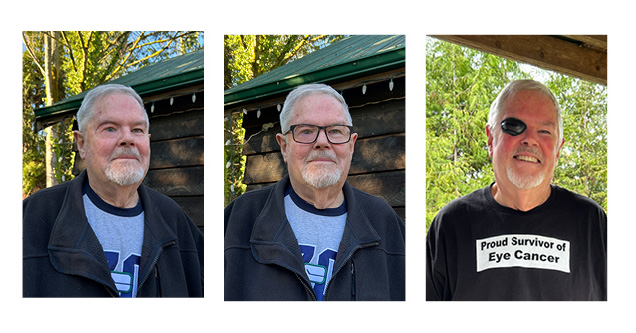
Three faces of Steve Lynch: From left, in December 2024 with his new prosthetic eye, at the same time wearing glasses, and in November wearing a patch after the eye was removed in May but before the orbital prosthesis had been made and fitted.
“It wasn’t alarming to me or anything,” he said in a recent interview. “I didn’t have any pain. It didn’t affect my vision. But the weird thing was if I sneezed a couple of times, my eye would go bloodshot.”
For the longtime islander, 71, known to many as a past Hastings House executive chef, Bay Window Restaurant chef, a ferry deckhand later in life and for beautiful gardens maintained with his wife Trudy Lynch, the term “weird” would become the norm as he was ultimately diagnosed with conjunctival melanoma. Identifying the disease took some time in part because the bloodshot condition obscured the problem, but a suspicion about cancer led to a consultation with Vancouver specialist Dr. Katherine Paton, who made the diagnosis in 2019.
“I saw her on a Tuesday, and she said, ‘We’re going to have to do surgery on Thursday. Okay?’”
Dr. Paton explained that Steve had a rare form of cancer — affecting one in 2.5 million people — but she had good news as well.
“Most people that have melanoma in their eye, it’s in the back of their eye, and by the time you have any symptoms, you’re hooped, because it’s gone to your liver or your lungs or wherever,” Steve recalled her saying.
Dr. Paton explained that the surgery would involve removing pretty much the entire conjunctiva, described as being like Saran wrap that goes over the front of the eye. She said that would be followed by three cycles of chemotherapy because of the high chance of the cancer recurring.
Unfortunately, what followed wasn’t that straightforward.
For one thing, the chemotherapy was administered in the form of eye drops. The rareness of Steve’s condition was underscored when he went to pick up the drops at the B.C. Cancer Agency and the staff person said, “Oh, you must be Steve. You’re the only one in the province getting these right now.”
Responsibility for applying the drops fell to Trudy.
“She basically had to be in a complete hazmat suit — gloves, eye protection, mask, full suit — and anything that she was wearing when she was giving me the drops had to be disposed of at the hospital.”
For Steve, “It was literally like putting Tabasco in your eye, and I would know that it was time for the next eye drop when the eye finally quit hurting.”
When he returned to Dr. Paton’s office after the end of the second cycle, she advised against doing the third due to the angry state of his eye. Steve was treated for a suspected infection, but a sensation of having a scratch on his cornea persisted. That led him to see cornea specialist Dr. Alfonso Iovenio, who determined the chemotherapy drops had killed most of his limbus — the ring of cells around the iris. A different kind of eye drop was made using his own blood — at a cost of about $400 every six weeks, which wasn’t covered by insurance — but the irritation continued, and he was eventually switched to a steroidal lubricating drop.
Then in January of 2024, at a follow-up visit with Dr. Paton, she said, “Oh, that’s actually really changed. The cancer has gone on to your eyelids now, and that’s really rare. That’s one in about six million.”
An MRI determined the cancer had not spread, and a slot with orbital surgeon Dr. Vivian Yin was requested.
Two months later, in March 2024, he developed a hole in his cornea. As much as this was a huge problem, it was also a blessing, as it introduced him to Dr. Hall Chew. Steve describes Dr. Chew as “the most caring doctor that I have ever encountered.” Dr. Chew patched Steve’s cornea and then went on to arrange the rest of the follow-up that was required.
In early May of 2024, Steve received an email advising that his surgery date with Dr. Yin was set for the following week.
Steve recalls how the procedure was described in the email as “lid-sparing orbital exenteration.” The term “exenteration” was not familiar to him, so he looked it up. Trudy was outside at the time and he called her to the door. “I said, ‘Uh, you need to come here. They’re taking my eye out next Wednesday.’”
The surgery went well. The pathology report later detailed how one tumour was about half an inch (12 mm) wide, and another was a third of an inch (eight mm) wide, but he was cancer-free.
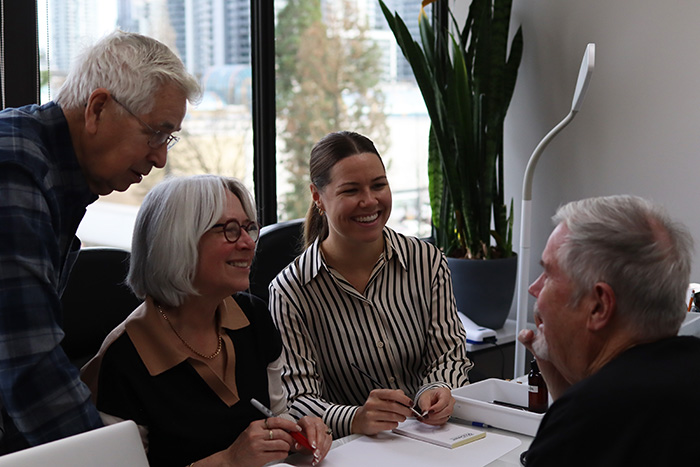
The next step was to have a prosthetic eye made and fitted, which proved to be a super interesting and positive experience thanks to the team at Marie Allen Ocularist in Burnaby. Marie’s father Ray Allen was also an ocularist, and her husband Rob Drennan and their daughter Heather Meszaros are now part of the practice. While Ray Allen is retired, he ended up participating in Steve’s case, which made it even more special for him and Trudy.
“You’ve got to basically be a sculptor,” explained Steve, adding that the discussions about colour accuracy, for example, were fascinating. “They probably spent an hour and a half just subtly changing the colour of the white part of my orbital prosthesis.”
“It’s just beyond amazing,” he added.
Like any complex medical journey, some experiences were extremely frustrating — such as the long waits in specialists’ offices — and other experiences were baffling — like being discharged from the hospital only two hours after his eye was removed. Travelling to Victoria and Vancouver was exhausting. During the Covid restriction period, Trudy couldn’t accompany Steve into his appointments, sometimes having to sit in a parking lot for up to nine hours.
Particularly aggravating was the relentless number of “pirate” comments people made about his wearing of a black eyepatch. He would be compelled to respond with comments like, “At least I don’t have cancer anymore,” or “You think I’m wearing this because I want to?” Trudy took care of responding to the two Costco employees who one day said, “Step aside, pirate coming through!” as they walked by. She admits now that she was not very kind.
They both stress how comments should never be made about a person wearing an eyepatch — even if it bears a Vancouver Canucks logo like the one Lynch would wear for luck on game days.
But they also received above-and-beyond support along the way, like from the staff at the Rosedale on Robson Suite Hotel, where they always stayed, and many others involved in Steve’s care and treatment.
“There have been some highlights amid all the bad stuff,” said Trudy, “like some people who have really helped make it better. But I wouldn’t want to wish the journey that he’s been on on anyone.”
They have so far met three other people with artificial eyes living on Salt Spring, and have appreciated them sharing their experiences. All along, Steve has authorized the use of images and his case history to advance understanding of ocular cancer. (See sidebar for one illustrative anecdote.)
In giving photos to the Allen family of ocularists, he said, “I don’t care whether anyone is looking at my face. I don’t care whether they’re looking at my eye. If you’re using it for teaching, or however you want to use it, feel free if it’s going to help somebody.”
Steve also urges people to not delay in having any anomaly or irritation with an eye investigated.
“If you have something that looks weird in your eye, go have it checked out. I had no idea you could get melanoma in your eye. It turns out melanoma is the one cancer you can get anywhere. Everybody thinks it’s skin cancer, but it does livers, it does lungs, it does brains, it does eyes — it does the whole thing.”
Steve says he is happy to have all the medical adventures behind him and to finally be free of cancer — and pain — after seven years.
A south-end blaze destroyed a fifth-wheel trailer home Tuesday night, officials said, and while an investigation is ongoing, there were no injuries, and foul play is not suspected.
Salt Spring Island Fire Rescue (SSIFR) responded to a call for a structure fire on Jones Road near Fulford just after 9:30 p.m. Jan. 7, according to SSIFR Chief Jamie Holmes, who said a trailer there was found completely engulfed in flames as firefighters arrived.
“Unfortunately, the trailer was fully involved, the propane tanks were already purging at that point,” said Holmes. “The structure was a total loss.”
Holmes said no one was home at the time of the fire, although Emergency Support Services were called to the scene and did help out. Coincidentally, Salt Spring firefighters had just wrapped up their annual department meet-and-greet in Ganges, celebrating the 2024 recruits’ first year and welcoming those joining in 2025. At the time of the page-out, Holmes said, several members stationed at Hall No. 2 in Fulford and Hall No. 3 at Central had already returned from the event –– and all three island halls subsequently had quick responses.
“Kind of a fitting way to welcome the new recruits,” said Holmes, “by leaving them all while we responded to a fire.”
Firefighters worked into the night to completely extinguish the blaze, Holmes said. Some 20 members were at the scene for about four hours, he added, and used around 4,000 gallons of water.
Keen property owners got an early peek at their new provincial assessments well before ringing in the new year –– and while most noted a decrease in value, a confoundingly higher “typical” home price in the Gulf Islands seems driven entirely by gains in outsized waterfront parcel values on Salt Spring.
Individual property assessment information scheduled for release Jan. 1 came available online late in the day New Year’s Eve, and B.C. residents were able to type in addresses at BC Assessment’s website for updated information –– calculated for value on July 1 of 2024, according to officials.
The headline 2025 figure for the Gulf Islands is that the “typical” home is now assessed at $857,000, BC Assessment announced Thursday, Jan. 2, a roughly one per cent recovery from last year’s $850,000 number, which had represented a three per cent drop from 2023’s $874,000.
But that dollar value is increasingly uncoupled from most islanders’ reality, as Salt Spring’s non-waterfront properties’ assessed values dropped 1.2 per cent, representing a 0.3 per cent fall among so-called single-family dwellings and 2.3 per cent decrease in strata homes’ values.
In contrast, inside Salt Spring’s “waterfront neighbourhood,” as BC Assessment categorizes ocean-bordered parcels on the island, values rose –– a seemingly modest 0.3 per cent, in this case encompassing a 0.6 per cent bump in values for single-family dwellings and an unspecified change in waterfront strata values.
That small rise in percentage value for a minority of parcels on Salt Spring has driven the top-line “typical” Gulf Islands home assessment higher, seemingly by virtue of the value in the category being larger in the first place; on other Gulf Islands, waterfront residential values actually fell 2.6 per cent as non-waterfront parcels there dropped 0.5 per cent.
While that means many “invested” in Salt Spring’s waterfront property are seeing positive returns while inland owners lose value, those ocean-adjacent owners could also face higher tax increases, according to deputy assessor Matthew Butterfield –– although that number depends on how values perform in the community.
“It is important to understand that changes in property assessments do not automatically translate into a corresponding change in property taxes,” said Butterfield. “As indicated on your assessment notice, how your assessment changes relative to the average change in your community is what may affect your property taxes.”
Butterfield said most homeowners in the broader Vancouver Island area could expect “minimal change” in their property values, although he noted some North Island areas with strong demand would buck that trend with double-digit percentage increases in communities like Alert Bay and Tahsis.
Commercial values in the Gulf Islands continued to see valuations rise, with the “business/other” category climbing 2.9 per cent and light industry parcels up 0.9 per cent. That follows last year’s trend, when those categories saw valuation gains of four per cent and 0.7 per cent respectively, according to BC Assessment’s neighbourhood data.
Overall, Vancouver Island’s total assessments increased from over $386 billion in 2024 to almost $391 billion this year; about $4.9 billion of the region’s updated assessments were from new construction, subdivisions and the rezoning of properties, according to BC Assessment.
The total value of all real estate on B.C.’s 2025 Assessment Roll is $2.83 trillion, an increase of just 1.5 per cent from 2024.
To see the assessed value of a property, visit the website bcassessment.ca and enter the address or parcel number. Property owners concerned about their assessments can find contact information there as well, if they feel their valuation or other information is incorrect.
Editor’s note: The following is part of a “looking back/looking forward” series of articles solicited by the Driftwood for publication in its Jan. 1, 8 and 15, 2025 papers.
By MAIRI WELMAN & ELIZABETH FITZZALAND
For Salt Spring Solutions
Salt Spring Solutions is a small, volunteer-run, non-profit organization dedicated to balancing environmental protection with creating a vibrant, diverse and equitable community. Right now, Salt Spring is neither diverse nor equitable. Our population is aging, and it is increasingly difficult for younger community members to stay here, raise a family, work for or own a business, farm, or create art because they can’t afford to rent or own suitable long-term housing.
Since 2018 Salt Spring Solutions has been deeply immersed in understanding the complexities of and finding solutions to the island’s housing crisis. We think the primary reason for the failure to take innovative approaches to housing here is due to a lack of coordination between governments (provincial, regional and local) and a lack of visionary and savvy leadership at the political and senior management level. As an island community, self-contained and isolated by water, we could become the poster child for how to use innovative ideas to make a community that works for all its people, but our institutions seem paralyzed, and every year that passes without action means more of our vital young community members move away, and many farmers, workforce families and individuals, lower-income seniors and longstanding islanders feel pushed aside, unheard and unrepresented.
Our 2023 report, Homes for Islanders, which was written by professionals with experience in inclusive community development and peer reviewed by planning and environmental professionals, policy and governance experts and housing specialists, was designed as a starting point to address housing inequities while fostering community resilience and environmental stewardship on Salt Spring. A year after publishing the report, government responses ranged from a pat on the head and zero action from the province to paralysis at the Islands Trust to the promising new dedication of resources and staff for the creation of a Rural Housing Program at the Capital Regional District.
Ironically, many local elected officials who ran on a “housing” platform don’t seem to have a handle on public opinion here regarding housing, often deferring to a small, well-organized and vocal group of anti-housing advocates. So, we decided to test our ideas with the Salt Spring community, see what you think, and then provide that input to decision-makers.
We hosted seven focus groups with 42 participants; renters of all ages and means, local employers, people in precarious housing and the local workforce. The focus groups were held in the evening in the library. This approach fostered low-barrier, intimate and meaningful discussions, allowing us to hear directly from those who are more impacted by housing decisions, whose housing experiences are often overlooked and/or who cannot attend government meetings held during working hours.
We also interviewed 12 local housing providers: landlords of legal and illegal housing, as well as those who have or would like to build housing for other islanders. Offering a confidential one-on-one interview allowed people to be candid when discussing the challenges and motivations of providing housing, delivering valuable context and insights into the rental market on Salt Spring.
Then we cast a wide net with an online survey open to the whole community. Of the 657 people who responded, 67 per cent are homeowners. The survey ensured that the whole community could share their perspectives, helping to create a truly comprehensive understanding of public opinion on housing across the island.
We look forward to sharing the results of the whole public engagement project in the new year. In the meantime, some early findings from the online survey:
• There was significant support for ensuring that services, particularly water, are prioritized for rental and non-market housing. This reflects an understanding of the need to safeguard essential resources to support the development of affordable housing while considering the island’s sustainability.
• There is strong support for prioritizing land for rental and non-market housing. This aligns with the community’s desire to address housing needs for diverse populations, ensuring that affordable options are made available where they are most needed.
• There was concurrently strong support for pre-zoning land in Ganges for housing. This indicates that our community is in favour of planning ahead to ensure adequate housing land is available in the most suitable areas, particularly near the village, to reduce sprawl, support walkability and provide more social connection.
• The core of Ganges village is expected to be significantly impacted by sea-level rise in the coming decades; 86 per cent of our survey respondents support identifying areas outside the projected floodplain for infrastructure investment, new development and homes that the community can support.
You can read our 2023 Homes for Islanders report and learn about our housing solutions at saltspringsolutions.com. Be among the first to hear the complete results of our public engagement project in the new year by signing up for our e-newsletter.
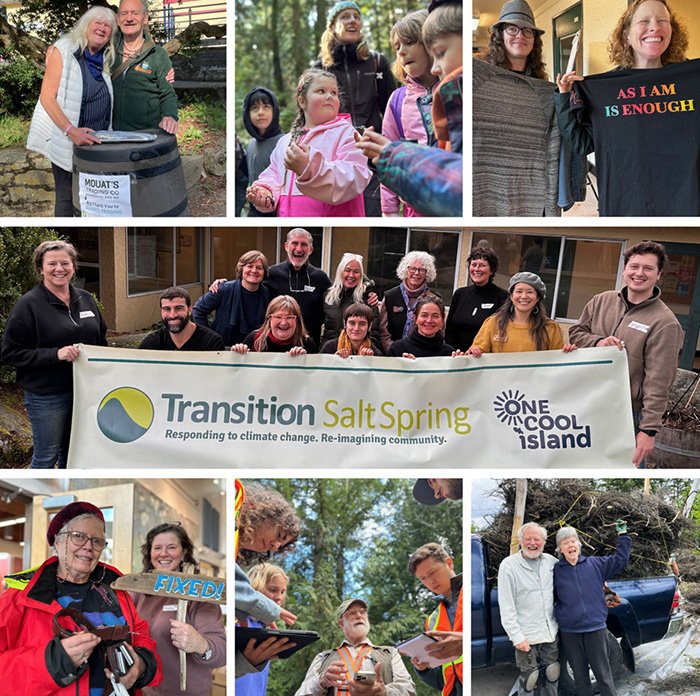
Amid the merry babble of voices at our Christmas party a couple weeks back, a few of us independently came to the same conclusion: something has really gelled within Transition Salt Spring (TSS)’s board, staff and volunteers this year.
But as we talked, we realized this sense of shift isn’t just about us. Across our beautifully caring and sometimes cranky “argument surrounded by water,” there’s a growing feeling of something new and more promising emerging.
This fall, TSS reached out to community leaders to explore the possibility of building a shared vision for Salt Spring’s future. It’s a warm-up for 2025 when our official community plan and land use bylaw will get their first updates in decades. While folks have strongly held views on many issues, there’s also a hunger for less conflict — perhaps driven by the divisions we see multiplying in the larger world.
We at TSS are heading into next year with optimism because we see that islanders’ passion for Salt Spring arises from a deep love for this place and a desire to make it even better.
Our big theme for 2025 is encouraging islanders to talk together as neighbours to tackle the big issues we face:
• How will we protect forests and watersheds amid rising drought and fire risks from climate change?
• How and where can we build more housing to ensure we have a diverse and inclusive community?
• How can our settler-based CRD and Islands Trust governance systems reconcile with First Nations to include them in governance?
The Penelakut Food Drive, beautifully described in the Driftwood recently, shows islander generosity at its best. It’s one of many examples of people stepping up to address local challenges. What new fruit might grow from these acts of neighbourly care as we tackle our pressing problems in 2025?
TSS has worked hard to cultivate this spirit of love and generosity by embracing hope. We’ve seen it reflected at clothing and toy swaps and Repair Cafés this year. In decades of traditional advocacy work, I’ve learned that policy change alone isn’t enough — lasting solutions require a groundswell of support built on relationships of reciprocity.
Our 2021 Climate Action Plan didn’t mention the need to change our culture. Instead, it focused on policies, programs and interagency collaboration. These remain essential, but we now see that addressing the climate crisis also requires changing how we treat one another. Building mutual respect and trust is where real change can begin.
This simple premise underpins our 2025 plans to help the community update its official community plan, addressing housing, ecosystem protection, climate action and First Nations reconciliation.
Deep listening is another critical ingredient we’re working hard to practice. In our work with organizations to resolve differences that stand in the way of shared progress, we’ve learned to seek common ground by listening to what the other really needs. Traditional Indigenous cultures are centred on listening first, while settler culture often emphasizes staking out individual positions first. That impulse — to “shoot first” with opinions — often builds fences between us. In 2025, TSS will invite islanders to sit down together, listen deeply, and collaboratively build solutions.
When we come together with humility and open hearts, magic can happen. Issues that once divided us become manageable as we realize the other person’s problem is our own as well. Solving Salt Spring’s challenges is as much about building relationships as it is about creating new bylaws and programs.
And as we do this work together, we’ll get to know each other better and maybe even have some fun. Whether it’s two organizations collaborating or a broken teapot repaired at one of our Repair Cafés, the payoff is more than just solved problems — it’s renewed trust and neighbourliness.
Time and again, we see that people love this community and the natural systems we depend on. When we truly listen with trust, solutions once unseen can become visible. In those moments, the argument surrounded by water is still there, sure, but there’s more silence between the sentences as we listen and take in what the other is saying. That’s an “island of sanity” emerging from Salt Spring’s famous “argument” — and the world needs a lot more of that.
We look forward to continuing this work with you.
Bryan Young is the chair of Transition Salt Spring. To donate or learn more about their work, including rebates for heat pumps, efficient wood stoves and rainwater catchment systems, visit transitionsaltspring.com.
mism because we see that islanders’ passion for Salt Spring arises from a deep love for this place and a desire to make it even better.
Our big theme for 2025 is encouraging islanders to talk together as neighbours to tackle the big issues we face:
• How will we protect forests and watersheds amid rising drought and fire risks from climate change?
• How and where can we build more housing to ensure we have a diverse and inclusivecommunity?
• How can our settler-based CRD and Islands Trust governance systems reconcile with First Nations to include them in governance?
The Penelakut Food Drive, beautifully described in the Driftwood recently, shows islander generosity at its best. It’s one of many examples of people stepping up to address local challenges. What new fruit might grow from these acts of neighbourly care as we tackle our pressing problems in 2025?
TSS has worked hard to cultivate this spirit of love and generosity by embracing hope. We’ve seen it reflected at clothing and toy swaps and Repair Cafés this year. In decades of traditional advocacy work, I’ve learned that policy change alone isn’t enough — lasting solutions require a groundswell of support built on relationships of reciprocity.
Our 2021 Climate Action Plan didn’t mention the need to change our culture. Instead, it focused on policies, programs and interagency collaboration. These remain essential, but we now see that addressing the climate crisis also requires changing how we treat one another. Building mutual respect and trust is where real change can begin.
This simple premise underpins our 2025 plans to help the community update its official community plan, addressing housing, ecosystem protection, climate action and First Nations reconciliation.
Deep listening is another critical ingredient we’re working hard to practice. In our work with organizations to resolve differences that stand in the way of shared progress, we’ve learned to seek common ground by listening to what the other really needs. Traditional Indigenous cultures are centred on listening first, while settler culture often emphasizes staking out individual positions first. That impulse — to “shoot first” with opinions — often builds fences between us. In2025, TSS will invite islanders to sit down together, listen deeply, and collaboratively build solutions.
When we come together with humility and open hearts, magic can happen. Issues that once divided us become manageable as we realize the other person’s problem is our own as well. Solving Salt Spring’s challenges is as much about building relationships as it is about creating new bylaws and programs.
And as we do this work together, we’ll get to know each other better and maybe even have some fun. Whether it’s two organizations collaborating or a broken teapot repaired at one of our Repair Cafés, the payoff is more than just solved problems — it’s renewed trust and neighbourliness.
Time and again, we see that people love this community and the natural systems we depend on. When we truly listen with trust, solutions once unseen can become visible. In those moments, the argument surrounded by water is still there, sure, but there’s more silence between the sentences as we listen and take in what the other is saying. That’s an “island of sanity” emerging from Salt Spring’s famous “argument” — and the world needs a lot more of that.
We look forward to continuing this work with you.
Bryan Young is the chair of Transition Salt Spring. To donate or learn more about their work, including rebates for heat pumps, efficient wood stoves and rainwater catchment systems, visit transitionsaltspring.com.