
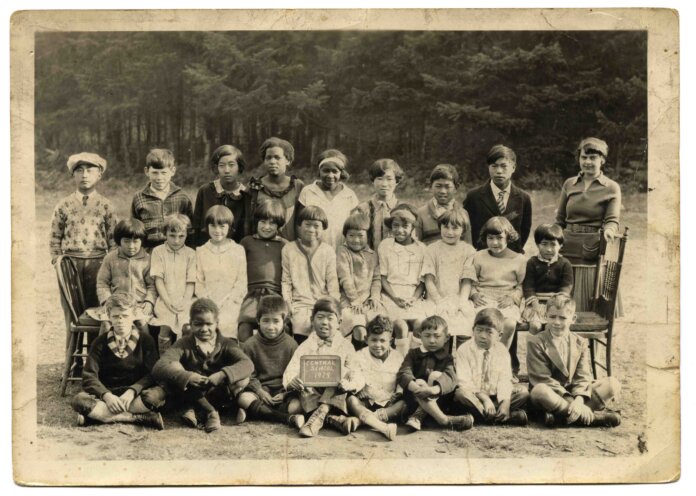
This weekend marks the unveiling of a project that hopes to illuminate a largely invisible part of island history, as the community is invited to join in commemorating the contributions, resilience and displacement of the pre-war Japanese Canadian community on Salt Spring and the Southern Gulf Islands.
The Japanese Garden Society will host the unveiling of the new Japanese Canadian Memorial Story Project interpretive structure at Heiwa Garden on Sunday, May 31, encouraging reflection on the consequences of exclusion, racism and forced displacement.
“The purpose of this project is not only to remember the past,” according to the project team, “but also to create opportunities for reconciliation, learning, dialogue and community connection.”
The new interpretive structure installed in Heiwa Garden is the heart of the project, inspired by traditional Japanese-style joinery and woodwork.
The structure houses four interpretive panels sharing stories of Japanese Canadian working life, family life and community-building on Salt Spring Island from the late 1800s onward.
The project also includes the installation of a new interpretive panel near the corner of Lower Ganges Road and Wildwood Crescent, recognizing the pre-war Japanese Canadian farming community that once thrived there, as well as revisions to the existing historical charcoal kiln panel in Mouat Park.
Organizers said the unveiling celebration will take place in two parts, the first being a space-limited invitation-only gathering from 1:15 to 2:15 p.m. at ArtSpring.
The second part, a public community gathering open to everyone, will take place from 2:30 to 3:30 p.m. at Heiwa Garden in Peace Park.
The gathering will feature remarks from community members, representatives of pre-war Japanese Canadian families and local elected officials, along with a ribbon-cutting ceremony and musical performances.
The event will open with a land acknowledgement and remarks by J,SINTEN John Elliott, respected Elder and SENĆOŦEN Language Knowledge Holder of the Tsartlip, W̱SÁNEĆ Nation.
Members of five pre-war Salt Spring Island Japanese Canadian families will attend the gathering.
Before the Second World War, according to the society, eleven Japanese Canadian families lived on Salt Spring Island; following wartime uprooting, dispossession and displacement under government policies that did not support cultural diversity, only one family — the Murakamis — returned to live on the island after the war.
The Japanese Canadian Legacies Society is supporting 29 heritage projects across British Columbia to recognize and preserve the history and legacies of Japanese Canadians in the province. For information visit saltspringjapanesegarden.com.