Home Blog

First Battle of the Books a blast

BY VIOLET PENNER

Grade 7 student,

Fulford Community Elementary School

At 11 a.m. Wednesday, May 20, at Fernwood Elementary School, the second of what we hope will be an annual event took place: the Battle of the Books! 

Teams of students from grades 3, 4/5 and 6/7 from five different schools — Fulford, Fernwood, Salt Spring Elementary, Mayne and Galiano — answered questions about the books on their pre-assigned reading lists. Whichever team answered the most questions correctly won — but the point was to read and have fun, and victory was a bonus. However, the winning team in each category did receive a prize bag for each student in its ranks. 

I’m sure that if you don’t already know, you are wondering who won in each category, and they are as follows: in Grade 3, the team that took the crown was from Mayne Island; one of the participating teams from Fulford Elementary won in the Grade 4/5 category; and finally, the victorious team in Grade 6/7 (who won in a tiebreaker round, by the way) came from Salt Spring Elementary. 

Everyone who took part in the event, no matter what placement they ended up in, participated in an ice cream party after the competition. 

Thank you to the parents and family members who were invited and encouraged to watch and support the children. There were also several parent volunteers that should be thanked who helped with the event, and it could not have happened without them. 

A few organizations also contributed to the event. Salt Spring Public Library, Rainbow Recreation Centre, Country Grocer  and Salt Spring Books were all a huge help to the Battle of the Books, whether by sponsoring the event or contributing to the prize bags. A huge thanks to them as well! 

However, the largest thanks should be reserved for the teacher/librarians and event coordinators, Amber Thompson and Katie Brown. None of it could have taken place without their dedication and hard work. 

The Battle of the Books was an incredibly enjoyable and engaging event. I hope that it will continue to take place so that the children of our school district will be encouraged to expand their literary horizons, make inter-school connections and practise sportsmanship.

Trustee Laura Patrick: Toward a more inclusive and resilient future for Salt Spring

By LAURA PATRICK

After nearly eight years in public office as one of your two Salt Spring Island local trustees, I have decided that I will not be seeking a third term in the upcoming local elections this fall.

When I first stepped forward in 2018, I did so with a clear goal: to support the Islands Trust in better protecting the environment while also supporting a healthy, resilient community. Almost a decade had passed since a woman had held the position of local trustee on Salt Spring Island, and many community members were actively looking for a new approach. I threw my hat in the ring determined to help move the island forward.

Over two terms, I focused on the priorities that I heard about most from the community: improving housing outcomes, strengthening environmental stewardship and modernizing our slow and confusing governance. I worked to build stronger relationships between the Islands Trust and the Capital Regional District, local commissions, water districts and housing providers. Among my early achievements, I sponsored the successful request to declare a Housing Equity and Workforce Shortage Crisis across the Gulf Islands and helped advance practical updates to the Islands Trust Housing Toolkit. I also brought my professional background in environmental impact assessment into the role, supporting work on forest ecosystem health, wildfire risk reduction and freshwater sustainability and the completion of the Salt Spring Island Watershed Protection Plan 2023-2032. I supported our Climate Change Emergency and Reconciliation declarations and contributed to local climate action planning.

While I accomplished a great deal, much of my agenda was either blocked or lost within the complexities of our local governance system. I leave with the sense that there is still significant work ahead.

With a limited mandate to make change and with few resources, a key lesson that I take away from my time in office is that strong regional collaboration is critical to achieving tangible results. During my first term, working alongside our respected former MLA Adam Olsen, we were able to build productive relationships with provincial decision-makers, improve access to cabinet ministers and advance complex issues affecting Salt Spring Island. That collaboration made a real difference.

More recently, collaboration has become more challenging. The working relationship with MLA Rob Botterell, who expressed strong feelings about an environment-only mandate for the Trust, has not provided the same opportunity to advance shared priorities, and I believe our community cohesion and momentum for solutions has suffered as a result.

Despite these challenges, I continued to push for governance improvements. I supported a provincial review of the Islands Trust Act and was honoured to be elected chair of the entire Islands Trust Council by my peers.

Locally, I focused on practical, community-based planning for an uncertain future. I initiated the Ganges Village Planning process, launched a Housing Action Program, worked to strengthen relationships with farmers, food producers, small businesses and community organizations, especially during the pandemic, and championed an update of our official community plan and land use bylaws grounded in equitable public engagement and meaningful relationships with First Nations.

One of the most important lessons of public service for me has been the responsibility to approach reconciliation from my heart as a principled commitment to truth, respect and relationship. I have reflected deeply on the reality that Indigenous title in British Columbia was never extinguished and believe leadership requires us to move forward with integrity, even when conversations are difficult. I remain proud to have consistently supported reconciliation efforts grounded in facts, humility and a commitment to building a more respectful and just future together.

While some progress has been made, I believe the Islands Trust is still far from achieving its potential. In my view it could become one of the best coastal planning authorities in the world, being truly innovative in protecting the environment and these unique and diverse island communities, but only if it is willing to evolve. That means modernizing policies, improving governance and continuing to drive even stronger environmental protection and ensure that the people who live and work here, who are in an increasingly precarious situations, can thrive.

What is stopping the Islands Trust from reaching its potential?

From what I see, the problem is structural. The Islands Trust operates within provincial legislation that constrains its authority and limits its ability to adapt. The framework was built decades ago and has not kept pace with evolving understandings of reconciliation, Indigenous Rights, environmental stewardship, climate resiliency and regional governance. Efforts to build meaningful government-to-government relationships with First Nations are further complicated by a provincial structure that has not consistently provided the support, legislative tools or the political will necessary to do this work properly.

If we are serious about reconciliation, environmental protection, maintaining an economically diverse community and strengthening good governance, then we must be willing to confront the systemic barriers that stand in the way. That requires more than incremental adjustments; it requires examining the governance structures, decision-making processes, and inter-jurisdictional relationships that shape how authority is exercised and how outcomes are achieved.

The reality is this: we cannot meaningfully redesign governance relationships or modernize our policy framework while operating within legislation that already predetermines our authority, our structure and our relationship to First Nations. We are being asked to reform a system from within a framework that was never designed to accommodate the kind of transformation that is now needed.

Aggravating these structural challenges is the way we, as islanders, often engage with one another on difficult issues. Too often, public dialogue breaks into sides defined by extreme language, personal attacks and winners and losers, often split across generations. Like many other communities, I observed significant imbalances between those voices that are most heard in traditional public processes on Salt Spring Island versus those people most affected by decisions and thereby excluded from meaningful participation. While disagreement is healthy in a democracy, the hostility, misinformation and personal attacks directed at those willing to step into public service come at a real cost and discourage many thoughtful people from participating at all.

As I step aside, I hope those who come next continue pushing this island forward with a broader vision of what this community is becoming and who should be included in our future if we are to thrive. I hope they listen not only to the loudest voices, but also to families, young people, workers, renters, small business owners and those struggling to remain part of this community. Salt Spring needs leadership willing to build a community that is resilient, economically and socially diverse, less divisive and capable of working for everyone who calls this island home. The work matters, and the organization needs new voices ready to continue modernizing the Islands Trust and building on the progress that has been made. I am grateful for having had the opportunity to serve.

Now it is time for the next generation of leadership to carry this work forward.

Viewpoint: The politics of exclusion

By Frants Attorp

Salt Spring trustees recently announced that work on our new Official Community Plan (OCP) will continue until the Trust elections in October. This is surprising, given that the consultant hired to do the project — and now the senior planner put in charge of it — have both suddenly departed.

A major concern is that our trustees directed the McElhanney consulting firm, by contract, to use a public engagement process called “Beyond Inclusion” — a strategy that has resulted in the exclusion of unwelcome facts and voices.

Adopted by our Local Trust Committee (LTC) in 2023 at the behest of trustee Laura Patrick, Beyond Inclusion has been used to restrict information, cherry-pick input and justify holding no open public meetings on a radical remake of our OCP that could unleash runaway development for decades.

Another telling example is the fate of the 2024 Complete Communities Assessment, a detailed external study that our trustees commissioned for their Plan review at a cost of $140,000. It found that 84 per cent of survey respondents wanted “a strong emphasis on environmental considerations.” Trustees promptly withdrew it from the whole OCP process. Also excluded was Positively Forward’s petition, now with 1900 signatures, upholding our current OCP’s density limits and supporting truly affordable housing sheltered from market forces.

It seems the McElhanney consultant was never told that Salt Spring is a protected area under BC’s Islands Trust Act, with an ecological mandate to limit mass development throughout these islands. In January, I revealed that a key McElhanney report recommending major OCP changes contained errors that were in line with Salt Spring trustees’ agenda, but contrary to provincial legislation exempting the Islands Trust from Bill 44 and other housing requirements.

McElhanney submitted a revised version with corrections in February, and then final documents in March with this disclaimer: “McElhanney accepts no responsibility for any deficiency, misstatements or inaccuracy contained in this report as a result of omissions or errors in information provided by third parties or for omissions, misstatements or fraudulent acts of persons interviewed.”Is this wording standard boilerplate, or an indication of why the consultant refused to renew their contract with Salt Spring’s LTC?

At a May 14 meeting, when the citizen advisory committee asked trustees for “any and all information related to the motivation behind the decision of McElhanney not to renew their contract,” the LTC chose not to ask staff to pursue the matter with the consultant.

With Trust staff now moving the project forward, trustee Patrick encouraged them to “stand strong” and not abandon the Beyond Inclusion approach: “We can’t have engagement processes where we just engage who shows up.”

But showing up is a crucial part of how democracy works in Canada. Much will be at stake during the Trust elections this fall — above all, open government, fair process and the Islands Trust Act’s mandate to preserve and protect our islands.

SȾÁUTW̱ land project plans shared

0

The SȾÁUTW̱ (Tsawout) First Nation has announced plans for its reserve lands in WENÁ,NEĆ, also known as Fulford Bay, including a campground project, initially, with work scheduled to begin this month.

According to a press release issued by the SȾÁUTW̱ First Nation, a second phase will create a cultural space rooted in SȾÁUTW̱ teachings and traditions, inspired by the significance and form of a traditional longhouse, reflecting the cultural heart of the site.

“This project is more than a return to place; it reflects the teachings our people have always carried — to care for the land, to lift one another up, and to build with future generations in mind,” said Chief Abraham Pelkey. “The campground will help us steward this place in a good way, create opportunities for our members to gather along this shoreline and welcome others in a manner that reflects who we are as SȾÁUTW̱ people. For our Elders who have carried this vision for so long, and for the young people who will one day carry it forward, this is a meaningful step for our nation.”

Sixty campsites will be nestled in the upper forested area, with on-site management in place during camping season. Campfires will not be permitted.

“Work on the reserve will begin in June with minimally invasive campsites designed to honour the land and protect its ecosystems,” states the release. “Campsites will have access to water and, in some cases, power extended from the adjacent beach property. That property, known as Lot A, was purchased with funds raised by the Salt Spring community in 2025 as its first land back initiative, with support from the Salt Spring Island Foundation — an example of meaningful partnership in support of SȾÁUTW̱ priorities.”

“The foundation team is delighted to learn of the vision and activities led by the SȾÁUTW̱ on their land in WENÁ,NEĆ,” said foundation executive director Shannon Cowan. “We raise our hands to the entire Salt Spring Island community for such strong and enduring allyship in support of land back initiatives, and in support of SȾÁUTW̱ people and their traditional knowledge and culture. The renewed SȾÁUTW̱ presence, ecologically sensible approach and social enterprise are all meaningful steps in an ongoing process of reconciliation.”

“Our thanks to the SȾÁUTW̱ First Nation who have generously allowed our community free access to this incredible natural oasis for generations,” said Salt Spring’s Capital Regional District (CRD) director Gary Holman. “The return of the SȾÁUTW̱ to their precious lands, while still sharing those lands with hikers and campers, is an act of reconciliation that will continue to benefit us all.”

The SȾÁUTW̱ release explains that once construction is completed, the reserve will remain accessible to those arriving by bike or on foot, with new access also available by boat.

“The project is designed to encourage low-impact visitation, reduce vehicular traffic and support respectful shared use of the area. Parking for the project, as well as for day visitors, will be located on the reserve as part of a broader approach to minimizing impacts on neighbouring properties.”

Keefer Ecological Services has been engaged to help reduce environmental impacts and support careful site stewardship. The project will also include interpretive signage to share information about the unique ecological features of the reserve and deepen public understanding of the land.

“We are honoured to witness the return of the SȾÁUTW̱ First Nation to Salt Spring for the first time in generations, and we congratulate them on this significant undertaking and reaffirmation of enduring connection to the land, waters, culture and community,” said Trust Council chair Laura Patrick. “We look forward to their continued stewardship and leadership in preserving and protecting these lands and waters for future generations.”

Project plans were shared by Jon Cooksey and Pam Tarr, on behalf of the SȾÁUTW̱ First Nation, with neighbours at a meeting held May 17. Since then, several area residents have written letters to MLA Rob Botterell, Capital Regional District (CRD) director Gary Holman, Salt Spring Fire Chief Jamie Holmes and other government representatives. While general support for the project and fire safety plans is expressed in the letters, the anticipated level of traffic and the impact of construction and ongoing traffic increases on culverts in “damaged or compromised condition” remain concerns. Neighbours have requested assessments be done and meetings with affected parties be convened by the Ministry of Transportation and Transit and the CRD.

An informational webpage about the project has been created and will be updated as work progresses over the summer at stautw.ca/renewing-community-presence-in-wenanec/.

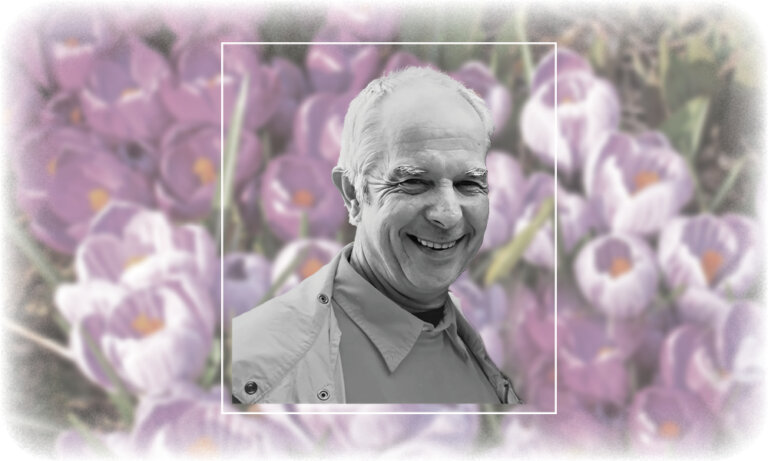
WEBB, Donald Bruce


May 18, 1942 – Apr 15, 2026

Don suffered a cardiac arrest at home on April 15, managing to avoid the sense of disbelief he would have felt at turning 84 this spring.

While Don was a private man, he would probably be happy for people to know a few things about his life.

Don grew up in North Vancouver where his parents owned D.J. Webb’s Drug Store in an iconic building on Lonsdale Avenue. He earned top honours in his graduating year at the Vancouver School of Art (now Emily Carr University of Art + Design) and used the award funds to go to Japan, where he taught English for a couple of years and cultivated an appreciation for Japanese culture, art and food that endured throughout his life. Living abroad also sparked his love of travel.

As a younger man Don made a living in community planning (was senior draftsman with the Comox Valley Regional District) and then landscaping, but he eventually settled on doing house painting and small renovations, ultimately as Don Webb Paintworks on Salt Spring, where he worked on many beautiful homes and properties. While Don had come and gone from the island at various times since 1976, he returned and remained following a second period of his life spent in the Comox Valley after his wife Wendy died in 2001.

Don played the piano in his younger years, loved jazz music (and his and Wendy’s tuxedo cat Jazz), and his artistic nature influenced his fine taste in decor. He was a master of assembling lovely appy plates and serving pasta with his killer Bolognese sauce, always with red wine, and finding perfect birthday and Christmas cards for those in his small circle. In recent years, cinnamon twists and double lattes from Barb’s got his weekdays off to a good start. Thank you to everyone on Salt Spring and beyond who had a positive connection with our gentle friend. You know who you are.

In the last 18 years, Don revisited his passion for photography. Two of his pieces were selected for an exhibit at Blue Sky Gallery in Portland, Oregon, and he had solo shows at the former Café Talia on Salt Spring and the New Photographers Gallery in Sidney.

Rather than a formal memorial event, an exhibit of Don’s photos will be held in the Salt Spring Public Library Community Program Room in August.

LCC, LTC advance integrated housing strategy

0

A cross-jurisdictional attempt to sort a list of possible actions toward improving housing attainability on Salt Spring painted a picture of two island governmental bodies eager to work together — and likely still some distance from consensus.

Almost exactly two years after the two groups first met jointly in June 2024 — and nearly a full year since work began on developing the Salt Spring Island Integrated Housing Strategy (IHS) action plan — on Thursday, May 28 the island’s Local Community Commission (LCC) and its Local Trust Committee (LTC) took their first run at the aptly-named Long List of potential actions.

That Long List, according to project coordinator Isha Matous-Gibbs, is the product of a review of nearly 20 years worth of documents related to housing and urban planning on Salt Spring — and almost a year of talking to renters, housing providers, employers and people with lived experience of housing insecurity, taking all the suggested actions identified during that process, narrowing them to those within the scope of the LCC and LTC and then circulating them to planning staff for both, to confirm they’re even possible.

The result was a list of more than 30 possible actions, ranging from broad data collection efforts to very specific legislative changes; and while it might be tempting to hope solving Salt Spring’s affordable housing shortage could be as simple as endorsing everything on that list, it’s not quite that simple.

“I know a lot of the actions read like they’re policies,” said Matous-Gibbs. “They’re not; they’re what we heard from the community through the process.”

And despite being an LCC initiative, both that commission’s members and local staff emphasized the purpose was not to position either body as the sole decision-makers. The goal, according to Matous-Gibbs, is to identify a set of actions they all agree align with an overarching vision — and then take those actions back to their respective agencies to advance them, within the context of the IHS.

“So we know, for example, the LTC has the authority to consider [actions] that read like land use policies, through their Official Community Plan and Land Use Bylaw review,” she said. “And we know that in doing so, they will do all kinds of engagement and further refine specific language and details. So it is iterative, and it’s a bit of an onion.”

But just sorting the Long List was the goal of the day — prioritizing, hopefully, but also ensuring the “winners” reflected the needs of the community, increasing access to affordable and adequate housing. A first effort was tackled through a computerized voting process; trustees and commissioners were invited to choose where to place each proposed action on a contextual graph — imagine “effort” on one axis and “impact” on the other — with the tabulated votes hopefully visualizing consensus on low-effort, high-impact “quick wins” they could start with.

The resulting plots did indeed often cluster, but there were several that did so toward the centre of the matrix — a pattern that suggested less agreement than might’ve been hoped for. 

“Which, to me, is striking,” said LCC member Brian Webster. “I think that we’re going to require a few more iterations before there’s something that everyone’s comfortable with.”

Webster suggested some of the proposals were simply controversial — meaning someone who disagreed with an action would be expected to rate it low impact and high effort, with the reverse true for someone in support. And local trustee Laura Patrick pointed out there were also stumbling blocks in language; someone might oppose putting a “planner” on a particular action, for example, but might be in favour of a volunteer facilitator.

“Some of them just need to be parsed further,” said  Patrick. “There are some things that will be taken care of just by talking to the parties involved.”

Mattous-Gibbs said her team would take the plotted results of the polling back to see what consensus could be teased from the data. 

But whether through directly changing regulations at their respective levels, or via advocating up to senior government — or, indeed, finding funding locally or through provincial or federal programs — all seemed to agree that increasing the attainability of housing on Salt Spring would need to come through implementing multiple strategies, not just one.

“There’s no panacea,” said LCC member and Capital Regional District director Gary Holman. “There’s no single action that will resolve the housing crisis.” 

And there was also at least a tacit agreement with IHS language around the overarching goals of the project: that residents “new and old” can find appropriate housing they can afford, year-round; that development be focused in Ganges and other serviced village areas; that people be provided with the tools and supports they need to be part of solutions; that development be planned based on data; and, finally, that the work be “actionable” — in this context meaning the LCC and LTC should be working together to reduce delays and regulatory barriers.

“It’s most important to get it right, as opposed to fast,” said Webster. “Although I really hope we will have an Integrated Housing Strategy signed off by the LCC, not [only] left for the next LCC.”

Editorial: Chance of rain in housing realm

0

You used to hear it often: “You can’t conserve your way out of a drought.”

A few farmers might still mutter it skyward with hope, but the supply-side phrase has fallen out of fashion, partly for its fatalism but just as much for its lack of imagination. Pilots understand that during a crisis, altitude equals options — and aggressive water conservation, it turns out, lowers baseline demand and buys everyone time until inevitably, it rains. 

If we are in a housing drought, provincial regulators seem to have given up hope the rain will ever return on its own, and have taken square aim at the supply side of our housing affordability crisis. This week’s story on the increased scrutiny given to short-term accommodations on Salt Spring and other Gulf Islands includes statements from the B.C. Ministry of Housing and Municipal Affairs that attempt to tie 5,000 fewer short-term rentals in the province to “thousands” more long-term housing options.

That’s hard arithmetic to back up, even roughly. Last year on Bowen Island we saw that of six short-term rentals that had run immediately afoul of that municipality’s principal residency requirement, just one had converted into a long-term rental. Small sample size notwithstanding, we know it’s not going to be every vacation rental operator’s choice to become a full-time landlord — and if the vanishingly small uptake of the Rural Housing Program’s offer to trade $40,000 in fix-up dollars for five years of discounted rent at existing suites was any indication, it’s going to be almost none of them on Salt Spring.

Meanwhile, local Islands Trust staff recently reported they had been able to “re-initiate” work on our LTC’s languishing Housing Action Program by re-referring Bylaw 537 — the Accessory Dwelling Unit (ADU) map scheme to grow the rental pool — in January at the request of Tsawout First Nation, with the goal of bringing the bylaw back to trustees this summer, and possibly as early as next week’s meeting. 

One might reasonably wonder whether more permissive regulation is sufficient to create more affordable housing stock, or whether it’s the lack of serious numbers in funding that’s the real roadblock. If there’s any hope of getting out of the housing drought, the province might have to literally make it rain. 

Northwest Passage trek recounted in Keough presentation

By MARGRIET RUURS

for Salt Spring Trail & Nature Club

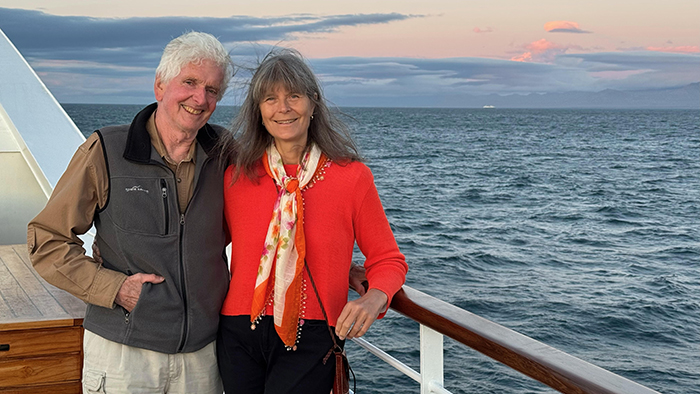
The Salt Spring Trail and Nature Club (SSTNC) invites everyone to vicariously voyage the Arctic’s fabled Northwest Passage via Pat and Rosemarie Keough’s great stories and stunning photography garnered during three transits and many Arctic adventures.

Their presentation — taking place Saturday, June 13 at 2 p.m. at the Salt Spring Public Library — will touch on topics like people and culture, wildlife and vegetation, geology and ice, history and discoveries, climate change, boundary and waterway disputes and more.

“We are fortunate to have explored many of the world’s remote and majestic places. The Northwest Passage ranks among the most memorable,” said Rosemarie.

Together, the Keoughs have been exploring the world as professional photographers and book publishers for 41 years. Their work has taken them throughout the Arctic and Antarctica as well as to the tropics and points between. Their limited-edition, hand-bound tomes — Antarctica and Labyrinth Sublime — are the apogee of their careers. Prestigious international honours for these works include World’s Best Photography Book, Outstanding Bookarts Craftsmanship, Nature Photographers of the Year and Official Book of POLAR2018. Yale University maintains a comprehensive archive of the Keoughs’ artistry. Pat and Rosemarie are Medalists and Fellows of The Explorers Club, Medalists of Britain’s Royal Geographical Society, Fellows of the Royal Canadian Geographical Society and recipients of Queen Elizabeth II Diamond Jubilee Medals. 

They share the adventure gene. In his teens, Pat explored the South Pacific where, among many occupations, he had a dive salvage company and constructed a house from 40,000 beer bottles. For several years he sailed a trimaran through much of Polynesia. 

Rosemarie’s early career in corporate finance was balanced by personal time leading canoeing, hiking and skiing outings, all while honing her photographic skills and knowledge of nature. Cultural heritage is another of her interests, especially traditional dance.

 Kindred spirits, the Keoughs met during a 550-km whitewater-canoe expedition down the legendary South Nahanni River in Canada’s subarctic wilderness. Not long after, while photographing elephants and keeping an eye for tigers in the Ghat Mountains of southern India, the newlyweds turned their mutual enjoyment of photography, then a hobby, into an exciting new career. As you can imagine, these long-time Salt Springer Islanders have many great stories to tell. 

The free presentation is hosted by the SSTNC and sponsored by the Salt Spring Public Library.

Level 4 drought declared

0

Predictions for a hot, dry summer for the Southern Gulf Islands are beginning to materialize, as federal and provincial agencies sharpen their warnings — and island water districts move into seasonal restrictions.

Dry conditions prompted B.C.’s Ministry of Water, Land and Resource Stewardship to declare a Level 4 drought Thursday, May 28 for the region that includes eastern Vancouver Island and every Gulf Island; last year, the region escalated to Level 4 in August, and in the previous year on July 18.

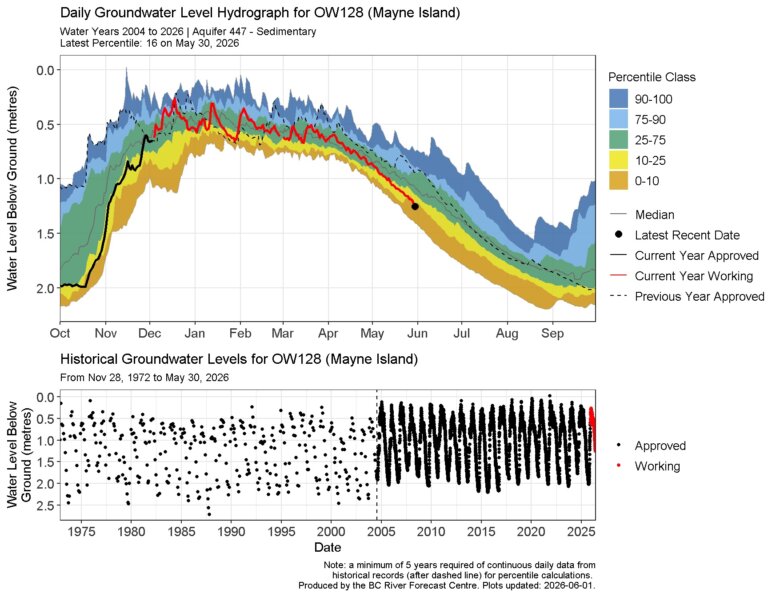
The province uses a six-level classification system to assess drought conditions, with no drought occurring at Level 0 and an increasingly common severe drought at Level 5. Data for that assessment are mainly gathered from stream gauges and a network of groundwater observation wells that monitor what the province calls “priority aquifers” — and as of the end of May, about 23 per cent of those wells are measuring below normal, three per cent more than at the same time last year. 

That percentage, representing sufficiently monitored wells sitting below normal for at least two weeks, includes one of three data-rich wells on Salt Spring Island and the only such wells on both Mayne and Saturna islands. 

On Salt Spring, about half of the island’s drinking water is supplied from St. Mary and Maxwell lakes, and water restrictions are triggered largely by lake levels — as with the North Salt Spring Waterworks District’s Level 3 measures enacted June 1. The latest data graphs from that district show lake levels tracking alongside the lowest “curves” since 2009. 

But residents on smaller well-fed systems — and individual well users on every Gulf Island — are watching the aquifers closely. Robin Walsh sits on the board of the Mayne Island Water Systems Society, an umbrella organization for the 10 water districts on the island. Walsh said Mayne Island’s districts are promoting conservation and water use restrictions with signs, local publications and on social media.

“Mayne doesn’t have lakes or reservoirs,” said Walsh. “We rely completely on groundwater from our aquifers — five of them — which are replenished by rain.”

In April, according to monitoring from Agriculture and Agri-Food Canada, most of B.C. saw below-normal precipitation, with much of the province receiving under 60 per cent of normal. In the Vancouver Island region, the agency’s “Abnormally Dry” classification for the area expanded due to “continued multi‑month deficits” in rainfall.

Meanwhile, three-month modelling for the region updated Monday, June 1 by Environment Canada now predicts a 96 to 98 per cent likelihood of above-normal temperatures this summer, with likely normal rainfall amounts that typically show little precipitation until September.

Black battalion story highlighted in multi-media performance

BY SALT SPRING HISTORICAL SOCIETY AND ARCHIVES

Some stories take a long time to return home. This year we are learning that the story of the No. 2 Construction Battalion is one of them.

Authorized on July 5, 1916, the No. 2 Construction Battalion was the first and only all-Black battalion in Canadian military history. They served in France during the First World War building roads, rail lines and infrastructure essential to the war effort, contributions too often left out of Canada’s historical record regardless of racial heritage. 

Twelve of the men who enlisted with the “Black Battalion” came from British Columbia, and of those, three travelled overseas from Salt Spring Island. The youngest was James Douglas Whims, only 18 years old, who did not return.

On Sunday, June 7, we are invited to an evening that shines a light on their service and legacy.

The BC Black History Awareness Society presents The Bugle Called & Forth They Went, a multimedia performance written and performed by B.C. folklorist, playwright, poet and singer Shayna-Adjowa Jones. Drawing on African and Afro-Diasporic oral storytelling traditions, Jones combines history, performance and spoken word to bring these stories vividly to life.

The performance takes place at ArtSpring from 7 to 8:30 p.m., followed by a Q&A.

Admission is by donation ($5 to $15 suggested), with tickets available through the ArtSpring box office.

This event is made possible through the Commemorative Partnership Program of Veterans Affairs Canada and presented by the BC Black History Awareness Society in collaboration with the Salt Spring Island Historical Society & Archives.

Salt Spring history would not be what it is without the contribution of Black pioneer families who arrived here in 1859 among the first colonists to take up land on the island. Some of their names — Stark, Whims, Robinson — are preserved on the roads we travel today. Our archives holds photographs and records of those who enlisted in the First and the Second World Wars, including the sons of our Black pioneers, and we are honoured to help connect this national story to our own community.

We hope islanders will join us for this special evening. The sliding scale price is a gift to the cultural history of Salt Spring Island and we look forward to sharing this with you.