Home Blog Page 55

A tribute to Mike Charlie and March for the Children invitation

BY PHIL VERNON

Special to the Driftwood

“Some people can talk about their residential school experience. Others may be willing to tell their story one day. Then there are those, like me, who will take it to their graves.”

I was speaking with Mike Charlie at the Fernwood Road Café about six years ago. Mike was chair of the Penelakut Sulxwe’en Elders Group, whom Chris Marshall of the Salt Spring Archives and I had invited over to discuss the creation of Indigenous signage at the Fernwood dock.

A key question for the signage was whether to include the residential school story on a panel, so I asked Mike.

“It was bad,” he said. “Kids died there.”

Mike’s father was W̱SÁNEĆ, his mother Penelakut. He and his brothers had been living in Washington state when their mom’s sister called them home to Penelakut — to Kuper Island as it was called then — when their mom wasn’t well enough to look after them. As soon as the kids got there, they were sent to the Kuper Island Industrial School, an imposing two-storey brick building overlooking the bay.

I’d first met Mike some years before, on a visit to Penelakut. We were just leaving when a voice called out, “Hi!” I turned and there was this guy looking up with an irrepressible grin. “I’m Mike,” he said, and shook my hand. That was all; I left and filed away his creased, crumpled — yet bright — face in my brain.

It wasn’t until that day in the Fernwood café, and subsequent conversations with Mike about the residential school and his passion to honour those who didn’t come home, that I began to appreciate Mike more deeply. Never marrying, he was dedicated to his community, a good uncle to his brothers’ children and soccer coach to all the kids on Penelakut.

As the Indigenous Signage Project inched forward through COVID shutdown, cancelled meetings and funerals, Mike kept alive our collaborative process. Despite his own health struggles, he was determined that we’d finish the panels.

During the project’s final year the news broke about the unmarked graves at the Kamloops Residential School, followed immediately by Penelakut revealing they’d already documented more than 160 graves next to the site of the demolished Kuper Island Industrial School. In the flurry of news reports and interviews, the Sulxwe’en met and Myrus James suggested a March for the Children.

As chair of the Elders Group, Mike took on organizing the event, connecting with First Nation communities up and down Vancouver Island where kids had been taken and sent to Kuper Island, getting hundreds of orange T-shirts printed and even dying his own hair orange.

When over 1,500 people showed up that August day in 2021, a veritable sea of orange washing up the hill to Waterwheel Park, everyone including Mike was stunned — they’d never imagined such a turn-out. Salt Spring Islanders were there in force to listen to the stories and show support, and we’ve continued every year since.

Sadly, Mike never saw the completion of the signage project. That winter he entered hospital with complications of kidney disease; while there he contracted COVID and died.

Those of us who worked with Mike will never forget him — his jokes, his warmth and infectious spirit.

Mike’s commitment to helping strengthen his people’s culture extended beyond this life, making final arrangements before his death for a traditional service and burial.

At the graveside after the service, I watched the men of the community lining up to take turns with the shovel to cover the coffin and slowly fill the grave. Towards the end I stepped up too. I thought of the day I first met Mike. What I saw then in his face, I came to know: a fire, brightly burning, for truth and for justice.

This Monday, Aug. 4, is the fifth annual March for the Children. What does it mean? To me, it means standing with those whose brothers, sisters and cousins never came home. It means standing with survivors and their families across Canada, those who lost their childhoods, their languages and cultures. Those forever marked by their experiences, who struggle every day to stop the cycle of violence in their families and communities.

I know how much it means to them for non-Indigenous people like me to listen to their stories, to bear witness to the terrible legacy of our governments’ racist policies and, finally, to acknowledge that things have yet to be made right.

The Penelakut People invite you to join them on their unceded territory and traditional village of Sunuwnets (Chemainus), meeting at 8:30 a.m. at the Salish Sea Market/Chemainus ferry terminal. For those unable to participate in the march, go directly to Waterwheel Park for prayers, dances and testimonials.

Editorial: No free [bus] ride

0

It’s hard to argue against support for public transit.

Anything that reduces the number of vehicles on our roads or improves the quality of life for those who do not own a vehicle must be a good thing, right? And as we so often hear, Salt Spring Island’s transit system is well used when compared to those in other communities in B.C. So it’s easy to see why it’s tempting for the Salt Spring Local Community Commission (LCC) to support growing the system.

But before committing to the eventual 78 per cent increase in property tax support for an expanded system, the LCC and Capital Regional District (CRD) should make the case that such an increase is justified. In 2025, Salt Spring property owners contributed about $450,000 to the local transit service. It cost the owner of an average-assessed million-dollar property about $68 of the $1,230 tax levy paid to the CRD (not counting extra monies paid by those who live within CRD water or sewer service areas). Contributing that amount for bus service seems perfectly reasonable. But considering island geography and where people live, we can’t help wonder how much more service it truly makes sense to add and pay for.

A recommended expansion of Route 2 between Fulford and Ganges is justified by current demand, so there’s no argument there. But the next suggested expansion is to extend the Beddis/Cusheon route (#7) by 1.8 kilometres from the Beddis/Cusheon Lake Road intersection to Beddis Beach. The least expensive of two options presented in a report to the LCC would cost taxpayers an additional $32,320 of the estimated $77,413 cost. That same report tells us that a weekly average of 32 trips were made by people on the Beddis route’s three daily round trips. It seems impossible to believe that many more souls living in and around the proposed extended area might want to ride a bus to justify such a cost.

Has anyone canvassed residents living in the affected area to see if they have a need for the service? The simple fact is that it is extremely difficult for a schedule with only a few trips per day to be usable for most people, and it would be ridiculous to fund enough buses to make it more usable. Then there’s the fact that travel in a private vehicle will likely always be preferred by most: for comfort, privacy and convenience.

The LCC/CRD can and likely will raise the allowable requisition amount for local transit, which is fine. But they and BC Transit need to justify reasons for spending it at every stop along the way.

Nobody Asked Me But: Ready for a grand summer camping adventure

0

Here we are, in the peak of summer, and it’s time to let our minds stray to one of our favourite seasonal activities. Yes, summer’s here and the time is right for camping in the woods.

Before you start tossing camping supplies willy-nilly into your car or camper unit, you must make the psychological transformation into the headspace of a camper. Start preparing yourself for how the next few days or weeks are going to play out. Find ways to break yourself in. Are you going to be sleeping in a tent? If so, you need to simulate how the cold, hard ground is going to feel against your brittle bones. Don’t think that a thin foamie is going to make much of a comfort difference. Stop using your expensive memory foam mattress a few days before you leave and lay out a small layer of crushed gravel or navy jack on the living room floor. Now snuggle up to yourself and feel every single little sharp edge dig into your body. This is as good as it’s going to get, so you better start getting used to it.

Food intake is another adjustment you are going to have to make. Before you leave home, start decreasing your daily consumption of fresh vegetables and real food. Instead, you want to start leaning towards those trusted camping staples such as hot dogs, popcorn and marshmallows. You can prepare yourself for campground coffee (aka cowboy coffee) by gathering up a few days’ worth of old grounds and dumping them in a big pot of boiling water. After a couple of hours of maximum heat, the thick black liquid should be revived back to its original full-body flavour.

The battle against insects and their annoying habits of biting and stinging innocent campers like you is another issue you will need to consider. By all means, bring along bug spray and mosquito repellant, but preparing your body against the inevitable itch/scratch conditioned response to these flying bandits is the best way to go. Personally, before I leave on a camping trip, I strip off my clothes and take a little naked run through the nearby blackberry hedge. After the bleeding has stopped, I can be quite certain that insect bites and stings will seem hardly noticeable.

Now it’s time to think of packing for the trip. Many campers claim that less is more, but I belong to the camp that insists that more is more. Basically, you want to take along everything that will fit in your trunk, camper or trailer, and then everything else you own. Drawing up a packing list will help you organize for the trip, but don’t let the list cramp your creativity. A general rule of thumb is to pack five times as much as you’ll ever need. You never know when you might have mechanical problems and have to rely on that never-opened fondue set to fend off starvation.

Getting the right campsite at a campground will make a big difference in how much you enjoy your experience. For instance, camping close to the outhouse can be a good thing because you’re close to the outhouse. On the other hand, it can be somewhat revolting because, well . . . you’re close to the outhouse.

It’s almost impossible to know for sure who will be your camping neighbours at any particular campground. Maybe you will be within sharing distance of a peaceful gathering of a local Raging Grannies chapter who are celebrating the completion of an Honour Our Earth Mother weekend workshop. Just as easily, you may be interfacing with Club 666 of the California Hell’s Angels who are ready to party hardy because their incarcerated leader, Snakehead, has finally been released on parole.

One summer, a friend and I were camped next to a bizarre religious sect from Seattle who were followers of the mysterious cultist Brother Love. Each of them had been given a new name by the good Brother to remind them that they needed to resist temptation and keep working on their spiritual auras so they could attain enlightenment. They sported names like Ego, Greed and Envy and wore these monikers proudly. We were invited to join the Love family and were told that Brother Love had taken a shine to us and was willing to bestow new names upon us. We declined the invite and informed them that we already had taken on new spiritual names. We said that we had considered Dopey, Sneezy and Bashful, but settled finally on Flashing Amber Light and Shoulder Check. They didn’t bother us much after that.

People go camping because they want to have fun. And how can you have fun unless you bring toys to play with? You’re going to need a variety of recreational accessories to enjoy the grandeur of nature and to keep from getting bored. By these, I mean surfboards, paddleboards, kayaks, canoes, jet skis, motorcycles, dirt bikes and ATVs. If you find that you don’t have enough room in your vehicle for all these toys, you can always tow a trailer behind you or, better yet, a speedboat (or both).

If you’re going to camp anywhere near water, you’ll want to have inflatables on hand. These can range all the way from water wings and air mattresses to humongous floating castles that look like they would not seem out of place as attractions at Disney World. When inflated, these floaties could actually save your life if you get into a serious collision and your air bags fail. You will also need about a dozen colourful foam noodles lashed onto different parts of your vehicle to prevent your ride from sinking to the bottom of a lake and to make sure that you are visible from outer space. Don’t forget the Super Soaker water guns in case you get hijacked by banditos.

There. You are all packed and ready to go. Nobody asked me, but the only things standing in your way are packed ferry parking lots, overloads, bumper to bumper traffic, highway construction and deconstruction, road closures, full campgrounds and weather that’s either cold and rainy or abysmally scorching. Have a great time camping.

On the other hand, have you considered a staycation?

‘Two Tricksters’ authors visit library

0

A pair of Mayne Island authors hope their new children’s book — a collaboration set in a familiar-feeling small island town — will help readers build a bridge across sometimes-troubling cultural differences, through the example set by two seemingly unlikely role models: the authors themselves, reimagined as they might’ve been in Grade 4. 

Jess Willows and Johnny Aitken will be at the library on Salt Spring Island at 1 p.m. Friday, Aug. 1 as part of their Southern Gulf Islands book launch tour for Two Tricksters Find Friendship. That book’s themes of friendship and strength of character have resonated with readers, telling the story of a young girl named Jessie who moves to the small coastal community and becomes fast friends with Johnny — a local Indigenous boy from the nearby reserve.  

And while Willows and Aitken said the small community where the story is set may remind readers of Mayne Island — or Cortes, or Alert Bay, or even Salt Spring, they said — and familiar tales of beachcombing or coveted cinnamon buns notwithstanding, Two Tricksters Find Friendship could be seen as happening anywhere Coast Salish culture intersects with that of non-Indigenous settlers, and wherever ties to the land are felt and differences spark misunderstanding. 

In the new chapter book, illustrated by Alyssa Koski, the young protagonists face outside pressures and prejudices, but with guidance from Raven — the wise trickster from many Indigenous stories — a Two-Spirit spiritual teacher named Steven and other community members, the pair learn to celebrate and lean on one another. Telling the story through younger versions of themselves helped make the story’s lessons simpler, the authors said; Aitken called it a delightful way to “live a sort of fantasy life of what could have been.” 

“Growing up I didn’t get to spend too much time on the reserve,” said Aitken. “Just because of circumstances in my life, I wasn’t brought up in that way. So it’s been a great experience to be able to fantasize about it. I come from a theatre background, so we did some role playing, saying, ‘OK, well, this is what we’re doing — and what would Johnny say? What would Jessie say?’ And we had fun with it.” 

Other events in the book are based upon life experiences the pair had when they were kids in their respective Indigenous and non-Indigenous communities — some fact and fiction mixed together, they said. 

“There’s lots to draw upon,” chuckled Aitken, who identifies as Two-Spirit. “I’m a bit of an activist in my community.” 

With Aitken’s background as an Indigenous artist and activist, and Willows’ as an educator with the Gulf Islands School District, the duo’s initial focus was to create something for teachers to use in the classroom — exploring entry points for integrating Indigenous content into the curriculum. 

“The book talks a lot about reconciliation through friendship,” said Willows. “And here Johnny and I are writing together and as such good friends there are so many overlapping parallels between this book and real life.” 

The collaboration has quickly found footing; Two Tricksters Find Friendship has been added to the 2025 Telling Tales and Festival of Literary Diversity Kids summer reading lists, and has been shortlisted for the Children’s/YA Book Award for B.C. authors through the Sunshine Coast Writers and Editors Society.  

Willows said a draft has been accepted for a second book in what is now a series, and the third is sketched out with writing underway. Two Tricksters is a “gentle” vehicle for storytelling, she said, and bringing that world to life through the fictional eyes of younger versions of themselves has been a joy. 

“We wanted the Jessie character to have that curiosity as a way to navigate things that can be a little tricky in our world,” said Willows. “Coming at things like kids do — maybe not with as much judgment as we adults have, but with respect and curiosity.”  

“In this friendship, between Johnny who is First Nations and Jessie who’s a settler, they don’t face obstacles between themselves — those challenges come from the adults,” said Aitken. “But it’s also the adults — and Raven — that bring mentorship through conflict.” 

Not to spoil the story, said Aitken, but a “bona fide reconciliation” takes place between the friends. 

“Johnny and Jessie stand together and support each other in a really good way,” said Aitken. “And they become role models in their community.” 

After Friday’s visit to the Salt Spring Island Public Library, Willows and Aitken — and, of course, Raven — will be at the Saturna Island Community Hall from 2 to 3 p.m. on Saturday, Aug. 2.

For more information about the book visit orcabook.com/Two-Tricksters-Find-Friendship

The Point Gallery: a place for great art ideas

By MARGARET DAY

THE POINT GALLERY

The Point Gallery is now in its 25th year as a place to encourage and enjoy art. Over time it has evolved.

Initially a gallery space showing work that stimulated and provoked discussion, in the last nine years it has mainly become the temporary home of an extraordinary group of artists, the residents of the Salt Spring Arts residency.

When we embarked on the program in 2014 we had no idea the diversity we would attract, the wonderful mix of genders, orientations, ethnic origins and, in this case most importantly, of creative practice and ideas. Instigated initially to accommodate the Salt Spring National Art Prize winner, as time went on the program accepted submissions from all over Canada and beyond.

The Point was always available as a studio and for the pop-up exhibits and gave the artists the opportunity to see their work in a gallery setting. These short exhibits were loyally supported by informed and knowledgeable islanders, their interest, comments and questions appreciated by the artists in residence. For the last few years The Point has offered accommodation and work space. Thanks to a hardworking group of artist volunteers, residents were introduced to island artists, visited their studios and explored the landscapes and seascapes of this beautiful place. Many of the artists stayed in touch and some of them returned. On these later occasions conversations revealed just how important their time on Salt Spring had been to their artistic development.

The Salt Spring Arts residency ended this spring when the money from a long-ago fundraiser finally gave out. It is time to move on. The gallery remains, still with the lighting and 2×4 solid wood floor installed by the efforts of the nine island artists who made up the original Vortex co-op, but mainly by the hard work of Deon Venter in 1991. It still pleases and surprises people who come in through the door for the first time. It would be good to think that there are a few more art-related years left in its future.

Over the last few years it has been a pleasure to accept proposals from artist friends and family for a temporary workspace, an informal exhibit, an evening lecture or for a play reading or performance piece. This week it will host a workshop given by the University of Regina’s Kathryn Ricketts. Four days of making and playing with paper will be coupled with writing stories and poems of renewal.

The participants of these explorations are generously exhibiting some of their work for a short window at The Point Gallery on Friday, Aug. 1 from 1 to 4 p.m. only. The show is called Repurposing and Reimagining Stories — an exhibition exploring the repurposing of paper and words.

Come by and enjoy the results of these fascinating experimentations with the idea of repurposing paper and words. If you are an artist, it will provide an opportunity — if you haven’t been before — to see the space and consider how it might fit into your art practice (or that of an off-island artist friend) as a temporary solution to move a great art idea forward.

The Point entrance is on South Ridge Drive and will be marked with a sandwich board and “entrance” sign.

Coast Salish artist Margaret August featured in next Showcase

BY ELIZABETH NOLAN

Artcraft Manager

Artcraft will be celebrating the month of August in an especially fitting way this year, with a Showcase exhibition featuring contemporary Coast Salish artist Margaret August taking pride of place on the Mahon Hall stage.

August (who uses the pronouns they/them/their) is a two-spirit Coast Salish artist and a member of shíshálh Nation. Into the Wild is an exhibition that explores gender identity, and what identifying as “two-spirit” means, revealing contemporary Coast Salish art and stories of living in the modern context through tradition.

“Where Indigenous identity and LGBTQ+ identity overlap and shape their lived realities, or through an intersectional lens, we can see how the unique experiences of two-spirit individuals are shaped by their Indigenous background and their gender,” August’s artist statement explains.

August’s new body of work therefore dissects and highlights the gifts of two-spirit people in the framework of the artist’s own unique perspective, while encouraging an understanding that two-spirit identity requires recognizing the intersectional nature of their experiences. The show will also include pieces from August’s Rebirth series, demonstrating the artistic building blocks that brought them into a new type of self-expression.

August was born in 1983 in the traditional unceded L ək ̓ ʷəŋən and W̱SÁNEĆ territories, now referred to as Victoria, B.C. Their work is inspired by the archival art pieces of their ancestors in combination with their spiritual encounters with nature.

August originally began developing their artistic talents at an early age. They were introduced to Coast Salish art through the late Tlingit artist Mark Preston in 2016, which then led them to seek guidance and mentorship with Coast Salish artist Dylan Thomas from 2016-23. This mentorship and others have helped August expand their talent and practice to creating art in multiple mediums such as serigraph and giclee prints, glass, cedar sandblasted pieces and wood carving (including a special learning trip to Haida Gwaii this past month to study with a renowned female carver.)

During a recent visit to their studio in Quw’utsun, August outlined just how necessary their six-year mentorship program with Thomas was for learning the foundations of traditional Coast Salish art before attempting to stretch the rules. Artists such as Susan Point, John Marston and Luke Marston have been a huge influence, offering a sense of permission to push the boundaries.

“I still have a hard time breaking outside those lines,” August said. “I mean, I don’t think it has to happen overnight either. I think it’s something that is gradually happening and I think each time I get to present my work in a way that I am, with exhibiting it, it just kind of pushes me to go further.”

Unlike the northern coast’s formline style that many are familiar with, Coast Salish art features symmetrical designs that balance positive and negative space. Designs are built on shapes such as trigons and trigon variations, crescents, variation of crescents, circles and ovals. The themes shíshálh Nation (now called Sechelt and the Sunshine Coast) depicted often had to do with family crests and histories — salmon, thunderbirds, orca and medicine people — while the colours used were those that could be found in nature or produced with available materials, meaning black, reds and ochres.

August’s work builds on those foundations but incorporates colours such as lavender and plum, while telling new stories important to them — especially those exploring their two-spirit identity. The traditional connections to that identity have been challenging to discover since colonial acts obliterated much language and culture.

“I’m still exploring what that means, but there’s no wrong or right. I just think there is something that makes me really different from other people,” August said. “And I’ve always felt that in a way that I don’t think I really honoured until I really branched on my own last year — so this is still pretty new to me.

“But I feel more comfortable in myself, being on my own with this exploration, with this continuation, and building on the experience of my mentorship for six years. I’m glad I dedicated that time to learning and finetuning and really perfecting what I do today and will continue to build in the future.”

The Showcase runs Friday, Aug. 1 through Monday, Aug. 25 during Artcraft gallery hours (10 to 5 daily) at Mahon Hall. Members of the public are encouraged to attend the opening reception from 6 to 8 p.m. on Aug. 1 and an artist talk on Aug. 2 starting at 1 p.m.

For more information, visit saltspringarts.com/exhibitions.

Mosaic Arts & Culture Festival on Pender for the long weekend

Back for another year, the Mosaic Arts & Culture Festival presented by Ptarmigan Arts will take place for the second time in the pine forest behind the Pender Community Hall, offering a weekend full of live music performances, emerging youth performers and lots of arts and nature-based activities for the whole family.  

The festival has been part of the island community for years, with its origins in the old Hope Bay Boat Days, which ran from 2012 to 2017 as a celebration of wooden boats, music and local art. Mosaic began in 2019 and — except for a pandemic break in 2020 — has grown to include more music and activities every year.  

Friday’s schedule kicks off at 6:15 p.m. with a welcome and land acknowledgement, followed by Star Captains at 6:30 p.m. and tweener Cole Dine before Garret T. Willie at 8 p.m. and After Dark with Goertz and Lopatecki and DJ Denny at 9:30 p.m.

Saturday’s main stage headline performers include The Dip at 2 p.m., Mercedes Papalia at 4 p.m., Tio Chorinho with Flavia Nascimento at 6:30 p.m., The Infinite Atom at 8 p.m. and After Dark with DJ Denny at 9 p.m. Numerous “tweeners” will also perform between the main acts.  

On Sunday, back on the Main Stage at 10 a.m. is the Sunday Singalong with Wayward Sirens, followed at 11 a.m. by Madame B Musique. After the lunch break at 2 p.m. is Cork and Porcupine, followed by a 3 p.m. performance by Clanna Morna. The Angelica Taekema Band and the Songwriters Circle is at 4 p.m. Pony Gold plays at 6:30 p.m. and The Brooks at 8 p.m.  

Other activities are the Zen Zone, face painting, workshops, market stage music, Art Play with Wendy and the TOTT Mural Installation, plus Saturday’s Imagination Station featuring the POD Baleinophone workshop from 2 to 4 p.m.

Field + Forest programs include Yoga with Mia, Art in the Pines exhibit and Typewriter Poetry in the Pines at different times, and a reconciliation discussion on Sunday with author and artist Johnny Aitken from 12:30 to 1:30 p.m. 

Parking is available at the hall; for more information and tickets visit themosaicfestival.com

‘Sister island’ Orcas bash planned for fall

0

An event celebrating a planned “sister” relationship between islands on opposite sides of the Canada-U.S. border is moving full steam ahead — and will get a financial boost from island government. 

Under its grants-in-aid authority, Salt Spring’s Local Community Commission (LCC) voted Thursday, July 17 to approve in principle up to $5,000 in funding to the island’s Chamber of Commerce for the Hands Across the Water event, spearheaded by the Orcas Island Yacht Club in Washington state. 

Some still-to-be-determined number of vessels are planning to sail from Orcas Island up to Ganges Harbour on Friday, Sept. 19, kicking off three days of Salt Spring events organizers hope will strengthen bonds between neighbouring island communities. Still in the planning stages, according to LCC members, events shaping up thus far include welcome receptions and friendly sailing competitions for islanders young and old. 

Also still in the planning stages is the “sister island” relationship itself. On Wednesday, July 9, at Capital Regional District (CRD) director Gary Holman’s recommendation through the Electoral Areas Committee, the CRD board tasked staff with providing a brief report on the process necessary for Salt Spring to establish that relationship with Orcas. 

“I support this initiative; it came at the request of folks living on Orcas,” said Holman on Thursday. “The person who contacted me was a former MP who just happens to have friends in the area.” 

LCC chair Earl Rook said the chamber was “quite gung-ho on the whole thing,” and were well into organizing events and wrangling local businesses eager to participate. 

“They’re expecting quite a big impact on what would otherwise be a shoulder-season weekend,” said Rook. “We don’t know what their expenses are going to be; based on the most recent conversations, they’re talking about targeting $135 per person coming up from the U.S.” 

Holman said he felt it was prudent to show LCC support but added the “up to $5,000” to similarly indicate a preference that the chamber wouldn’t use the whole amount — and most commissioners agreed. LCC member Brian Webster said he was willing to “grudgingly” support the motion, in the hopes it would be a bit less. 

“If we assume the management of this grant is going to be prudent, so that if the event only needs $3,000 then it only [uses] $3,000, then I feel comfortable with it,” said Webster. “I think there are benefits to the event, economic but also cultural. These are our very near neighbours, and it amazes me how little interaction we generally have with these people who live a couple of kilometres away from us.” 

The sole vote against the motion came from LCC member Ben Corno, who said while he supported the event itself, he’d always looked at the grants-in-aid service as “helping the little guy” that might not otherwise be able to find funding for a community effort, and that the chamber-organized event didn’t seem appropriate for that sort of taxpayer funding. 

“This is not how we do this [grants-in-aid] service, and this is not an emergency,” said Corno, who bristled at the lack of a detailed budget accompanying the request, and that the amount — “a little bit big for me,” he admitted — was being requested outside the planned fall grants-in-aid application intake schedule guiding the island’s other potential applicants.  

“[In 2024] we spent a good deal of our time trying to figure out how to best use our funds for the good of our community,” said Corno. “We didn’t offer $5,000 to community groups.” 

“‘Up to,’” added Rook. 

Although this is the first significant cross-border cultural event in recent memory, regional government officials from both nations have met often, most recently in March through the framework of the Southern Gulf Islands Forum. That gathering included members of the San Juan County Council (the county where Orcas Island is located), Islands Trust trustees, First Nations representatives and Washington state’s Second Congressional District U.S. Rep. Rick Larsen.  

The Islands Trust Council and San Juan County Council also have a long record of transboundary cooperation, dating back decades and including partnerships of public awareness and stewardship. In the past, those two governing bodies have sent joint letters to their respective provincial, state and federal governments on island-related issues, from environmental and maritime safety concerns to housing and economic development. 

A website for the September event has been established at acrossthewater.org

Hayley Wallis & the Bright Futures on stage

SUBMITTED BY SALT SPRING ARTS 

The Summer Outdoor Concert Series continues next week with its third performance of the season on Thursday, July 31, bringing the powerhouse vocals of Hayley Wallis & the Bright Futures to Centennial Park. Presented by Salt Spring Arts, this free event runs from 6 to 8 p.m., featuring an opening set by local favourite Mary Kastle. 

Wallis is an artist from the Kitasoo/Xai’xais First Nation in Klemtu, a small and remote island community located in the heart of the Great Bear Rainforest in British Columbia, whose voice is as commanding as it is soulful. Drawing from her Indigenous roots and contemporary influences, Wallis weaves powerful stories into her music, which spans pop, folk and soul. Since the release of her single Coffee Cup, she has been recognized across the country for her raw emotional delivery and inspiring stage presence. 

Backed by the Bright Futures, Wallis brings an electrifying live show that balances soulful grooves with deep emotional impact. Together, they create a sound that is both modern and timeless, infused with hope and honesty. 

Opening the evening is Salt Spring-based Mary Kastle, known for her rich vocals and warm, jazzy folk stylings. Anchored by funky piano lines, rhythmic guitar, soulful vocals and an inviting openness, her music carries a sense of warmth, resilience and connection. With roots on both the island and in Vancouver’s music scene, Kastle brings a grounded, soulful energy to the stage that perfectly sets the tone for the night. 

The Summer Outdoor Concert Series has become a seasonal highlight in our community, drawing locals and visitors alike for six consecutive Thursday evenings of free live music in the heart of Ganges. This year’s lineup is a dynamic mix of global sounds and West Coast favourites, curated to reflect both the diversity and talent of the wider music community. 

With three concerts still to come, including performances by Alpha Yaya Diallo, Ashleigh Ball and Empanadas Ilegales, the series is in full swing. But on July 31, all eyes — and ears — will be on Hayley Wallis and her Bright Futures. 

And as detailed last week, the July 24 concert features Inn Echo and opening act Yael Wand. 

Visit saltspringarts.com/socs to learn more. 

From branch to basket: harvest season begins

BY ELLA ROWLAND

Food Share Program Coordinator

This week, as plums and cherries ripen on the trees, the Salt Spring Island Farmland Trust is kicking off its long-awaited 2025 harvest season, and calling out for volunteers. 

The Harvest Program is part of the broader Food Share Program, which aims to increase food security on Salt Spring, acting as a connection point between delicious, island-grown food and the people who need it. 

After a wildly successful first year in 2024, program co-leads Nick Adamson-Jones and Indra Singh couldn’t be more proud of the impact the Food Share has had so far. With the help of amazing volunteers, they were able to save over 15,000 pounds of apples from going to waste, redistributing them to the community — and that’s just apples! 

As Singh leads me through The Root at 189 Beddis Rd. to the empty storage facility that will soon be filled top-to-bottom with salvaged Salt Spring produce, she reflects on the inaugural year of the program. 

“It was so wonderful last year to see the sheer variety of produce shared with us, and to work with such a lovely group of volunteers,” she said.

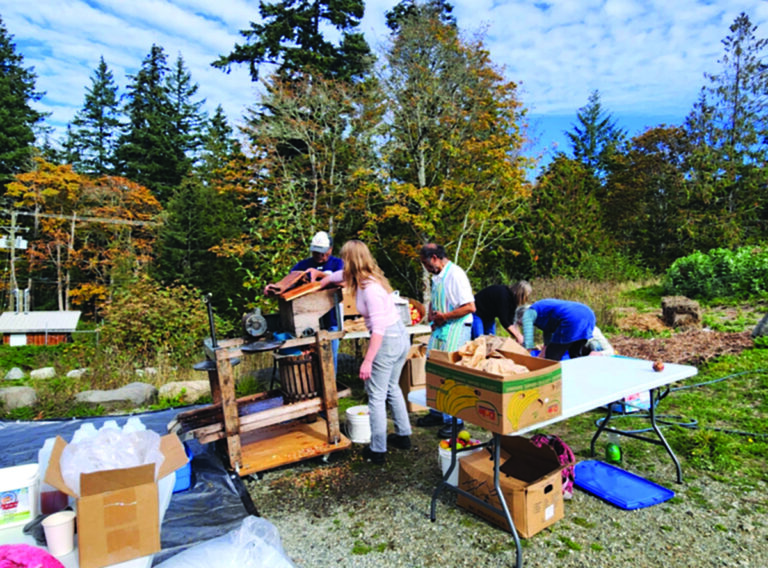
Harvested foods were distributed island-wide to organizations like the Food Bank, Gabriel’s Kitchen, IWAV and the Women’s Institute “Pie Ladies.” During one joyful community event, apples were even pressed into juice using an antique apple press. This trusty piece of history has since been retired to make way for a brand-new commercial apple press, allowing the team to greatly scale up production. 

This year’s Food Share coordinator, Ella Rowland, is organizing and guiding backyard harvests across the island. In addition to coordinating harvests, she is also launching a cost-recovery initiative featuring our signature “Eternal Apple Juice” — a custom blend pressed from apples harvested throughout the island. The Food Share team is excited to announce a weekly booth, where community members can sip our delicious cosmic apple juice elixirs, pick up fresh two-litre jugs of apple juice, learn more about our gleaning efforts and connect with local food initiatives. All proceeds will go towards supporting the Food Share program. If you have an event that could benefit from a cider booth, the Food Share team is eager to collaborate, and let the juice speak for itself.

“We had a few information booths last year that were a huge draw to the program,” laughs Singh, “mainly because the juice samples were really, really good.” 

For those unfamiliar with how the Food Share works, the program structure is simple: local treeholders with excess or hard-to-access fruit can register their tree with the Farmland Trust, and a group of dedicated volunteers will come by to harvest it. The bounty is then shared equally between the land owner, volunteers and community organizations. This act of collecting leftover or excess crops, called “gleaning,” reduces food waste, encourages food sharing, and strengthens involvement in local food systems. The Salt Spring Island Food Share is only one of over 200 gleaning programs across North America that are actively working toward these goals. 

Volunteers are essential to the program’s success, and 2024 was proof of just how much can be accomplished with community involvement. The team is now putting out a call for volunteers to join in the 2025 harvests. There’s no minimum commitment, and volunteers like Richard — a fixture of the 2024 program — say the experience is both fun and rewarding. 

“Being a part of the Food Share is a win-win-win for me,” he said. “I get to make a tangible difference in the lives of others while enjoying the camaraderie of like minded-individuals, fresh, local fruit and the beautiful gardens and orchards we have here on Salt Spring.” 

If that sounds appealing to you, sign up to volunteer on the Farmland Trust website by navigating to the Food Share page and clicking “Volunteer Registration Form.” 

The Root will also continue to host its monthly Food Exchange — a beloved tradition where islanders gather to share homegrown produce and homemade dishes. These exchanges take place on the third Sunday of every month, from 3 to 5 p.m., and always begin with a short moment of gratitude for everyone’s contributions. All are welcome. 

As the 2025 season kicks off, the Food Share team invites everyone to take part. Let’s let local food take root!