Wednesday, April 22, 2026
April 22, 2026
Home Blog

Three waterworks board candidates step up

0

Three Salt Spring residents have been nominated for two available seats on the five-member North Salt Spring Waterworks District (NSSWD) board of trustees.

Voting takes place either by mail-in (or drop-off) ballot — which must be received at the NSSWD office on Upper Ganges Road by 4:30 p.m. on Monday, May 4 — or in-person voting on Wednesday, May 6 from 2 to 6 p.m. at Community Gospel Chapel. Voting will be followed by the NSSWD annual general meeting, which begins at 6 p.m. Voting results will be announced at the meeting. 

All ratepayers qualified to vote should have received a ballot package in the mail by now. Contact the NSSWD office if packages have not been received or for more voting information. Recent issues of the Driftwood have contained voting qualification details. 

Candidates have answered four questions posed to them by the Driftwood, as shown below in alphabetical order by surname. 

Philippe Erdmer 

Q. What motivates you to run for a NSSWD trustee position?

A. Providing water on Salt Spring is both challenging and costly. The value of NSSWD assets now exceeds $100 million and the annual budget is over $6 million. Ratepayers deserve responsible oversight of these assets and expect value in the service they receive. As a ratepayer, I am standing for the board to ensure that local needs and priorities continue to be heard. Everyone who can, should take a turn.

Q. Please describe your past career, board or academic experience and how it is applicable to the trustee position.

A. I have been a member of the Association of Professional Engineers and Geoscientists of Alberta (APEGA) for 41 years and am now a life member. My career has included working for industry, government (provincial and federal geological surveys) and universities (Royal Military College of Canada, University of Alberta, now emeritus). I have served on and chaired regulatory boards (37 years on the APEGA Board of Examiners), scientific research and grant committees, strata corporation boards, non-profit foundations and community boards (sailing and flying clubs). Successful boards are made of people who cooperate, and I have been privileged to contribute to many.

Q. What decisions of the current board do you applaud and what might you have wanted to see done differently?

A. My reading of the district’s Strategic Plan gives me confidence that we are on the right track regarding the Maxwell Lake treatment plant. It is the largest capital project in NSSWD history. It has taken years to finalize and it will serve us for decades. It is a success. As with any organization, there have been challenges and lessons learned over time, but it is more constructive to look forward.

Q. As succinctly as possible, why should people vote for you?  

A. As a geologist, I am interested in understanding the limits of unconstrained (surface) aquifers and the hydrogeology that sets those limits. I am acutely aware of supply challenges posed by climate change, and the eutrophication and drawdown of finite water resources. 

For more than 10 years, our family lived with a 100 per cent rainwater catchment system in an otherwise normal, newly built house on Salt Spring, without a well or connection to piped water. Potable water supply is an infrastructure constraint within the district, and for all of Salt Spring. NSSWD trustees take on responsibility for leadership and guidance in the best interest of the community. This is achieved through fact-based, collective decision-making.

Steve Lam 

Q. What motivates you to run for a NSSWD trustee position?

A. It has been an honour to serve as your trustee over the past three years, and I’m motivated to continue building on that experience. I love living here on Salt Spring Island. Water is one of the most important services in our community, and decisions made today have long-term impacts on reliability, affordability, and growth. I’m motivated by the opportunity to help ensure our system is sustainable, practical, and fair for ratepayers.

Q. Please describe your past career, board or academic experience and how it is applicable to the trustee position.

A. I bring over 30 years of experience in the water treatment industry.  I currently work for Veolia, one of the largest water and environmental services companies in the world. My work provides a strong foundation for understanding the district’s challenges. Combined with my experience as a current trustee, this allows me to make informed and balanced decisions.

Q. What decisions of the current board do you applaud and what might you have wanted to see done differently?

A. The board has made important progress on long-term infrastructure, including moving forward with the Mount Maxwell treatment plant and lifting the moratorium. I also support decisions that improve fairness, such as capping leak-related charges and adjusting the rate structure so essential water use remains affordable.

One area for continued improvement is communication. Water decisions are complex, and I believe we can do more to clearly explain both the costs and the long-term benefits to ratepayers.

Q. As succinctly as possible, why should people vote for you?

A. I bring real-world water treatment experience, a proven track record as a trustee, and a practical, fair approach to decision-making.

Jon Scott 

Q. What motivates you to run for a NSSWD trustee position?

A. Back in 2015 when the NSSWD was working on the plan for the St. Mary Lake plant, I became aware that they had hired a consultant who designed a water plant much more expensive than it needed to be and that the ratepayers were not made aware of this. This bothered me since it has cost each ratepayer at least an extra $300 per year in parcel tax since then. If I get elected, I will do my best to ensure that the ratepayers are made aware of issues like this, and fight for cost-effective solutions.

In addition to the above, I am very interested in steps going forward regarding providing adequate water as the population of Salt Spring grows. This includes things such as grey-water usage, catchment during the winter, along with the regulations and incentives to make it happen.

Q. Please describe your past career, board or academic experience and how it is applicable to the trustee position.

A. I am a retired engineer who has lived on Salt Spring for 16 years. Most of my engineering work was in new product development, and I am named on 14 patents. I am known for “outside the box” creative thinking, and I hope to use this to help the NSSWD.

During my engineering career, before moving on to consulting, I was a manager of 12 people, so have experience as a team player. This also applies to my main volunteer activity on Salt Spring, which is involvement with the Island Pathways group.

Q. What decisions of the current board do you applaud and what might you have wanted to see done differently?

A. The current board is doing a great job, but I would like to see stronger efforts on reducing costs for the ratepayers. For example, the consultant on the Maxwell Lake water plant is charging $925,000 just for project management [and construction engineering].

Q. As succinctly as possible, why should people vote for you?  

A. Firstly, I will push hard to reduce costs for the ratepayer. Secondly, my engineering and creative thinking will help in future projects.

Skating rink on its way to Salt Spring

0

If you’ve dreamed one day to become Salt Spring’s first Zamboni driver, it may be an even longer wait than you thought.

But year-round recreational ice skating is coming soon to the island nonetheless, according to a local nonprofit, which announced Thursday, April 16 it had taken ownership of an 80-foot by 40-foot synthetic rink — and all its boards and netting — and now just needs a place to put it.

“It’s now ours to bring home to Salt Spring,” said Salt Spring Island Healthy Living Society (SSIHLS) co-chair Jesse Giddings. “So the question isn’t whether the rink is coming, it’s where it will live.”

Giddings told Salt Spring’s Local Community Commission (LCC) that over the past year he’d been working with the BC Amateur Sport Fund and a team of funding and operations consultants to explore bringing an ice arena to the island — and among them, he said, was SSIHLS co-chair and Hockey Hall of Fame inductee Luc Robitaille.

“He’s been an active partner in pursuing this,” chuckled Giddings. “I bring him up, not to name-drop, but to give you a sense that there are serious people behind this project.”

The society’s early estimates had put the cost of building a full-size ice arena on Salt Spring at roughly $15-20 million before land costs, Giddings said. They were, however, recently approached by KidSport Greater Victoria about a 3,200-square-foot “Can-Ice” synthetic rink, owned by the Victoria Hockey Legacy Society (VHLS). 

From an environmental standpoint, Giddings said, the modern synthetic surface material is a solid polymer that stays intact through its 10-year lifespan — the rink is squeegeed-off after a rain, and the double-sided tiles can be flipped for a second decade of use.

“It’s not the old-generation plastic people may remember; there’s no microplastic shedding, no runoff, no chemical coatings,” he said. “No refrigeration, no Zamboni and no ongoing utility costs — it’s a lower impact footprint than any real-ice facility you could build.”

The rink had been purchased for $175,000 in 2024, and used only twice — first at the 2024 Scotiabank Hockey Day in Canada celebration at Ship Point, and again in 2025 during the Century Celebration for the Victoria Cougars’ 1925 Stanley Cup victory. 

The timing seemed too good to pass up, so SSIHLS didn’t.

“VHLS was open to releasing it in exchange for a $100,000 donation to Kidsport,” said Giddings. “A donor has committed the full $100,000, and [their] only ask is that the rink go to a community that will actually use it.”

f his 15 years on the island either serving on the former Parks and Recreation Commission (PARC) or the LCC, and while ice rink proposals were brought up from time to time, they were always made a lower priority due to the tremendous costs involved.

“When it did come up, there was something verging on terror in the eyes of staff,” laughed Webster. “But I see this concept working. I look at our master plans, and of course none of them include a rink, but boy, I can sure imagine the Rainbow Road site as being a fit.”

“I was on PARC in 2008,” said LCC member Gayle Baker, “and we had a commissioner rather dramatically quit when it looked like we weren’t getting an ice rink. So this is exciting.”

In addition to the maintenance and energy expenses avoided with synthetic ice, Giddings pointed out the modular rink offers a great deal of flexibility — it could be easily expanded to a full-size rink with additional “tiles,” he said, if a larger space became available. And once disassembled, the rink sets up in about seven hours with relatively few tools.

“This means that it doesn’t have to live in just one place,” he said. “Imagine for a moment; we could move this and set it out in Centennial Park for the winter, right in the heart of our village, as a winter gathering point for the whole community.”

Giddings said SSIHLS had raised additional funds for equipment — “Right now, I’ve got 100 ice skates on hold,” he said — and that the rink, boards and netting were in a shipping container in Victoria which could be repurposed on-island as the rental hut. 

SSIHLS had negotiated to have transportation and delivery covered under their agreement, Giddings said, and the current owners would prefer to have the container relocated in the next 60 to 90 days.

“It may end up in my yard in the short term, while we work with the community to find the appropriate location,” he laughed. “Ideally we find the appropriate site, it gets delivered and set up on the same day.”

Staff will review the proposal and bring back a full report to the LCC along with options for location and operating structure. Capital Regional District (CRD) director and LCC member Gary Holman cautioned commissioners should ensure the operational expenses could be covered by SSIHLS through reasonable use fees — particularly if they were committing CRD-owned land for the rink.

“But it does really seem like an exciting opportunity,” said Holman, “that for our unique community, is uniquely suited.”

LCC targets six of Ganges’ worst intersections

0

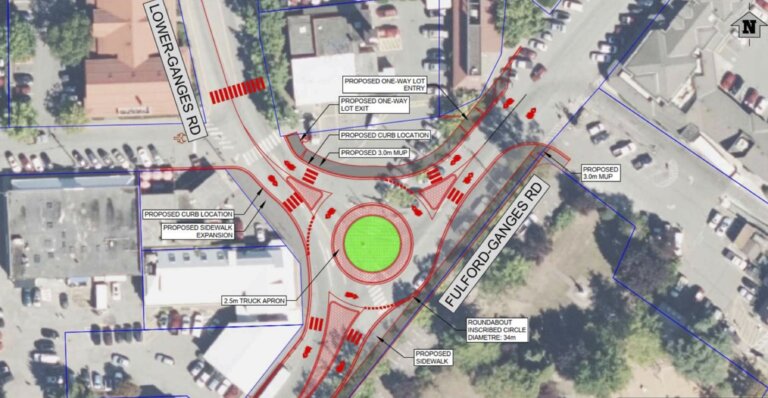
Traffic experts are proposing roundabouts be built at two of six identified intersections in Ganges, part of a laundry list of recommendations in a recently completed analysis of village crosswalks.

And Salt Spring’s Local Community Commission (LCC) has approved the Ganges Crosswalk Project’s draft report, which targets nearly $1.2 million in work on those intersections based on safety risk and pedestrian demand, according to early cost estimates prepared for commissioners.

A conceptual design — notably from the 2023 Salt Spring Island Cycling Safety Review — was presented for one of the two roundabouts suggested, offered as a solution to pedestrian-vehicle conflicts that take place where Fulford-Ganges and Lower Ganges roads meet fronting Centennial Park and the fire hall. The draft analysis report also encouraged a roundabout at the intersection of Upper and Lower Ganges roads, again to calm speeding traffic and prioritize pedestrian safety. Neither roundabout was priced out, although preliminary cost estimates for more modest improvements near those intersections, such as realignments and pedestrian refuge islands, still rang in at $277,400 and $174,800 respectively.

But islanders should temper their expectations, according to Capital Regional District (CRD) staff, who noted the analysis was intended mostly to inform future planning, rather than to signal road crews were on their way; and with a local budget for those projects sitting at just $100,000 — and even then, pending ICBC funding and Ministry of Transportation and Transit (MoTT) approvals — in all likelihood there may be, at most, a single crosswalk tackled this year.

“There are only two projects in the six that are under $100,000,” said Salt Spring senior CRD manager Dan Ovington, who laid out the study’s conclusions for the Local Community Commission (LCC) Thursday, April 16. “If we’re successful with the grant we’d be looking at those two intersections and identifying which one we can do within that funding.”

From there, Ovington said, Salt Spring staff would put together a capital plan that identifies “two, maybe three” of the intersections that could be built over the next few years. 

Of the six, the least expensive project — and most likely to be completed within that budget — is improvement of an existing crossing of Lower Ganges Road at Village Terrace across from Pioneer Village and other senior residential communities. Traffic passing that intersection was found to be exceeding the 50 km/h speed limit about 46 per cent of the time, according to data collected for the study. With an hourly pedestrian volume of 16 and an average 8,750 vehicles going by on a busy summer day, the study recommended a refreshed crosswalk include rectangular flashing beacons to improve visibility. The Class D estimate for that work came in at $77,400.

For $93,300, a proposal for the intersection at Lower Ganges and Atkins Road would finally give pedestrians there a signed and marked crosswalk. Similarly, a new crossing at Lower Ganges and Blain roads would help people crossing in and around Country Grocer for an estimated price of $127,100. And at the high end, a long list of improvements for crossings at Lower Ganges Road where it splits Hereford Avenue and Purvis Lane frame the most comprehensive and expensive project, estimated at $397,600. 

Regardless, commissioners weren’t ready to commit on April 16 to starting with the least expensive projects first, nor necessarily to settle on $100,000 as a ceiling for the coming year’s intersection budget.

“We as a group will have to decide which of the six priorities we believe are most important,” said LCC member Gayle Baker. “There may be one [costing more] that is way more important to the island.”

“Each of these projects will require a permit through MoTT,” said Ovington. “And I think we need clarification on the funding that’s actually available in order to identify our priorities.”

The crosswalk study took place last year, and in addition to collecting traffic data incorporated community engagement, including in-person discussions during site visits, an online comment form that received 92 submissions from 75 participants and a public open house in September, according to staff. Feedback consistently identified concerns related to vehicle speeds, failure to yield, poor crosswalk visibility, accessibility barriers and informal pedestrian crossings near key destinations such as Centennial Park schools, grocery stores and senior housing. 

Point no longer referred to as ‘savage’

0

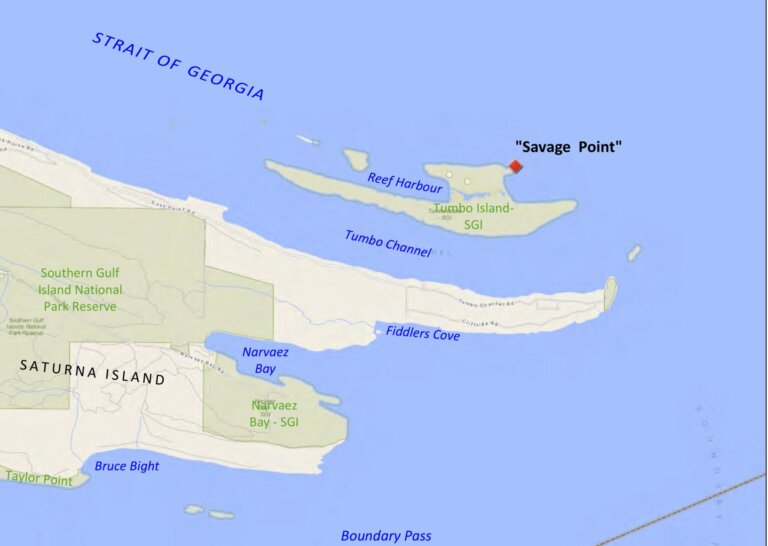
A point on a small island off Saturna will no longer be known as Savage Point, according to the BC Geographical Names Office (BCGNO) — and, for now, won’t be known as anything.

In a letter sent to the Islands Trust Council in late March, BCGNO provincial toponymist Trent Thomas said the name for the smaller of two eastern points on Tumbo Island had been officially rescinded March 25, in a joint decision with Parks Canada, due to its derogatory nature.

“Governments and organizations consistently expressed that official names with derogatory connotations are unacceptable,” wrote Thomas, who also serves on the Geographical Names Board of Canada. “The name in question was described [in a request to rescind] as having ‘offensive, derogatory and racist meaning.’” 

During a meeting in November 2025, the Islands Trust Executive Committee had expressed broad support of the recension, ultimately asking staff to respond via letter to advise the BCGNO office they had no concerns with dropping the name. Thomas said BCGNO had invited all local and First Nation governments nearby to comment on the proposal, and had received no objections or concerns regarding the rescinding of Savage Point as an official name.

Notably, the proposal to rescind the name did not include ideas for a replacement, according to BCGNO, so for the time being the point will likely be referenced only by its GPS coordinates or in relation to nearby named locations. The name will no longer appear on provincial and federal maps, Thomas said, or be distributed in any lists of official B.C. place names.

Tumbo Island lies just north of the east end of Saturna Island — missing out on being the easternmost Gulf Island by some 500 metres — and the former Savage Point points northeast into the Strait of Georgia. According to BCGNO’s records, the name was first established on British Admiralty Charts in 1859, and officially adopted in 1946 — although the significance or origin of the name was not recorded. 

Local lore that the point was named for an explorer’s vessel is unsubstantiated by the historical record; the Royal Navy did have several ships named HMS Savage, but none are recorded as having served near the Gulf Islands during the primary period of coastal surveying. 

Editorial: Anything’s possible

0

Is it just us, or have a few news stories published in recent weeks had a similar flavour to our April 1 front-page gondola article? 

In case you missed it, that piece announced “Gondola system planned for island” and detailed a fully funded ready-to-roll project linking Ganges, Vesuvius and Fulford Harbour via use of enclosed eight-passenger aerial cabins. It was a joke, but some people have told us they thought it was a great idea. 

Since then we’ve heard about a comprehensive healing and arts centre proposed by a nonprofit for Musgrave Road, extension of a Rogers Communications Mount Bruce cell tower to 55 metres in height and, in today’s issue of the paper, mention of round-abouts to improve pedestrian and traffic safety in Ganges, and plans for an ice rink to be set up on the island. All true!

According to our research, documented attempts to secure a place to skate on Salt Spring reach back to 1974. Then in 1995, much like the current proponents, a nonprofit society was formed specifically for the purpose of creating an ice arena. While a location for today’s portable facility must still be found, this effort, theoretically requiring no taxpayer funding, feels like it could hit the net. 

Roundabouts — the clear choice by consultants for improving safety at the intersections of Fulford-Ganges and Lower Ganges roads (by Centennial Park) and at Upper and Lower Ganges roads — are also in the long-wished-for-but-deemed-impossible category of community amenity.  

But in both the ice rink and roundabout cases, it’s appropriate to bring out the “never say never” adage. Who would have thought the Salt Spring fire department could ever acquire a ladder truck, as recently announced — or a new fire hall, for that matter? 

And speaking of getting things done, islanders have been absolute rock stars in this year’s Let’s Pick It Up, Salt Spring! campaign. There’s still another week left in April and time to choose a road or beach on the island to make trash free. (See page 12 in this week’s paper for details on how to help.)

Who knows, if that level of energy can be harnessed, maybe we’d be able to get a roundabout by the soon-to-be old fire hall within five years. If not, it will make a good April Fool’s Day headline in 2037, the next time April 1 falls on Driftwood’s Wednesday publication day.

Viewpoint: Crucial exemption applies

By Frants Attorp

For 50 years the Islands Trust has succeeded in keeping Salt Spring largely rural and distinct from the surrounding urban sprawl. Unfortunately, the planning agency is now under attack by factions not only claiming they want something done about the current housing shortage but also seeking to make housing the main driver of land-use planning forevermore, just like in any municipality. This would amount to nothing less than the overthrow of the Islands Trust.

Almost everyone has heard of the Trust’s “preserve and protect” mandate, but few know there is something much more specific to constrain development, namely exemption from Section 473.1 (3) of the Local Government Act, which requires local governments to “provide for at least the 20-year total number of housing units required to meet anticipated housing needs, which total number is included in the most recent housing needs report . . . .”

While the Local Trust Committee has to file and consider housing needs reports, it is not required to meet the identified needs. Housing is a secondary consideration subject to the primary goal of protecting the island’s natural environment. Without this legal protection, growth cannot be limited and the island’s unspoiled beauty and vulnerable ecosystems would soon succumb to the same market forces that have engulfed the whole region.

HOUSING WORKING GROUP

A report written by the Housing Working Group in 2020 laid the groundwork for today’s “targeted update” of our Official Community Plan) (OCP) — with no public meetings. That document set out a process for a major OCP amendment that promised “integrated solutions” but focused primarily on housing needs as identified in housing needs reports. The urgent need for new carrying capacity and ecosystem-health studies was not even mentioned.

OCP “UPDATE”

Today’s “targeted OCP update” project, which is clearly a full-scale remake of the island, is similarly contrary to the Islands Trust Act as it makes increased housing the primary, long-term goal while naming environmental protection as a secondary consideration to be “integrated.” Furthermore, the limited scope of the project precludes any discussion of growth, sustainability and existing science showing the island is already overdeveloped at build-out — again, without public meetings.

TRANSITION SALT SPRING

In their recent feedback to Trust Council regarding the draft Trust Policy Statement, Transition Salt Spring incorrectly described LTC responsibilities with regard to housing in much the same way the OCP consultant did just prior to abandoning the “update” project.

From their Jan. 31, 2026 submission: “This balance is critical to allow LTCs to update their OCPs and Land Use Bylaws to meet local and provincial requirements, particularly around housing, and to align with the current and future needs.”

Making the Islands Trust a slave to housing needs reports defeats its entire purpose as a conservation agency.

INCORPORATION REJECTED

Salt Springers soundly rejected municipal governance in the 2002 and 2017 referendums. If those results are going to be overturned, it must not happen without a further referendum and a full community discussion of what is possible under our existing OCP and the Islands Trust Act itself.

The writer is a Salt Spring resident.

Concert bridges eras, genres and repertoire 

BY MEGAN WARREN

For ArtSpring

On Tuesday, April 28 at 7:30 p.m., the ArtSpring stage hosts a rare meeting of musical minds as the Juno-nominated Cheng² Duo joins forces with legendary clarinetist James Campbell. 

This performance brings together three of Canada’s most celebrated instrumentalists for an evening that transcends the boundaries of a traditional classical recital. 

Siblings Bryan (cello) and Silvie (piano) Cheng share an onstage rapport that can only come from a lifetime of making music together. Since their 2011 Carnegie Weill Recital Hall debut, they have toured extensively across Europe, the Americas, Asia and South Africa, earning a reputation for a “contagious joy” that makes classical music feel immediate and accessible. Their performances embody the physical energy of a live conversation — a quality that has earned them praise for being truly exhilarating to watch.

The Chengs are dedicated to presenting a repertoire that bridges eras and cultures. Their most recent album, Portrait — Juno-nominated for the 2024 Small Ensemble Classical Album of the Year — features original arrangements of two beloved Chinese folk songs alongside vibrant contemporary commissions. Whether they are tackling historical masterworks or jazz-infused pieces, the duo moves seamlessly between the delicate and the powerful, making music that is both perfectly executed and deeply personal.

For this Salt Spring engagement, the duo becomes a trio with the addition of Canadian clarinet superstar James Campbell. A Member of the Order of Canada and artistic director of the Festival of the Sound since 1985, Campbell has performed in over 35 countries with more than 60 orchestras. His clarinet work is described by the Governor General of Canada awards page as “flawless, rich and technically superb.” By adding his clarinet to the Chengs’ piano and cello, the group is able to explore a wider range of textures and sounds, from intimate melodies to complex, high-energy exchanges.

To secure your seat for this unforgettable evening, visit the ArtSpring box office or purchase.artspring.ca

Repair Cafés offer more than just fixing

By Lighter Living, a Transition Salt Spring Initiative

There’s a particular kind of energy in a Repair Café: part curiosity, part hope, part quiet determination. A table full of broken things, and behind it, people who simply refuse to believe those things are at the end of their story.

Spend a few hours with four of our volunteer fixer crew — Martin Thorn, John Newton, Omar Al-Khafaji and Gary Kunz — and you start to see that what’s being repaired isn’t just lamps and kettles. It’s something deeper. A mindset. A memory. A way of being in the world.

Where it all begins

For many of them, fixing isn’t “a skill” they picked up, it was culture, a requirement of daily life previous to our modern “everything is disposable” society.

Martin traces it back to his father, raised during the Depression, when nothing was wasted and everything was made to last. Hockey sticks weren’t bought, they were crafted by hand. As a kid, he admits, that was a little embarrassing. But they worked. And that was the point.

John’s story echoes a similar thread. Wartime frugality, an analogue world and a natural curiosity about how things worked. You didn’t throw things away. You figured them out.

Omar remembers being just eight years old, already convinced that if humans could build something, he could take it apart and fix it. (Though he laughs about his mother’s TV he never managed to revive despite packing it in a suitcase when he first came to Canada.)

Gary puts it simply: when something breaks, like a flat tire, you fix it. You figure it out because it needs figuring out.

The quiet satisfaction of fixing

Ask them what they enjoy most, and none of them talk about complexity or challenge. It’s something more human.

Martin lights up when someone brings in a cherished object — something with a story attached. Watching the owner’s face when it works again — that’s the reward.

John finds satisfaction in restoring broken ceramics or artwork especially when it matters deeply to the person who brought it in.

Omar recalls a father and son standing across the table from him, the boy completely absorbed in the process of figuring out a repair. “That alone made the entire afternoon worthwhile,” he says.

And Gary? Sometimes it’s as simple as a kettle. Five seconds, a tiny adjustment and suddenly it works again. The owner is surprised, delighted and maybe just a little amazed.

Lamps, glue and the unexpected

There are patterns, of course.

“Lamps, lamps, lamps,” Martin says.

John agrees, along with a steady stream of items that just need gluing back together. Simple breaks. Clean fixes.

Gary adds kettles to the list. Omar sees a rotating cast of coffee machines, mowers, blowers and a whole variety of other mechanical bits that land on his table.

And then there are the surprises: A red-light facial mask. A fishing reel that refused to cooperate. A toilet bidet attachment. The Repair Café, it turns out, is never boring.

What people really come for

At first glance, people come to get things fixed. But standing at the table, something else happens.

People ask questions . . . about tools, about glue, about how something works. They watch closely. They’re often surprised that repair is even possible.

Omar sees it all the time: “People are astounded that things can be fixed.”

Martin notices something similar, people gaining the confidence to try things themselves. Even when they’re just observing, as Gary points out, something is being absorbed.

The bigger picture

Underneath the fixes, there’s a shared frustration: cheap, disposable products. Poor design. Things built without repair in mind. 

Omar doesn’t mince words: we’ve been trained to chase shiny, low-cost items without understanding the relationship between quality and price.

Gary sees it too — older items often can be repaired. Newer ones? Not so much.

And yet, none of them frame the Repair Café as a protest.

For John, it’s about community first. The environmental impact matters, but what keeps him coming back is the sense of connection. Familiar faces. Conversations. The simple act of helping.

Martin calls it a perfect fit for a long-held dream, a place where tools, knowledge and people come together.

Omar says it more bluntly: “I can help. It’s great to feel useful.”

Why they keep showing up

Across all four, one thing is consistent: they come back because it feels good. Not in a grand, abstract way, but in a grounded, human one.

People say thank you. Things that mattered get a second life. Strangers become neighbours.

There’s laughter. Problem-solving. The occasional unsolvable puzzle. And always, the sense that something worthwhile is happening, one small repair at a time.

An open invitation

If you ask them what they’d say to someone considering volunteering, the answers are simple.

“There’s no downside,” Omar says.

John points to the feeling of being part of something larger, a caring, capable community. Martin offers gratitude, plain and direct.

And Gary?  “Hello, I’m Gary. Nice to meet you.” Which might be exactly the point. Because at the Repair Café, you don’t have to be an expert. You just have to show up, get involved and be willing to try.

And sometimes, that’s where the real repair begins.

Come meet the fixers at our next Repair Café, Sunday, April 26, 10:30 a.m. to 1:30 p.m. at Meaden Hall. 

We invite you to sign up for more free access to Lighter Living content at tinyurl.com/Lighter-Living. Learn how to take low-effort actions that feel good, benefit our community and help the planet.

BARRETT, Anthony Haydn

February 5, 1970 – April 8, 2026

It is with great sorrow that I’m announcing the passing of my son Anthony Haydn Barrett, who died suddenly in his home of natural causes on April 8 2026. He leaves behind his loving mother Joanna, her partner Brian, his father Geoff and his partner Lindsey.

Upon moving to Salt Spring with his family in 1981, he enjoyed his youth, joining sports teams and riding his dirt bike over the hills of Salt Spring. Anthony, unbeknownst to his Mum, had started cutting friends’ hair in his bedroom so upon graduation he joined his Mum at Island Magic Touch Hair Salon. There as a team, side by side they cut Salt Springers’ hair for the last 26 years.

He loved music, his guitars, his snazzy white sports car, his home and family, especially visiting his family in England. He and his dog were constant companions until Barnaby’s death 4 years ago.

Anthony will be sorely missed by his family and friends but never forgotten.

There will be a memorial service Friday, April 24 at 11am at All Saints church and a gathering at 121 Desmond Cr. following the service.

SMITH, Marilyne

1945 – 2026

With deep love, we announce the passing of Marilyne Kathleen Smith in Taber on Tuesday, April 7, 2026 at the age of 80 years.

Marilyne is lovingly remembered by her children Lisa (Mark) Meuleman of Seattle and Nicole (Jim) Biniaris of Moose Jaw; her cherished grandchildren Katia and Ava Meuleman, and Yiorgo and Yhanei Biniaris. She is also survived by her sister Bonnie (Barry) Daisley; sister-in-law Teresa Illerbrun; cousin-in-law Wendy Scott (Ed Wallace) as well as numerous nieces and nephews.

She was predeceased by her husband Monti Maxwell; parents Alan and Marie Smith; siblings Frank (Violet) Smith, James Smith, Vicki Smith, Marjorie Smith, and Sonja Smith; and her former husband, Ronald Mowbray.

Born in Taber, Marilyne carried her prairie roots with her throughout her life. She dedicated over forty years to a career in banking, serving in a variety of roles, including management, until her retirement in 2005. She lived in Calgary and Vancouver, and spent nineteen cherished years on Pender Island before returning to Taber in 2023.

Marilyne’s greatest joy was her grandchildren. She treasured time spent with them – day trips to Roe Island and the spit, simple picnics at the park, singing to and fro – simple moments that became lasting memories. Marilyne also loved to bake, especially fresh pies, which she often shared as her quiet token of appreciation. Her heart was also given to a very special dog named Finegan, who has been lovingly taken in by niece Joan Smith. If you ever have a chance to meet Finegan, give him lots of rubs and treats as he will miss his Marilyne ever so much. She will be deeply missed and forever loved.

“Those we love never truly leave us; they live on in the love they gave.”