
By Lighter Living, a Transition Salt Spring Initiative
There’s a particular kind of energy in a Repair Café: part curiosity, part hope, part quiet determination. A table full of broken things, and behind it, people who simply refuse to believe those things are at the end of their story.
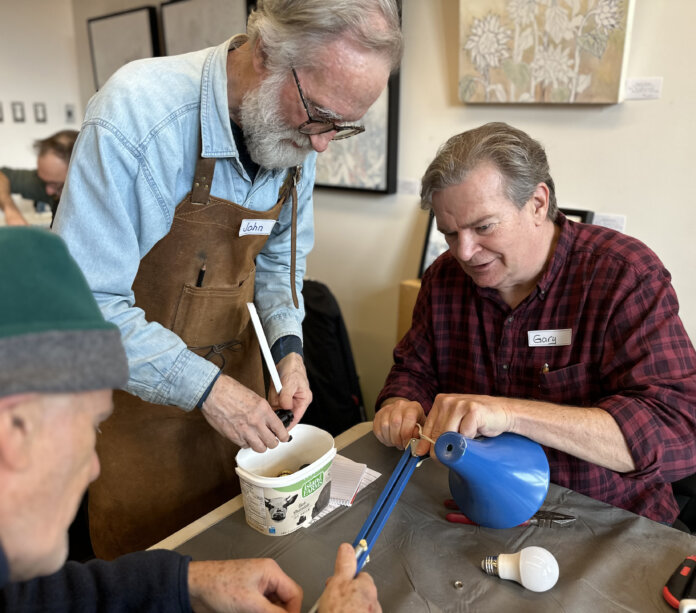
Spend a few hours with four of our volunteer fixer crew — Martin Thorn, John Newton, Omar Al-Khafaji and Gary Kunz — and you start to see that what’s being repaired isn’t just lamps and kettles. It’s something deeper. A mindset. A memory. A way of being in the world.
Where it all begins
For many of them, fixing isn’t “a skill” they picked up, it was culture, a requirement of daily life previous to our modern “everything is disposable” society.
Martin traces it back to his father, raised during the Depression, when nothing was wasted and everything was made to last. Hockey sticks weren’t bought, they were crafted by hand. As a kid, he admits, that was a little embarrassing. But they worked. And that was the point.
John’s story echoes a similar thread. Wartime frugality, an analogue world and a natural curiosity about how things worked. You didn’t throw things away. You figured them out.
Omar remembers being just eight years old, already convinced that if humans could build something, he could take it apart and fix it. (Though he laughs about his mother’s TV he never managed to revive despite packing it in a suitcase when he first came to Canada.)
Gary puts it simply: when something breaks, like a flat tire, you fix it. You figure it out because it needs figuring out.
The quiet satisfaction of fixing
Ask them what they enjoy most, and none of them talk about complexity or challenge. It’s something more human.
Martin lights up when someone brings in a cherished object — something with a story attached. Watching the owner’s face when it works again — that’s the reward.
John finds satisfaction in restoring broken ceramics or artwork especially when it matters deeply to the person who brought it in.
Omar recalls a father and son standing across the table from him, the boy completely absorbed in the process of figuring out a repair. “That alone made the entire afternoon worthwhile,” he says.
And Gary? Sometimes it’s as simple as a kettle. Five seconds, a tiny adjustment and suddenly it works again. The owner is surprised, delighted and maybe just a little amazed.
Lamps, glue and the unexpected
There are patterns, of course.
“Lamps, lamps, lamps,” Martin says.
John agrees, along with a steady stream of items that just need gluing back together. Simple breaks. Clean fixes.
Gary adds kettles to the list. Omar sees a rotating cast of coffee machines, mowers, blowers and a whole variety of other mechanical bits that land on his table.
And then there are the surprises: A red-light facial mask. A fishing reel that refused to cooperate. A toilet bidet attachment. The Repair Café, it turns out, is never boring.
What people really come for
At first glance, people come to get things fixed. But standing at the table, something else happens.
People ask questions . . . about tools, about glue, about how something works. They watch closely. They’re often surprised that repair is even possible.
Omar sees it all the time: “People are astounded that things can be fixed.”
Martin notices something similar, people gaining the confidence to try things themselves. Even when they’re just observing, as Gary points out, something is being absorbed.
The bigger picture
Underneath the fixes, there’s a shared frustration: cheap, disposable products. Poor design. Things built without repair in mind.
Omar doesn’t mince words: we’ve been trained to chase shiny, low-cost items without understanding the relationship between quality and price.
Gary sees it too — older items often can be repaired. Newer ones? Not so much.
And yet, none of them frame the Repair Café as a protest.
For John, it’s about community first. The environmental impact matters, but what keeps him coming back is the sense of connection. Familiar faces. Conversations. The simple act of helping.
Martin calls it a perfect fit for a long-held dream, a place where tools, knowledge and people come together.
Omar says it more bluntly: “I can help. It’s great to feel useful.”
Why they keep showing up
Across all four, one thing is consistent: they come back because it feels good. Not in a grand, abstract way, but in a grounded, human one.
People say thank you. Things that mattered get a second life. Strangers become neighbours.
There’s laughter. Problem-solving. The occasional unsolvable puzzle. And always, the sense that something worthwhile is happening, one small repair at a time.
An open invitation
If you ask them what they’d say to someone considering volunteering, the answers are simple.
“There’s no downside,” Omar says.
John points to the feeling of being part of something larger, a caring, capable community. Martin offers gratitude, plain and direct.
And Gary? “Hello, I’m Gary. Nice to meet you.” Which might be exactly the point. Because at the Repair Café, you don’t have to be an expert. You just have to show up, get involved and be willing to try.
And sometimes, that’s where the real repair begins.
Come meet the fixers at our next Repair Café, Sunday, April 26, 10:30 a.m. to 1:30 p.m. at Meaden Hall.
We invite you to sign up for more free access to Lighter Living content at tinyurl.com/Lighter-Living. Learn how to take low-effort actions that feel good, benefit our community and help the planet.