
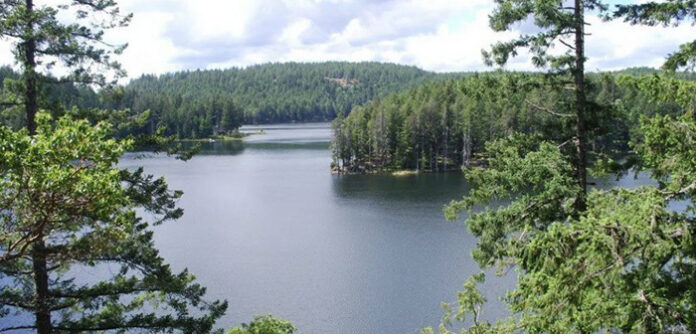
As Salt Spring heads into what Environment and Climate Change Canada has said is “virtually certain” to be among the four hottest years on record, the island’s largest water district is starting its annual water restrictions with a new, simpler set of regulations it says will increase compliance and spur conservation.
Trustees for the North Salt Spring Waterworks District (NSSWD) approved the changes Thursday, March 26, just in time for Stage 1 restrictions — the most permissive of potentially four that limit summertime water use — to take effect April 1. Along with simplifying when and how much people should water, according to NSSWD water data and assets coordinator Brenna Wells, trustees wanted the new rules to make the use of sprinklers less permissive, particularly for watering lawns, and encourage micro and drip irrigation and hand watering.
Longtime water users will notice the traditional odd and even dates for watering have been abandoned in the new user-friendly format, in favour of permitting a set number of days per week, depending on what stage the district is in. As well, permitted times for watering have been replaced with recommendations about when watering is most effective and when no watering should take place.
“We also added a ‘food producing plants and crops’ category, which we didn’t have before,” said Wells, “and we have that as the most permissive, relative to ‘trees, shrubs, plants and flowers.’”
Other changes include allowing vehicle and boat washing during Stage 4 restrictions for safety and invasive species control purposes, respectively; allowing more watering for public parks and fields, through not having specific hours allotted; and adding specific bylaw language setting definitions.
The new rules all fit on a handy one-page colour-coded chart that will be available to download on the district’s northsaltspringwaterworks.ca website. Staff said they would also have some printed copies available at the district office and at NSSWD’s May 6 AGM at Community Gospel Chapel.
NSSWD’s watering restrictions are in effect every year from April 1 until Nov. 1, and enter different stages mostly as conditions shift. The district uses current and historical water levels at St. Mary and Maxwell lakes to chart a course through restriction planning each year, managing both lakes to ensure adequate customer supply and maintain mandated minimum lake levels.
Also helping out with conservation efforts this year, the first of the district’s new water meters have been installed, according to operations director Ryan Moray, who told trustees that 165 of the cellular-capable devices are currently operating. The meters can transmit consumption data back to the office four times a day, he added, and replace devices in the system that are often as much as 40 years old.
“They’ll also flag continual use, no use, backflow, that sort of thing,” said Moray. “And you can look at your consumption trends.”
Eventually NSSWD plans to replace all 1,800-plus meters in the district, a project that will take multiple years to complete. The new meters have already found a few “slow leaks” on customers’ sides, according to Moray, which he said would have been “very difficult” to catch during normal meter reads that only took place every couple of months.
Customers will also have the opportunity to create their online “My360” accounts later this spring, according to district chief administrative officer Mark Boysen, bringing more information about their water use to their own computers.
“We’re getting some very excited responses from customers about these,” said Boysen. “Particularly strata owners, with 20 to 30 different people connected, there’s a lot of interest in having accurate information — and minimizing leaks that can impact the whole unit.”
The hot summer predicted for 2026 has the potential to break long-standing dry streak records on Salt Spring, which were nearly challenged last July as that calendar month came and went without a drop of rain falling. The driest month on record, according to Driftwood reporting, was August 1986, when no precipitation was recorded as part of what became a 58-day rain-free streak — although an 1898 drought was also reported in the pages of the Salt Spring Island Parish and Home newsletter.
That year, according to the newsletter, except for “one day’s wetting” of 5.6 mm in August, there was no precipitation between June 19 and Sept. 19, or 92 days.