
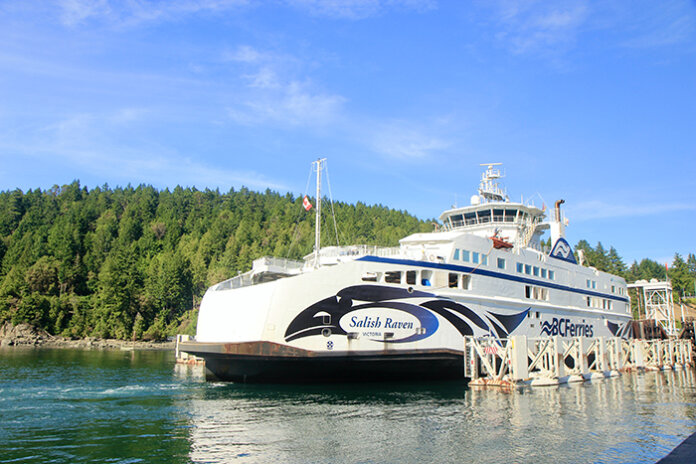
After an abrupt BC Ferries ban last summer — that for almost a year left about 1,000 vehicle owners on Salt Spring wondering how they’d get their electric and hybrid-electric cars or trucks off-island if they needed repair — the company has changed course.
BC Ferries announced Tuesday, May 5 that starting May 19 it would again welcome “immobile undamaged or cosmetically damaged electric vehicles” (EVs) to be towed aboard its fleet on regular routes, although the company said it would maintain its restrictions on more damaged EVs “where battery integrity cannot be confirmed.”
The policy represents another reinterpretation of federal Transportation of Dangerous Goods regulations in place since 2017, which BC Ferries cited last June in suddenly prohibiting all vehicles that used high-voltage batteries from boarding under anything but their own power — potentially stranding one in seven vehicles on Salt Spring Island alone, had they needed to be towed elsewhere for service.
“We understand the importance of this policy for ferry-dependent residents and EV owners,” said Darren Johnston, vice president of marine operations at BC Ferries. “Our revised policy recognizes the challenges they face while at the same time ensures that we comply with laws and regulations and continue to keep our focus on the safety of all our passengers and crew while travelling with BC Ferries.”
The corporation said in a press release the decision to again shift policy came after engagement with Transport Canada officials and “discussions with industry experts,” although what prompted the original policy change remains unclear. BC Ferries vessels must comply with Transport Canada’s safety guidance, and a Ship Safety Bulletin in 2024 noted EVs are “not more prone to fires than vehicles with an internal combustion engine,” although it recommended crews train specifically for fighting EV fires — which, the bulletin noted, can burn hotter and are more likely to re-ignite once extinguished.
BC Ferries posted updated materials on its website, including reference images illustrating cosmetic versus more serious damage and guidance for “improving the likelihood of successfully transporting immobile vehicles” — noting that each vessel’s captain retains “final discretion” to refuse transport.
“Where a damaged EV still contains its battery, ferry operators are responsible for determining whether its transport would pose a safety risk to passengers and crew,” according to the press release. “BC Ferries does not have the mandate or technical authority to inspect, remove or independently certify compromised EV batteries [and] BC Ferries crews are not trained to diagnose technical and complex issues with EVs.”
BC Ferries said there is currently no standardized inspection framework that ferry operators can rely upon to verify battery integrity for marine transport, and barring establishment of a “consistent, industry-recognized framework,” current restrictions will remain in place.
Local “institutional” EV users, such as Salt Spring’s Capital Regional District (CRD) and the Gulf Islands School District (SD64), will feel the same relief as those owning passenger vehicles; the CRD currently has several battery-electric and hybrid-electric vehicles in its fleet — along with an electric mower — and SD64’s five all-electric school buses, which represent nearly half its fleet across multiple islands, are largely under service contracts in Victoria and Vancouver for their high-voltage components.
Salt Spring EV enthusiast Jim Standen said he knew of fewer than five vehicles affected by the ban, none of which had been immobilized as the result of an accident; one was ultimately barged by the dealer back to Victoria for service, he added, and the rest had been waiting for the policy review — and are now eligible for a tow.
“There may be others I am unaware of, but I tend to be in the EV news rumour grapevine, so I think that is pretty close,” said Standen, who co-founded Salt Spring’s Electric Vehicle Group in 2014. “For sure, some potential EV purchases were shied away from because of the ban, [but] the new rules make good sense, and still prioritize passenger safety.”
Sufficiently damaged EVs or hybrids will still need to have their batteries removed before they can be transported by BC Ferries, according to the company, adding those batteries must be transported separately as a “dangerous good” in accordance with Transport Canada regulations.
The EV and/or the high-voltage battery is considered damaged or defective if:
• The vehicle has anything more than minor cosmetic damage
• There are signs that the vehicle has been submerged in water beyond the axle
• Leaking coolant or unknown fluids from the battery area
• Smoke, vapours or heat coming from the battery
• Exposed or frayed high voltage wiring
• White powder residue near battery components
• Any signs of fire damage or unusual odours
• The battery casing is cracked, punctured, or visibly damaged.
For details — and visual examples of BC Ferries’ standards of acceptable vehicle conditions — visit bcferries.com/travel-boarding/dangerous-goods/immobile-EVs.