
Tuesday, April 21, 2026
April 21, 2026
Home Blog Page 16

B.C. Seniors Advocate shares tips to tackle abuse

0

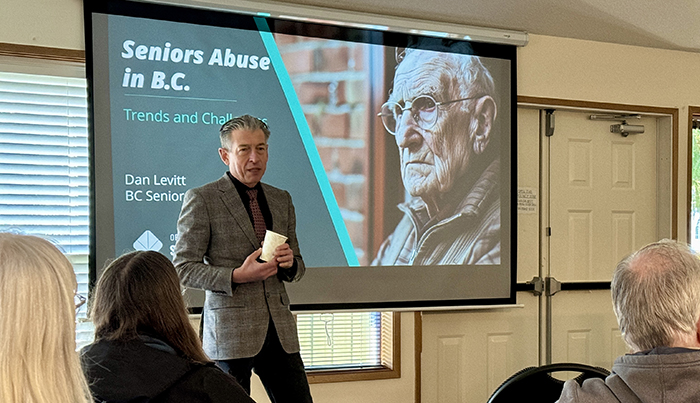
In the face of a marked uptick in incidents of scams and abuse, local seniors and caregivers last week heard they have ways to fight back — and that on Salt Spring, local government should be stepping up as the island’s demographics shift. 

About 30 people attended a discussion led by Dan Levitt at the Salt Spring Seniors Centre Tuesday, Jan. 20. Levitt heads the Office of the Seniors Advocate, an independent agency in the B.C. provincial government, which acts in the interest of seniors and their caregivers.

Levitt’s office monitors and analyzes seniors’ services and makes recommendations to government and service providers to address systemic issues. He gave a preview of an annual report on elder abuse being released later this year, and said given the aging population in B.C. — and indeed on Salt Spring Island — the trends are worrying.

“Over the past five years, we’ve seen 28 per cent more calls to the Senior Abuse Information Line,” said Levitt. “Victims of violent offences reported to the RCMP are up 18 per cent, financial abuse reported to the Vancouver Police Department is up 68 per cent; trends are going in the wrong direction.”

And much senior abuse goes unreported. Levitt said victims often feel ashamed, or worry reporting would make things worse. Friends and family can watch for signs of abuse — different behaviours, he said, like if someone seems more generally anxious or depressed, or physical signs things aren’t going as usual. 

“When I worked in care homes, we were always concerned about bruising — and that’s a tricky one, because many seniors are more likely to bruise because of a blood condition,” said Levitt. “But someone might have poor hygiene, dehydration or poor nutrition; they might be going through their medications faster than usual. Or they might seem more isolated, withdrawing from social situations.”

Levitt said that isolation was a technique perpetrators of financial abuse in particular use — trying to isolate a senior so the grift is less likely to be noticed. Things to watch out for include the appearance of new legal documents, like a will or power of attorney, or changes in banking.

“They could have less money available all of a sudden,” he said, “or suddenly be more reluctant to speak about their financial situation.”

The days of one-off, small-scale scammers seem to be over. At last Tuesday’s event, island social worker Ellie Parks said she and her colleagues see a perhaps surprising number of people on Salt Spring being swindled, with the cons having an increasing level of sophistication — and tempo.

“Now it is organized crime, thousands of people,” said Parks. “This is their job, all day long: to scam people. And it’s very sophisticated.”

Levitt agreed there were good habits to get into, like avoiding unknown phone numbers, or regularly checking banking statements for irregularities. Parks said anyone concerned about themselves or someone else should reach out to Island Health for support, particularly if that kind of “outside expert” advice might be more convincing than hearing it from a family member. 

“And if you meet someone new on social media, be very wary,” said Parks. “Particularly if they want you to go to another platform. Salt Spring is a place where we have a high degree of trust, because we have such a strong community — but you have to be more on your guard now.”

Local government has a role to play, Levitt said. He regularly encourages communities to develop a “seniors plan” — something which would be undertaken by entities like Salt Spring’s Local Community Commission or the broader Islands Trust — to map out future needs as the community’s population ages.

“If you had a seniors plan for Salt Spring, then you might be thinking about things like transportation services for seniors, how many long-term care beds do you need, how many retirement homes — and how do you organize that?” said Levitt. “It’s a bit of a vision, some things will take a long time to get, but it’s worthwhile getting that plan so you know where you are going.”

In addition to Island Health, Levitt said anyone concerned they or someone they know is a victim of abuse could reach out to Seniors First BC’s Seniors Abuse and Information Line (1-866-437-1940), local RCMP (250-537-5555) and the Seniors Advocate Line (1-877-952-3181).

For more information on services from the Seniors Advocate office, visit seniorsadvocatebc.ca.

TreeFrog Daycare needs post-flood support

0

TreeFrog Daycare in Fulford has filled a vital community role for more than three decades, facing its share of “character-building” challenges, including its most recent one last week.

Staff arrived at the centre on South Ridge Drive Tuesday, Jan. 20 to discover a flood caused by a faulty toilet fill valve and water shooting out of a toilet tank.

Danielle Taylor, chair of the Fulford Harbour Childcare Society (FHCS), which runs TreeFrog Daycare, said the plumber’s assessment was that the bizarre scenario couldn’t be duplicated, “even if you tried.”

The result was more than an inch of water on the bathroom floor by Tuesday morning, which leaked underneath the walls and into daycare coordinator Lisa Bleskie’s office.

“Immediate action was taken to get soaking wet carpet removed, dehumidifiers and fans in place, and the plumbing issue repaired, and we were able to contain the situation in a way that allowed us to continue to provide care for the children scheduled,” explains a funding request letter sent to the Salt Spring Lions Club.

Lions Club treasurer Sandy Harkema had seen Taylor’s social media post about TreeFrog’s plight and asked that a letter be delivered in time for the club’s Jan. 23 board meeting. Bleskie and board members were thrilled when Harkema told them the board approved a $7,000 donation for the society.

Between that money and funds donated to a GoFundMe campaign so far, the society can deal with remediation costs either directly or through paying the insurance deductible, said Taylor.

“So the immediate issue of the flood has been dealt with — aside from having to refloor the office and stuff like that — but it basically opened up a Pandora’s box that we didn’t know existed to way bigger issues.”

Those include a need to replace the building’s original poly-b pipes, which the society has been advised will cause problems in the foreseeable future.

The timing of the flood was particularly unfortunate as it was the first day of the daycare’s operation under a new multi-aged program licence that helped address a staffing shortage causing a facility closure in December 2021.

“We had a quite comfortable nest egg when we had to close for six months due to lack of staffing, right after Covid,” said Taylor, “but obviously we had to eat into that, and there wasn’t much left when we reopened our doors. And we’ve just slowly been rebuilding these last two years, and it’s just been really, really hard.”

Other financial challenges included damage from a washing machine malfunction, hot water tank replacement and a period of higher staffing costs before the multi-aged program licence was obtained.

TreeFrog provides daycare for more than 20 island children. Taylor, who was among the facility’s first cohort in 1994/1995 and whose three children have also attended, said the society has a solid business plan and TreeFrog is in no danger of closing, but any and all community support is appreciated to tackle building upgrades in plumbing and other areas.

“If there are any donations of material or time or labour that the public can offer to get us back on our feet, that would be huge,” said Taylor.

People can reach out to the daycare at treefrogdaycare@shaw.ca or 250-653-4998.

Contributions can also be made to the GoFundMe campaign.

Opinion: A Missed Opportunity for Leadership on Shoreline Protection

0

By ETHAN WILDING

In its decision last week, the Supreme Court of British Columbia dismissed a judicial review challenging the Islands Trust’s rejection of the Baker Beach nature-based shoreline protection proposal.

The implication is troubling: that professionally designed, peer-reviewed solutions — supported by both the province and Fisheries and Oceans Canada — are being treated as unacceptable responses to shoreline erosion in the Gulf Islands.  Yet shoreline loss continues, driven by climate change, and the responsibility to adapt accordingly has not disappeared. This leaves homeowners in an untenable position, even as the Islands Trust itself acknowledges that property owners must have access to feasible, science-based means of protecting their homes.

So how did we arrive at this point, where acknowledged needs and approved science lead nowhere? Quite simply, through a breakdown in fair and predictable process. Although the court dismissed our judicial petition, the decision itself is sharply critical of how the Islands Trust handled our application. The judge found the Trust’s process so problematic that he took the extraordinary step of denying them costs. This means the Trust must absorb its own legal expenses as a direct consequence of its mismanagement here.

It did not have to unfold this way. When we entered the Islands Trust development permit application process, we did so deliberately and in good faith. We sought early meetings, followed staff guidance, and invested heavily in professional advice and technical work. We did this not because we expected special treatment, but because we understood the system to be rules-based. The premise was simple: if you understand the bylaws, meet them, and do the work required, the process should be predictable.

That premise failed.

For much of the application period, there was no indication that our proposal was anything other than compliant. We coordinated parallel reviews with federal and provincial agencies, assuming that land-use confirmation by the Trust was a necessary first step and not a discretionary hurdle that could change without warning. At no point were we advised early on that the application was considered defective, or that policies applicable to the nature of the development permit would not be met.

Then, without any clear explanation, the ground moved. Criteria appeared to change. Standards were applied differently than before. Communication slowed, then stopped. We were left trying to understand how a project that aligned with the Trust’s own stated objectives could suddenly be deemed unacceptable, without a clear or consistent rationale.

The court took explicit note of this. Justice Milman found that the Islands Trust should have communicated and raised fundamental concerns at the outset, rather than allowing the process to unfold over many months without clarity. As he wrote:

“The petitioners should have been told early on that the [Islands Trust] considered the applications to be defective . . . After submitting the original application on Dec. 27, 2023, the petitioners had to wait until May 2025, nearly 18 months, for a decision that was forthcoming only after an application was made to this court to compel an answer.”

The concerns did not end there. Justice Milman went on to observe that even when a decision was finally issued, the Trust failed to address key issues directly:

“The record before me indicates that the [Islands Trust] failed at any stage to address important issues squarely, such as the claim for an exemption based on the DFO letter or the question of how the opinion expressed in that letter could be reconciled with the [Trust’s] own conclusions as to the anticipated impact of the project on fish habitat.”

That finding bears emphasis. Throughout the entire process, the Islands Trust never engaged with us to discuss how the proposal might be adapted to address concerns, despite repeated requests for dialogue. At no point were we given the opportunity to modify the project in response to objections or evolving issues expressed by members of the public. Instead, after 18 months, our first and only indication of any deficiencies with our application came in the form of an outright rejection. Core questions were left unresolved, conflicting evidence was not meaningfully reconciled, and we were left without clear explanations for how conclusions were reached. This is not a minor procedural flaw; it strikes at the heart of administrative fairness.

Justice Milman acknowledged the consequences of this failure, noting that “all of this made the process, including the court process, more costly for the petitioners than it should have been.”

But the true cost extends well beyond legal fees. Consider the broader resources consumed: multiple technical and environmental reports, coordination across federal and provincial agencies, staff time across multiple departments, and litigation that could have been avoided entirely with competent administration. All of this for a privately funded project proposing nature-based shoreline protection, aligned with the Islands Trust’s stated goals.

There was another cost as well: opportunity. The fact is that shoreline erosion is an ever-escalating challenge in the Gulf Islands. Our generation, and future generations, will need to contend with this reality. But rather than working with us to develop an appropriate, science-based response, the Islands Trust declined to engage this project outright, missing an opportunity to provide leadership at a moment when clarity is urgently needed. A collaborative process could have helped implement a region-appropriate shoreline protection measure, one that could be evaluated and applied responsibly across our island and beyond. Instead, what could have served as a constructive example of how climate adaptation and clear land-use governance can coexist became a case study in procedural breakdown.

The broader concern here is the risk this case poses for projects going forward. Under British Columbia’s Local Government Act, development permit processes are meant to be predictable when established guidelines are met. If staff positions can be reversed without explanation, if timelines extend well beyond what applicants are told to expect, and if bylaw compliance no longer offers predictability, then the message to the community is clear: proceed at your own risk. That discourages exactly the kind of careful, responsible and environmentally conscious projects that the Islands Trust says it wants to see.

If there is a constructive path forward, it lies in reforming the process itself. The Islands Trust must recommit to a genuinely rules-based system, one where concerns are raised early, standards are applied consistently and applicants can rely on published bylaws rather than shifting interpretations. Clear timelines, transparent reasoning and respect for jurisdictional boundaries are not optional extras; they are the foundation of credible land-use governance. Without those reforms, future applicants will face the same uncertainty and the Trust risks undermining both public confidence and its own policy objectives.

The writer and Salt Spring Island resident is one of three petitioners in a recently dismissed B.C. Supreme Court case against the Salt Spring Island Local Trust Committee.

Baker Beach petition against LTC dismissed

0

Chiding Salt Spring’s Local Trust Committee (LTC) about its process, a B.C. Supreme Court justice nonetheless dismissed a petition for review from three islanders owning waterfront property above Baker Beach, a ruling that shores up trustees’ authority over land use on the island — even if that land is covered by water.

In a decision issued Tuesday, Jan. 20, Justice Warren B. Milman rejected several grounds for review advanced by petitioners Ethan Wilding, David Demner and Heidi Kuhrt concerning the LTC’s decision not to issue a permit for a shoreline stabilization project at their high-bank waterfront homes. 

Among their arguments had been that the LTC overstepped its authority in crafting development permit areas (DPAs) to protect ocean fish habitat in Salt Spring’s official community plan, specifically the DPA-3 “Shoreline” area, which the petitioners said amounted to an improper attempt to regulate fisheries — and that the authority falls under federal rather than provincial jurisdiction.

Justice Milman disagreed, siding with the LTC’s submission that the Islands Trust’s DPAs regulate “land use and protection of the environment,” not fisheries — and that “land” subject to regulation under the Local Government Act “includes land covered by water, including intertidal waters” and “the surface of water.”

Further, Milman wrote that he found no basis to distinguish between the power to regulate the placement of structures on the water and the power to regulate the placement of sediments in the intertidal zone — referencing the proposed “beach nourishment” material central to the property owners’ “green shores” erosion protection plans.

“Both are within the purview of the local government’s authority to regulate land use,” wrote Milman, “including the use of land covered (permanently or intermittently) by the ocean.”

As the successful party, the LTC — and by extension, island taxpayers — would ordinarily be entitled to having the costs of legal proceedings covered by the other party. The judge, however, felt differently, noting several deficiencies and lengthy delays in the process, all of which he laid at the feet of the LTC.

“After submitting the original application on Dec. 27, 2023, the petitioners had to wait until May 2025, nearly 18 months, for a decision that was forthcoming only after an application was made to this court to compel an answer,” wrote Milman. “Even then, the record before me indicates that the [LTC] failed at any stage to address important issues squarely . . . All of this made the process, including the court process, more costly for the petitioners than it should have been.”

Reached for comment after the decision was issued, Wilding said he and his neighbours were considering their options moving forward. Since then Wilding has provided a written response. The Driftwood also reached out to Salt Spring Island LTC chair Tim Peterson, who was unable to comment before press time.

Commissioners punt on Baker Beach interpretive signs

0

Salt Spring’s Local Community Commission (LCC) is steering clear of an advocacy group’s proposal to place interpretive signage at an island beach that has become the centre of escalating land use litigation, voting to wait to act until the legal dispute over Baker Beach is resolved.

Back in September, local advocate Philip Grange had brought a proposal on behalf of the newly formed Concerned Citizens of Baker Beach, seeking to install an interpretive panel at the beach’s two access points — one near Quarry Drive and the other at the end of Baker Road. Each would show information about the flora and fauna of the beach, and would be built using grant funding — corralled by the interest group in partnership with Transition Salt Spring’s marine stewardship division, according to that delegation.

While the group insisted the signage would be “apolitical,” that delegation came days after news reports that several residents owning property above Baker Beach — homeowners Ethan Wilding, David Demner and Heidi Kuhrt — had petitioned B.C.’s Supreme Court for judicial review of the Salt Spring Island Local Trust Committee’s decision not to issue a permit for a shoreline stabilization project in front of their waterfront parcels. 

On Thursday commissioners agreed with staff that proceeding with the signage project before the court has ruled on that petition could be interpreted as taking a position in an active legal dispute — undermining expectations that public officials remain impartial during the legal process — and indicated they had no intention of wading into what has become a protracted conflict.

“There’s some stuff that needs to be resolved there,” said LCC member Brian Webster. “Information panels there are a good idea, but it doesn’t make sense for us to be acting until that happens.”

Staff said they had no sense of a timeline for the legal case to be resolved. After a hearing that spanned multiple days, a judge indicated only they would return with a decision at a later date. Wilding told the Driftwood last week he expected the decision would not be released for several weeks or even months.

Policy Statement session draws crowd

0

A standing-room-only crowd filled the Crofton Room at the Harbour House Hotel last Tuesday night to learn more about the Islands Trust Policy Statement (TPS) Amendment Project and give feedback. 

It followed a meeting held for the same purpose but attended by fewer people at Fulford Hall in December, and with similar dominant messages heard. 

Several of the 16 people speaking at the Harbour House on Jan. 13 felt the draft TPS did not give enough priority to environmental protection, with a few suggesting the updating process be halted now and passed on to a new set of trustees to be elected in October, in effect making it an election issue.

Phil Dearden observed the high level of interest signalled by the full house and said, “I don’t quite see the need to rush this before the elections, when there is something that’s so pivotal to the future. It might be wise to have this after the elections, because then that will have the democratic process endorsing this policy, rather than it being something already in the bag.”

Ronald Wright, of the Keep Salt Spring Sustainable group, agreed. He said the draft was an “extremely flawed document, which has enough loopholes in it to drive a developer’s bulldozer through” and should not be rushed to passage when a new Trust Council might have a different view.

Clare Frater, the Trust’s director of Trust Area Services, told the crowd it was ultimately council’s decision, but said “an awful lot of political, public energy has gone into this project, and I think there’s a desire to honour all of that work, because there’s some uncertainty after the election about what the priorities of a new council might be.”

Frater outlined how work to revise the 33-year-old TPS — the guiding document to which all Trust Area bylaws must be aligned — had been underway since 2019, and that attempts made before then had not gotten off the ground. An estimated $335,000 has been spent on the process since 2019, she told the Driftwood later. Frater stressed that trustees are listening to all the feedback being provided “and there is a desire to really honour what’s being heard and to run a good process that actually results in an outcome.”

Salt Spring trustee and Trust Council chair Laura Patrick said she welcomes the range of input being provided.

“If you find language that you think needs to be specifically changed, please, please give us those examples. That’s what I want to hear.”

Some speakers criticized the lack of definitions in the draft TPS, including for critical terms like “environment” and “unique amenities.”

Lawyer Jack Woodward said the Trust should have had a unique amenities list made 50 years ago, since that term was put into the original legislation creating the Islands Trust. 

“They should have been doing this. This is the hard work. This is the actual hard work of sitting down and saying, ‘what is it that’s unique and special about the islands?’ and putting that into words . . . We’re not talking about homogenizing things. We’re talking about identifying and preserving and protecting the uniqueness.”

“This has been a topic since day one,” said Frater, “so we welcome continued dialogue about the meaning of ‘amenities.’”

Speaker Mary Richardson pointed out that the current TPS iteration actually talks about amenities and the history and rationale for the Islands Trust in its first few pages, and suggested something similar be included in the 2026 version.

Regarding the “environment” definition, Patrick said Trust staff were seeking a published definition that will be included, but confirmed “trustees are thinking ‘natural environment.’” Patrick also said trustees had asked for a handbook to be created to accompany the document, and stressed that it was important to read the document as a whole.

Elizabeth White was one speaker who had read the document and also felt it lacked legally enforceable policies in areas such as affordable housing and environmental protection. 

“The TPS draft, in its present form, in my view, is toothless and inadequate and unfit for purpose,” she said. “I’m sorry to have to say that. I do think it can be fixed. I don’t know whether its fixing would result in a document that would be approved by Trust Council.”

Bryan Young of Transition Salt Spring (TSS) said his group felt the draft was “a thoughtful balance between protecting what makes the islands unique while allowing trustees to respond to local needs in the context of the mandate,” and applauded its inclusion of Indigenous rights. TSS felt the document falls short in areas of forest and freshwater protection, and growth management.

He summarized the TSS position by saying “building the right housing in the right places is not in opposition to Indigenous rights, food security, forests, water and climate resilience. They are one and must be treated together.”

Some people asked why Salt Spring’s official community plan (OCP) update was being done at the same time, when the TPS is a guiding document for all Trust islands’ OCPs.

Patrick responded that the OCP project will not be completed before the end of the term this fall, so the next Local Trust Committee will be in charge of completing the process.

The draft TPS, more information and a survey are available through islandstrust.bc.ca/programs/islands-2050/ or local Trust offices. The survey deadline is Feb. 2. 

The TPS will next be considered by Trust Council members at their  March 10-12 meeting.

BCF waves off local traffic boarding priority

1

BC Ferries has released a “what we heard” report summarizing the company’s Salt Spring Island engagement for the Crofton and Vesuvius terminal upgrade projects — a 90-minute event with a dozen participants.

And despite assertions the Dec. 2 session at Harbour House was an opportunity for the ferry company to inform the public of its plans, that handful of islanders clearly came with the idea they would be heard as well. 

From 12 participants, according to BC Ferries, “key themes” included homeporting concerns — plans to keep both of what will soon be two vessels overnight on the Crofton side, a change that has met with strong opposition from the community — as well as worries the ferry company was insufficiently prioritizing local traffic over tourism. 

BC Ferries said there were questions “outside of the project scope” of the engagement session, and so provided “consolidated” responses Thursday, Jan. 16, which were emailed to the 64 people currently subscribed to the project’s occasional newsletter. 

Ridership data show the ferry company carried 309,708 passengers and 180,912 vehicles on the Crofton-Vesuvius route last year.

On the issue of prioritization, the ferry company said its system is not designed to screen passengers based on where they live or their reason for travel, and that as a publicly funded part of B.C.’s transportation system it strives to serve “broad public interest” and meet the needs of all travellers.

“Prioritizing residents or certain types of travel could improve service for some users, but it would reduce access for others,” according to the engagement summary report response. “Tourism operators and business owners have raised concerns that limiting visitor access could negatively affect local economies and people travelling to see family and friends.”

BC Ferries has neither enumerated that feedback, nor said from what businesses — or from what part of its service area — those concerns were raised. 

Along with its responses, BC Ferries included several paragraphs explaining the intended nature of the engagement session, which it said was framed around the IAP2 Spectrum of Public Participation’s “inform” level; IAP2 is a professional organization that accredits and trains engagement facilitators. The “inform” level of engagement, according to that organization, has the least impact on a decision being made within the spectrum.

The ferry company said it expects construction to begin mid-2026 and be completed by early 2027. 

For updates  visit bcferriesprojects.ca.

Editorial: Work with the draft

1

Please — let’s not have déjà vu all over again. 

Hearing calls for the seven-year Trust Policy Statement (TPS) process to be halted at this point is enough to make otherwise sane islanders jump overboard from the Salish Eagle in Active Pass. 

It’s ridiculously easy to declare that work should be put on hold until the October elections are over. That is indirectly what ended up happening more than four years ago during the last electoral term because of vociferous opposition to a first-draft TPS released in 2021 after two years of intense work and public participation. 

Trying to create a new TPS has cost us an estimated $335,000 since 2019. One TPS baby has already been thrown out with the bathwater; making it two could lead to three if the public doesn’t endorse what the next batch of elected trustees comes up with. The TPS and its implementation can still be an election issue, and candidates will likely identify themselves as being for it or against it, but there is no need for the brakes to be applied at this late date. The mandate given to current trustees to get the job done should not be disregarded.

It’s not that the draft TPS doesn’t need more work. It clearly does. The public’s sense that its growth limit and environmental protection language isn’t strong enough is justified. Environment-related statements in some other sections are bang on, but the lack of an overarching committed statement not connected to Indigenous cultural protection is a flaw. Many people have made excellent suggestions for improvement that should lead to a stronger and more coherent next draft, along with, just as importantly, input from Indigenous governing bodies, various government agencies and the Ministry of Housing and Municipal Affairs (MHMA), whose sign-off is needed on the document. 

Something that Trust senior policy advisor Jason Youmans casually mentioned at the Salt Spring TPS meeting last week was that the Islands Trust Act contains no provision for public consultation in crafting of the TPS. He stressed that it should be undertaken, and we agree, but we also believe that consensus is likely not possible when it comes to the task at hand. It’s now up to the trustees and staff to seriously consider what they’ve heard from the public and come back with a better, more publicly supportable draft that will also get MHMA approval. 

We can’t wait to see it.

Viewpoint: Mandate non-negotiable

0

By ROB BOTTERELL

MLA, Saanich North and the Islands

At an Islands Trust information meeting on Jan. 13, I joined over 100 Salt Spring Islanders to hear presentations on the draft Islands Trust Policy Statement (TPS). It was a good night for democracy. The wisdom, insights, expertise and experience of those who spoke out were inspiring. 

Speakers identified numerous changes needed to bring the draft TPS into compliance with the Trust’s “preserve and protect” mandate, while at the same time addressing affordable housing needs on the islands. Many asked that terms like “preserving and protecting,” “unique amenities of the Trust Area” — and the word “environment” itself — be clearly defined. They objected to loose language in the proposed TPS like “consider,” “suitable” locations for housing, and enforcement “where possible,” and asked that the new term “attainable” housing be replaced with the legally binding term “affordable,” with guarantees it stays affordable. 

Public engagement on the draft TPS is expected to wrap up shortly. Every indication is that the Islands Trust Council plans to fast track their approval with the firm goal of Housing and Municipal Affairs Minister Christine Boyle signing off on the new TPS before the October Trust elections. There is no justification to do so. Everyone throughout the Trust Area must have sufficient time to see, review and confirm whether or not the finalized TPS has their confidence. So far that is nowhere near the case.

My message to the Islands Trust Council is: proceed at your own peril. Why? Because the B.C. government has been very clear that the Islands Trust “preserve and protect” mandate is not up for negotiation, re-interpretation or watering down. Two examples:

First, in November 2023, Salt Spring’s Local Trust Committee, including now- Trust chair Laura Patrick, requested the province treat Salt Spring as a municipality for the purposes of Bill 44 (the Housing Statutes Amendment Act, 2023). That would have unleashed development of the type currently challenging mainland municipalities without, in addition, considering the carrying capacity of island ecosystems. The minister who then oversaw the Islands Trust refused, stating that he did so “. . . because of the Trust’s special mandate to preserve and protect the Trust Area and its unique amenities and environment . . . .” 

Secondly, in an April 2025 letter, then- Minister of Housing and Municipal Affairs Ravi Kahlon reiterated the Islands Trust special mandate, writing that “land use planning to preserve and protect the Trust area . . . is the core responsibility of Islands Trust.” He added, “The development of the next iteration [of the TPS] requires care to result in a Policy Statement in which all involved can all have confidence.”

There is no justification for rushing to put this new TPS in front of the minister to sign before this fall’s elections. Doing so would flout democracy, destroy confidence and could trigger litigation. 

People moving to Salt Spring take up a trust to preserve and protect one of the most special natural environments on Earth. For those seeking urban amenities and growth, Salt Spring is the wrong place to live. Put simply, the preservation and protection of the Trust Area is non-negotiable. 

Concert, film, workshop form unique experience

BY MEGAN WARREN

FOR ARTSPRING

ArtSpring is set to host a profound immersive experience this month, welcoming multi-hyphenate extraordinaire Corey Payette for a weekend of film, music and ancestral exploration.

This film and music visionary of Oji-Cree, Franco-Ontarian and Irish descent, who has performed everywhere from Carnegie Hall to the National Arts Centre, centres Indigenous voices in a theatre of song that challenges historical narratives and gives a voice to those whose stories have not been told.

The residency begins Friday, Jan. 30, with actor-writer-director Julie McIsaac’s workshop called Theatre Devising with Memory and Ancestry and a screening of the award-winning musical film Les Filles du Roi. Co-written by Payette and McIsaac, the film offers a feminist and Indigenous exploration of the King’s Daughters’ arrival in 1665 New France. Originally a stage musical that had its national tour halted by the pandemic, the cinematic adaptation has since become a festival favourite.

Told in a rich linguistic tapestry of English, French and Kanien’kéha, the story follows Mohawk siblings Kateri and Jean-Baptiste as their lives intersect with Marie-Jeanne, one of the filles-du-roi sent from France to populate the colony. For McIsaac, who also stars as Marie-Jeanne, the project was born from a desire to fill gaps in the historical record. She notes that while women’s perspectives were often ignored, Indigenous narratives were missing entirely.

“What was happening on the land, and what were the perspectives and experiences of the Indigenous folks who were in that same area when all of these young women were getting shipped over?” she asked. 

In her workshop, McIsaac draws on her own discovery that she is a descendant of a fille-du-roi, and invites artists of all disciplines — from writers and actors to dancers and singers — to use their own lineages as a creative springboard. 

“My own experience discovering things about my family by virtue of doing a creative project that maybe I wouldn’t have discovered otherwise, and  having the opportunity to do exercises through my own creative work where I’ve felt a sense of kinship and connection with a sense of heritage or ancestry — I found it to be really beautiful and empowering. I’m hoping to spark something for other folks.”

Through guided visualizations, timed writing and other exercises, participants will explore what stories their ancestors might “whisper in their ear” if given the chance to guide their artistic output.

“I sometimes think,” McIsaac said, “if your great-great-great-grandmother knew that you were sitting down to write a story or choreograph a dance or create visual art, what might she want you to create?”

Each participant in the program will work toward creating and sharing a few minutes of material by the end of the workshop, but McIsaac emphasizes that sharing is not essential if that is outside a participant’s comfort level. 

For McIsaac, Les Filles du Roi is “like nothing you’ve ever seen before.” Its sharp focus on cultural and linguistic intersections complicates the typical narrative of Canadian colonization with richly written relationships between people from different worlds. 

“[Corey and I] both grew up in families and communities where the community was not all one thing,” said McIsaac. “You’ve got folks from different cultural backgrounds, and there are multiple languages being spoken in the household. I think a lot of Canadians have that experience. In fact, we all contain these multitudes, and we wanted a film that spoke to that. Seeing the characters grapple with collisions between different worldviews and different languages, we think, is really exciting.”

McIsaac’s ancestry played a definite role in shaping Les Filles du Roi’s focus on feminine community. 

“I look back at the work that we’ve created, and I think about the great matriarchy that I’m a part of with my mother and all her sisters and my grandmother,” she said. “When I was growing up, the idea of women supporting each other and female friendship was so central to what made me who I am, and I feel that that’s reflected in the piece tenfold.

“When I think about what the [filles-du-roi] might have experienced at that time, at least from the European perspective, I think it could have been tremendously isolating for them to leave everything and everyone they knew and to come to this place that was very strange and potentially harsh. The idea that they might have had opportunities to connect and share their fears and hopes is quite beautiful to me.”

The residency culminates on Saturday, Jan. 31 with Closest Thing to Home, an extraordinary live concert. This performance features selections from Payette’s acclaimed musicals, including Children of God, Sedna, Starwalker and a preview of his upcoming musical On Native Land. Accompanied by a chamber orchestra and local choirs, Payette and a cast of special guests will weave a powerful evening of music centred on resilience and the search for belonging.

This weekend is more than a showcase of talent; it is an invitation to witness a cultural reckoning and to refocus the founding stories of our country through the lens of those who have been excluded for generations. Whether you are an artist looking to unlock ancestral stories or are seeking a transformative cinematic and musical experience, this residency promises to be a highlight of the season.