
Wednesday, April 22, 2026
April 22, 2026
Home Blog Page 17

Viewpoint: Mandate non-negotiable

0

By ROB BOTTERELL

MLA, Saanich North and the Islands

At an Islands Trust information meeting on Jan. 13, I joined over 100 Salt Spring Islanders to hear presentations on the draft Islands Trust Policy Statement (TPS). It was a good night for democracy. The wisdom, insights, expertise and experience of those who spoke out were inspiring. 

Speakers identified numerous changes needed to bring the draft TPS into compliance with the Trust’s “preserve and protect” mandate, while at the same time addressing affordable housing needs on the islands. Many asked that terms like “preserving and protecting,” “unique amenities of the Trust Area” — and the word “environment” itself — be clearly defined. They objected to loose language in the proposed TPS like “consider,” “suitable” locations for housing, and enforcement “where possible,” and asked that the new term “attainable” housing be replaced with the legally binding term “affordable,” with guarantees it stays affordable. 

Public engagement on the draft TPS is expected to wrap up shortly. Every indication is that the Islands Trust Council plans to fast track their approval with the firm goal of Housing and Municipal Affairs Minister Christine Boyle signing off on the new TPS before the October Trust elections. There is no justification to do so. Everyone throughout the Trust Area must have sufficient time to see, review and confirm whether or not the finalized TPS has their confidence. So far that is nowhere near the case.

My message to the Islands Trust Council is: proceed at your own peril. Why? Because the B.C. government has been very clear that the Islands Trust “preserve and protect” mandate is not up for negotiation, re-interpretation or watering down. Two examples:

First, in November 2023, Salt Spring’s Local Trust Committee, including now- Trust chair Laura Patrick, requested the province treat Salt Spring as a municipality for the purposes of Bill 44 (the Housing Statutes Amendment Act, 2023). That would have unleashed development of the type currently challenging mainland municipalities without, in addition, considering the carrying capacity of island ecosystems. The minister who then oversaw the Islands Trust refused, stating that he did so “. . . because of the Trust’s special mandate to preserve and protect the Trust Area and its unique amenities and environment . . . .” 

Secondly, in an April 2025 letter, then- Minister of Housing and Municipal Affairs Ravi Kahlon reiterated the Islands Trust special mandate, writing that “land use planning to preserve and protect the Trust area . . . is the core responsibility of Islands Trust.” He added, “The development of the next iteration [of the TPS] requires care to result in a Policy Statement in which all involved can all have confidence.”

There is no justification for rushing to put this new TPS in front of the minister to sign before this fall’s elections. Doing so would flout democracy, destroy confidence and could trigger litigation. 

People moving to Salt Spring take up a trust to preserve and protect one of the most special natural environments on Earth. For those seeking urban amenities and growth, Salt Spring is the wrong place to live. Put simply, the preservation and protection of the Trust Area is non-negotiable. 

Concert, film, workshop form unique experience

BY MEGAN WARREN

FOR ARTSPRING

ArtSpring is set to host a profound immersive experience this month, welcoming multi-hyphenate extraordinaire Corey Payette for a weekend of film, music and ancestral exploration.

This film and music visionary of Oji-Cree, Franco-Ontarian and Irish descent, who has performed everywhere from Carnegie Hall to the National Arts Centre, centres Indigenous voices in a theatre of song that challenges historical narratives and gives a voice to those whose stories have not been told.

The residency begins Friday, Jan. 30, with actor-writer-director Julie McIsaac’s workshop called Theatre Devising with Memory and Ancestry and a screening of the award-winning musical film Les Filles du Roi. Co-written by Payette and McIsaac, the film offers a feminist and Indigenous exploration of the King’s Daughters’ arrival in 1665 New France. Originally a stage musical that had its national tour halted by the pandemic, the cinematic adaptation has since become a festival favourite.

Told in a rich linguistic tapestry of English, French and Kanien’kéha, the story follows Mohawk siblings Kateri and Jean-Baptiste as their lives intersect with Marie-Jeanne, one of the filles-du-roi sent from France to populate the colony. For McIsaac, who also stars as Marie-Jeanne, the project was born from a desire to fill gaps in the historical record. She notes that while women’s perspectives were often ignored, Indigenous narratives were missing entirely.

“What was happening on the land, and what were the perspectives and experiences of the Indigenous folks who were in that same area when all of these young women were getting shipped over?” she asked. 

In her workshop, McIsaac draws on her own discovery that she is a descendant of a fille-du-roi, and invites artists of all disciplines — from writers and actors to dancers and singers — to use their own lineages as a creative springboard. 

“My own experience discovering things about my family by virtue of doing a creative project that maybe I wouldn’t have discovered otherwise, and  having the opportunity to do exercises through my own creative work where I’ve felt a sense of kinship and connection with a sense of heritage or ancestry — I found it to be really beautiful and empowering. I’m hoping to spark something for other folks.”

Through guided visualizations, timed writing and other exercises, participants will explore what stories their ancestors might “whisper in their ear” if given the chance to guide their artistic output.

“I sometimes think,” McIsaac said, “if your great-great-great-grandmother knew that you were sitting down to write a story or choreograph a dance or create visual art, what might she want you to create?”

Each participant in the program will work toward creating and sharing a few minutes of material by the end of the workshop, but McIsaac emphasizes that sharing is not essential if that is outside a participant’s comfort level. 

For McIsaac, Les Filles du Roi is “like nothing you’ve ever seen before.” Its sharp focus on cultural and linguistic intersections complicates the typical narrative of Canadian colonization with richly written relationships between people from different worlds. 

“[Corey and I] both grew up in families and communities where the community was not all one thing,” said McIsaac. “You’ve got folks from different cultural backgrounds, and there are multiple languages being spoken in the household. I think a lot of Canadians have that experience. In fact, we all contain these multitudes, and we wanted a film that spoke to that. Seeing the characters grapple with collisions between different worldviews and different languages, we think, is really exciting.”

McIsaac’s ancestry played a definite role in shaping Les Filles du Roi’s focus on feminine community. 

“I look back at the work that we’ve created, and I think about the great matriarchy that I’m a part of with my mother and all her sisters and my grandmother,” she said. “When I was growing up, the idea of women supporting each other and female friendship was so central to what made me who I am, and I feel that that’s reflected in the piece tenfold.

“When I think about what the [filles-du-roi] might have experienced at that time, at least from the European perspective, I think it could have been tremendously isolating for them to leave everything and everyone they knew and to come to this place that was very strange and potentially harsh. The idea that they might have had opportunities to connect and share their fears and hopes is quite beautiful to me.”

The residency culminates on Saturday, Jan. 31 with Closest Thing to Home, an extraordinary live concert. This performance features selections from Payette’s acclaimed musicals, including Children of God, Sedna, Starwalker and a preview of his upcoming musical On Native Land. Accompanied by a chamber orchestra and local choirs, Payette and a cast of special guests will weave a powerful evening of music centred on resilience and the search for belonging.

This weekend is more than a showcase of talent; it is an invitation to witness a cultural reckoning and to refocus the founding stories of our country through the lens of those who have been excluded for generations. Whether you are an artist looking to unlock ancestral stories or are seeking a transformative cinematic and musical experience, this residency promises to be a highlight of the season.

Island volunteer series makes debut

0

This week marks the first instalment of the Driftwood’s Stepping Up focus on island volunteers and groups who need more of them. 

So many not-for-profit groups on Salt Spring Island are short of helping hands to keep their programs and services running, and we’d like to make it a little easier for groups and potential volunteers to find each other.

A casual call for interest in my Dec. 31, 2025 Viewpoint column resulted in a field of raised hands from leaders of groups who said they needed volunteers and wanted to participate. The hope is that by meeting a current volunteer through short articles or Q&As and learning about types of positions available, readers might be motivated to check out volunteering opportunities that sound right for them.

This week we meet Salt Spring Trail and Nature Club president Carron Carson and Robyn Huntley of Salt Spring Literacy’s One to One Reading Program.

If your group would like to participate in upcoming Stepping Up columns, just send an email message to news@gulfislandsdriftwood.com or phone me at 250-537-9933.

Salt Spring Trail and Nature Club 

The island’s trail and nature club was set up many years ago to stimulate interest in hiking and related outdoor activities and natural history, and to study flora and fauna in their natural habitats. The club runs weekly hikes, walks and rambles from September to June in addition to special events of interest. It is one of 55 clubs in the province that belong to BC Nature. 

If you want to get involved with the club, send an email to president Carron Carson at cjcarson44@gmail.com. 

Meet SSTNC volunteer Carron Carson! 

At the end of January, I will be finishing my fourth year in the volunteer position as Salt Spring Trail and Nature Club president. 

I have been a member of the club since 2015 when I retired from my full-time job and was anxious to get out and enjoy nature. When I had been a member for about a year, I felt comfortable enough to offer to lead one or two hikes or walks. I had not had any previous experience on the club’s executive when asked to become the president.  Because the other club members and executive were so supportive and encouraging, I undertook the new position. I am pleased to report that over my tenure I have become far more confident in leading a group as well as in public speaking.

My job as president, which involves approximately three to four hours a week, is to lead the executive committee and oversee the actions of the club in general. I am the first contact for potential new members and a liaison between BC Nature and Gulf Island Trails. 

I highly recommend this kind of a volunteer role for anyone wanting to combine great outdoor experiences with socializing with other like-minded islanders. There are currently executive board positions available as well as a need for leaders  for hikes, walks and rambles.

Salt Spring Literacy’s One to One Reading Program

Salt Spring Literacy’s One to One Reading is a unique program that provides one-to-one tutoring to primary and intermediate children in elementary schools during regular school hours. Trained volunteers work with children who are selected by their teachers for extra reading practice. Typically, each student spends approximately 30 minutes two to three times a week with a volunteer tutor. One to One provides these children with an opportunity to practise their reading in an environment where it is OK to take risks, make mistakes and learn at their own pace. 

New people are urgently needed to fill in for regular volunteers who are away for parts of the winter and early spring season. For more information, email Salt Spring Literacy children’s program coordinator Keiko Taylor at childrensprograms@saltspringliteracy.org or phone the Salt Spring Literacy office at 250-537-9717. 

Meet One to One Reading Program volunteer Robyn Huntley! 

Q. How long have you been volunteering with the One to One Reading Program?

A. Three years.

Q. What attracted you to this particular group?

A. I’ve lived on Salt Spring for 45 years. I worked in the elementary schools for almost 30 of those years and was familiar with the program so when I had the opportunity to be a volunteer, I was happy to join.

Q. What role do you have now and what other roles have you had?

A. I started out working with individual students and assisting them with their reading skills, but the past two years I have also been a coordinator for the Fernwood One to One Reading volunteers, relaying information and supporting the volunteers with any queries or concerns they may have.

Q. What do you like best about volunteering with the One to One Reading Program?

A. Being part of a lively, dynamic group of children and adults all working towards a similar goal.

Q. What is a challenge you’ve managed to overcome?

A. Encouraging students to read and play literacy games can come with its challenges, but the program provides training and experience as well as lots of materials to help make this possible.

Q. Is there an anecdote or memory you have that epitomizes the volunteer experience for you?

A. There are many moments of joy and feelings of accomplishment. One memory that sticks with me is the surprise and excitement in a young boy’s face when he realized he had read through a book he hadn’t been able to read before. This is just one of many happy and fulfilling experiences I have had working with this program.

Q. In a nutshell, why would you recommend volunteering with the One to One Reading Program?

A. I have met many interesting and talented adults and children who are a part of this program and I look forward to my volunteer day each week. I highly recommend becoming a volunteer for the One to One Reading Program. 

VAN PELT, Amos Jr.

1

February 27, 1947 – December 24, 2025

Amos Van Pelt Jr., 78, of Salt Spring Island, passed away peacefully at home on December 24, 2025.

A man of diverse talents and a generous heart, Amos was a former CFL running back for the Winnipeg Blue Bombers before making Salt Spring Island his home in 1995. For many years, he was a familiar and supportive face in the local school system, where he dedicated himself to helping children with special needs and learning difficulties.

Amos was a devoted father. He poured his heart into the care of his daughter, Naomi, providing her with a life of love and safety.

Away from work, Amos found peace in his garden and joy in the quiet pursuits of writing and reading. He was also a passionate collector and admirer of African art.

Amos is survived by his children: Melba (Kelly), Ezekiel (Crystal), Tanisha (Harry), and Naomi; and his beloved grandchildren: Tiahna, Xavier, Indio, and Radley. He also leaves behind his exwife and lifelong friend, Joanne; his sister, Velvet Brooks; his brothers, Charles, Kenneth, and Christopher Van Pelt; and a large circle of nieces, nephews and friends.

A Celebration of Life will be announced at a later date.

Fitness after 60: taking the first step pays off

0

I’m sure I heard warnings about what would happen to my body after I turned 60, but like any such grim predictions, it didn’t mean anything until it did.

At some point that year I noticed a vague reluctance to tackle physical activities on my chore-demanding property. My body suddenly seemed concerned that whatever I was contemplating — hauling wood, pruning fruit trees, cleaning out ditches — could be difficult, possibly unpleasant and likely painful. It seemed true that right on schedule I was losing muscle mass, strength and endurance. And was the “tweaky” knee I attributed to a long-ago skiing mishap getting worse too?

It’s not that I had been a sedentary person. I had enjoyed a fun movement practice called Nia for years, liked hiking on occasion, walked a challenging circuit with a friend every so often and in the distant past went to the gym and did Jazzercise. But I couldn’t escape the fact that I was getting noticeably weaker and less able. For me that jeopardized my ability to remain on my property.

Having gone to Ganges Fitness (then North End Fitness) decades earlier, I wondered if I could do it again. I went up the stairs one day in November of 2023 and checked it out, comforted by the relative familiarity, the atmosphere and the flexible price/pass options. A few days later I told a friend at Salt Spring Coffee Co. that I was thinking about trying the gym again. She offered to join me and we beetled across the street to Ganges Fitness, completed the paperwork and bought a 10-session pass. If I ended up hating it then it wouldn’t cost much to find out.

But the opposite occurred. I loved it and made a goal (not always achieved) of working out as early as possible three mornings a week. I’ve not taken the time to learn how to use free weights, but the weight machines work for me. As for cardio, I found the treadmill a super comfortable way to get my heart rate up and strengthen my lower body. In my 30s I would have found that terribly boring (and always used a bike and a stair climber then), but I plug into a CBC Ideas podcast for 35 or 40 minutes and the time just flies as I gradually up the speed on the treadmill. I cool down to the same Waxahatchee song every time. Don’t ask why. It just makes me feel happy. It’s a bonus when fellow earlybird Fiona is on the treadmill next to me and we can catch up on our news. Then I do some stretching before I leave, feeling like I could conquer the world if I had to.

For a variety of reasons I didn’t commit to an annual membership until last fall when Ganges Fitness instituted much-appreciated after-hours access — I use the phone app option that’s been flawless for me — but whenever I have to take a break from regular attendance it doesn’t take much to get back on track.

I don’t recall when I noticed how much easier it was to walk up my steep driveway or carry groceries, wood or anything up the path to my house, or how much longer I could do any number of chores before “feeling it.” Or when the pain in my right knee disappeared. But I know it’s for real and all due to walking up the stairs to Ganges Fitness that day in November of 2023.

It wouldn’t be reasonable to say, “If I can do it, you can do it.” But if you have no serious health issues and want to regain or develop your strength and stamina, I encourage you to explore local options for fitness, take the first step and see what happens.

Tips for Over-60 Fitness

• Go slow. Listen to your body. There’s no point injuring yourself right off the bat (or ever).

• Don’t worry about making a fashion statement. No one is judging you at your age. Get comfortable workout clothes and shoes.

• Find a friend to work out with, if possible; at least to help motivate you at the start.

• In addition to gym facilities, personal trainers and the Rainbow Road pool, Salt Spring has several fitness, dance and movement programs and instructors. Check out the options in the Parks and Recreation Leisure Guide that’s published three times a year. The latest issue covers the January through March period and can be found at various spots around town, at the Driftwood office or on our website.

New submarine cable to improve islands’ hydro connection

0

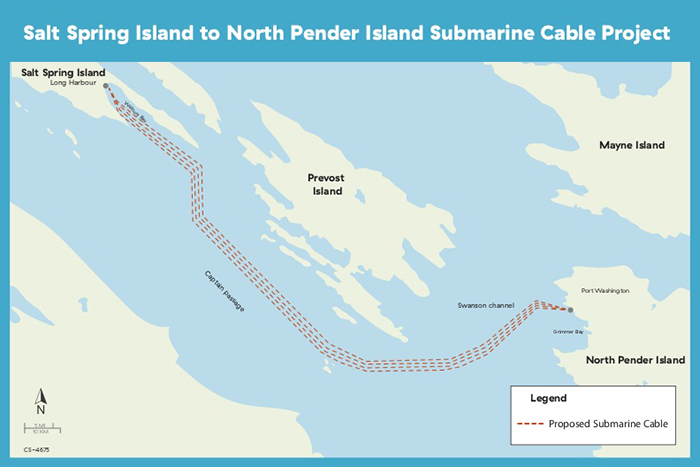
Work will begin this spring on overhead power line upgrades that will support a new underwater cable connecting Salt Spring and North Pender Island, expected to go live in September.

BC Hydro confirmed this week the project was going forward, with plans for 11 kilometres of cable between Welbury Bay and Port Washington placed along the sandy parts of the ocean floor in Captain Passage and Swanson Channel.

The new cable is meant to improve flexibility and reliability in electrical service for Salt Spring, Pender, Saturna, Mayne and Galiano islands, according to the utility, as well as provide infrastructure for future growth.

BC Hydro said the on-land upgrades on Salt Spring and Pender are expected to begin early this year, although exact timing is still to be confirmed; the submarine cable installation is planned for this summer. The route was designed to avoid rock outcrop, according to Transport Canada, who has said it expects the installation, once begun, will take approximately six days.

The project has been planned since 2022, although engineering and environmental studies weren’t completed until last year — alongside some civil construction on both islands, according to BC Hydro. 

The Welbury Bay project will likely run ahead of a submarine cable realignment, replacing the current connection between Beaver Point on Salt Spring and Irene Bay on North Pender with a new line running instead to Thieves Bay on North Pender. That change is meant to bring power closer to the area of highest use on North Pender, according to BC Hydro, and is expected to be complete in either summer 2027 or 2028.

Crews readying for winter shutdown at Cusheon Creek project

0

Two-way traffic across Salt Spring Island’s newest bridge will have to wait a few more weeks, according to officials, while crews complete final safety and embankment work ahead of a planned winter construction shutdown.

Temporary traffic signals — still the island’s only traffic lights — will likely remain in operation until the end of January at the site for the new Cusheon Creek Bridge, according to the Ministry of Transportation and Transit, when they will be removed and two-way traffic will be restored until work starts back up in the spring.

That springtime effort will include final landscaping and paving on the bridge deck and approaches and will be completed as soon as weather conditions permit, according to the ministry, adding that the public would be kept up-to-date in advance of crews’ return or if any traffic changes are required. 

Meanwhile, the new bridge itself is in place, and initial paving has been completed on the bridge approaches. The project, on Fulford-Ganges Road between Horel and Cusheon Lake Roads, was planned largely in response to the 2021 atmospheric river event that flooded Fulford-Ganges Road at Cusheon Creek; traffic there was fully halted for several days, with the road shoulder completely washed out.

The creek runs from Blackburn Lake to Cusheon Lake. A 2023 report from the ministry’s project manager noted the next “significant weather event” there could result in a complete failure of the road. That stretch of Fulford-Ganges Road sees significant vehicle traffic; a ministry study in 2023 counted an average of more than 4,300 vehicles passing the project area every day.

The bridge design was approved by Fisheries and Oceans Canada and provides improved fish passage, restoring a “more natural stream environment,” according to planning documents –– and should better balance water levels between Blackburn and Cusheon lakes during extreme weather events.

For updates visit gov.bc.ca/saltspringislandprojects.

Southern Gulf Islands Tourism Partnership Society looks back and to the future

0

The Southern Gulf Islands Tourism Partnership Society (SGITP) has operated for several years, but raised its profile in the last year with the release of the Short-term Rentals Impacts Report for Salt Spring Island. We asked the society’s executive director Jamie Sterling to answer a few questions in order to share more information about the organization and its role in the Southern Gulf Islands.

Jamie Sterling, executive director of the Southern Gulf Islands Tourism Partnership Society.

Q. When and why was SGITP created?

A. SGITP began operating in late 2019. It was born out of the “Experience the Gulf Islands” Proposal (2014) and subsequent Concept Plan (2016). These were led jointly by the Salt Spring and Southern Gulf Islands economic development commissions with the support of many volunteers across all five islands. The intentions were to advance community tourism planning, improve the social and environmental outcomes of tourism, and to improve inter-island mobility.

Q. What does the society do now? How is it funded?

A. Now, SGITP is actioning on those goals by promoting seasonal and geographic dispersion and responsible visitor behaviour. We only market the shoulder- and off-seasons, and in the summer we focus on visitor education. The rationale is to both provide more sustainable, year-round economic activity for businesses and to reduce the strains of summer overcrowding, ultimately working towards a regenerative visitor economy that gives back to our communities more than it takes. We operate from the standpoint that tourism should improve the quality of life for everyone in a community.

We’re funded by the Municipal Regional District Tax (MRDT), a two per cent tax on all visitor accommodations, including short-term rentals. So it’s visitors that provide our funding, not local businesses or residents. In order to be eligible for the MRDT program, however, the local electoral areas must contribute funds, which is a nominal amount.

Annually, the MRDT revenue is around $600,000. Expenditures are strictly limited to tourism marketing, programs and projects, except in the case of revenue derived from short-term rentals, which can be used towards affordable housing. Since 2024, SGITP has committed all of that portion to affordable housing, amounting to nearly 50 per cent of our total revenue.

Q. What is the current organizational structure?

A. Currently, there is one staff member (myself) supported by eight board directors from across the five islands: Jeremy Milsom (Salt Spring Inn), Glen Tremblay (Cusheon Lake Resort), Kelly Armstrong (Harbour House Hotel), David Wood (Salt Spring Island Cheese), Jesse Keefer (Bodega Ridge), Marcia Devicque (Marcia Devicque Glassworks), Anne Hayward (Sage Hayward Vineyards) and Lise Magee (Blue Vista Resort).

Q. What does an “average” work week look like for you, if there is such a thing?

A. The scope is really broad, which makes every week different. One week, I could be preparing reports for Destination BC, which oversees and approves our budgets and plans. The next, I could be planning or reviewing marketing campaigns, supporting board governance work, leading partner outreach and engagement, writing grants or working on advocacy.

Q. Your videos promoting tourism on the islands capture the culture and are so well done. Who is responsible for creating those?

A. We have a policy of procuring local first, so most of those are created by Brianna Cudmore, a young Salt Spring entrepreneur with a social media management business. She’s an expert at creating content that performs on social media and really understands how to present local values and culture for a visitor audience.

Q. The Gulf Island Events Calendar is another great initiative. How did that come about and how does it work?

A. We wanted to create more visibility for events to both attract visitors and to make sure those who are here can find out what’s happening. We found a great partner in Salt Spring Arts, which was exploring the calendar concept at the same time. Working together, we were able to create the only non-profit, region-wide cultural calendar that’s free to post on and is supported by digital ads. Event producers just have to submit their event on the website, and as long as it fits into the criteria, it will be posted within a few days.

Q. What was the impetus for the Short-term Rentals Impacts Report for Salt Spring Island?

A. The report was born out of a short term rental roundtable led by the CRD in January 2025 where it became clear that there wasn’t locally relevant data. SGITP offered to commission this report since the regenerative visitor economy we’re working towards depends on actively balancing housing needs with guest accommodation.

Among other things, the findings showed: the STR market has grown 24 per cent in booked nights from 2022–2024; they make up 48 per cent of the total guest accommodation units; and between May 2024 – May 2025, STR activity potentially led to the loss of 150 homes. I wouldn’t say this was revelatory as much as it confirmed existing assumptions and quantified the unchecked growth. However, the report makes it very clear that without clearer bylaws, a business licensing system and proactive enforcement, we won’t get more accurate local data or manage short-term rentals in a way that meets community needs. From SGITP’s perspective, that risks long-term industry resilience and limits resident quality of life, both of which fall under our mandate.

Q. What other projects or areas of focus kept the SGITP busy in 2025?

A.There was a big focus on revitalizing our policies and procedures, improving accountability and transparency, and strengthening relationships to make sure the society has a solid foundation as its operations mature. With our contributions to affordable housing, we also became hyper-focused on streamlining our activities and making sure our spending is providing the best ROI possible.

Q. What is on the agenda for the SGITP in 2026?

A. In 2026, I’m looking forward to turning the focus more onto marketing and destination management. We’ll be implementing better usability and functionality to our website, integrating AI, optimizing ads and campaigns for better performance, collecting and sharing more relevant data, and exploring a destination stewardship strategy.

Q. How can people learn more about the SGITP?

A. Our visitor-facing site is at southerngulfislands.com, but more information on the organization itself can be found at sgitourismpartnership.ca.

Viewpoint: Current OCP housing policy works

0

BY MAXINE LEICHTER

I wish to comment on Laura Patrick’s article in last week’s Driftwood that mentions the review of the Salt Spring Island Official Community Plan (OCP). 

Her article states that “the current OCP treats affordable housing as an exception to density limits rather than a central planning priority. It continues to leave substantial growth capacity within the density limits to satisfy ongoing demand for second and retirement homes.”

The “exception” Patrick is likely referring to is a policy in our current OCP that controls growth. The policy restricts changes to zoning except to achieve affordable housing and other objectives of the OCP. This policy does not take away anyone’s current right to build or subdivide their property but instead limits increases in density to be only for affordable housing. This policy has served us well and is still appropriate. 

Why the fuss then? There are those advocating for getting rid of this policy so we can have “flexible zoning” that would allow more homes on lots now allowed to have only one, with no legal limits to ensure affordability. This has already been done elsewhere in the Trust Area with the hope that building more homes will, on its own, provide affordable housing. Salt Spring already has 2,000 properties that were rezoned to allow full-time occupancy of a suite or cottage with no real effect on the availability of affordable housing. Now some want more suites and cottages, more multi-family housing in Ganges (condos) and several small houses on existing lots, all with no requirements for affordability. 

None of these schemes is allowed under the current limits in our OCP.  That is exactly why some want to get rid of them.  

As to criticisms of “substantial growth capacity,” reducing the right of property owners to subdivide or build to their current zoning would be strongly opposed by those owners. Clustering new housing on one portion of large properties is already allowed and encouraged by our OCP. Salt Spring already limits house size to approximately 5,382 square feet (500 square metres). So, what exactly is being proposed to address current “growth capacity?” Nothing. It is easier to criticize than submit realistic proposals. 

The way to get more affordable housing is to utilize government and private subsidies with legal constraints on who qualifies and to assure that rents or sale prices are, and remain, affordable. Expanding zoning to allow more housing that will be sold at market rates is more likely to provide expensive homes and profits to developers than affordable housing for island families and workers. It is critical that we maintain the current OCP policy that limits granting new densities to be only for legally restricted affordable housing. Otherwise, we will have the overdevelopment that the Islands Trust was created to prevent. 

Write to our elected trustees at ssiinfo@islandstrust.bc.ca with “OCP review” in the subject line. 

‘Lifetime’ boat licences expiring soon

1

The new year marks the beginning of the end for so-called “lifetime” licences for pleasure boats, with many owners in the Gulf Islands now looking at renewals with Transport Canada within the next three months.

Changes in Pleasure Craft Licence (PCL) regulations mean not only will boats with one or more motors adding up to a one-horsepower engine now only be able to be licensed for five years at a time, but starting at the end of 2027 those requirements will extend to wind-powered craft over six metres long.

The $24 fee — for a new, renewed, transferred or duplicate PCL — registers a boat’s unique identification number for five years, allowing emergency responders and law enforcement to quickly identify a boat’s owner, according to Minister of Transport Steven MacKinnon, who said the revision will help tackle wrecked, hazardous and abandoned vessels by keeping ownership information accurate and up to date.

“Recreational boating is part of who we are as Canadians,” said MacKinnon. “By modernizing the pleasure craft licensing program, we’re strengthening marine safety, improving environmental protection and ensuring we have accurate information when it matters most.”

Current “lifetime” licences will gradually need to be replaced with licences that must be renewed every five years, according to Transport Canada; the first to come due will be any issued before Jan. 1, 1975, which will expire March 31, 2026. Licences issued between Jan. 1, 1975 and Dec. 31, 1985 will expire Dec. 31, 2026; those from Jan. 1, 1986 to Dec. 31, 1995 expire Dec. 31, 2027.

Licences issued between Jan. 1, 1996 and Dec. 31, 1999 expire Dec. 31, 2028; those issued between Jan. 1, 2000 and Dec. 31, 2005 expire at the end of 2029 and those issued between Jan. 1, 2006 and April 28, 2010 expire at the end of 2030.

A PCL is different from a Pleasure Craft Operator Card (PCOC), which is more like a driver’s licence for a car.; PCLs are unnecessary if a boat is managed within the Canadian Register of Vessels title system, which issues certificates of registry also valid for five years.

Operating an unregistered or unlicensed vessel can incur fines.

The ministry confirmed boat owners who declare that they use a pleasure craft to exercise Section 35 treaty rights will not be required to pay the $24 service fee when renewing or registering for their PCL.

Applications for PCLs, payments of the new service fee and requests for fee exemptions can be completed on Transport Canada’s website. There is also a tool where people can check their licence expiry date by entering a licence number.