Tuesday, April 21, 2026
April 21, 2026
Home Blog Page 9

SMITH, Florence Beryl

Florence Beryl Smith passed away peacefully at the age of 101 on February 23rd, 2026.

She was born in Leicester, UK and moved to Canada in 1984. Predeceased by William Bee (husband), Harry Smith (Father), Sarah Smith (Mother). Survived by Susan Edwards (daughter), Julian Edwards (son in law) and Kirsten Edwards (grandaughter).

Salt Spring wildfire risk survey launched

Two organizations are teaming up to learn more about how islanders manage wildfire risk — and there’s a chance of a cash prize for residents who help out.

Transition Salt Spring and the Salt Spring Island Water Preservation Society have launched a survey aimed at better understanding how those who steward island properties reduce the chances of wildfires, increase water retention and resilience and protect ecological health beyond the usual 30-metre FireSmart zones on their land, according to consultant and educator Jennie Sparkes, who said survey results will be used to develop communications materials to help property owners make informed decisions about land management.

“We know Salt Spring property owners have invaluable local knowledge about managing their land,” said Sparkes. “This survey will help us gather this knowledge, link it with emerging science and share it back to the community in the form of clear, practical, localized guidance.”

The anonymous survey should take about 10 minutes to complete, Sparkes said, and all participants can choose to enter a draw for a $250 prize. 

The survey will be open until April 4 at transitionsaltspring.com/survey.

Maxwell Lake water plant work gets rolling

0

After years of planning, site work for the future Maxwell Lake water treatment plant is starting this month, with the facility expected to be online and improving water quality sometime in 2027.

North Salt Spring Waterworks District (NSSWD) staff will be visiting the site this week with lender’s representatives in tow, and expect the $11.7 million in borrowing authorized by last year’s referendum to be secured by next month at the latest.

“The site visit is a loan requirement, along with providing them with the contracts that have been signed,” said financial officer Tammy Lannan at the district’s meeting Thursday, Feb. 26. “We expect to get the $11.7 million started by the end of April.”

Meanwhile, contractors plan to mobilize during the first week of March for tree felling and site clearing. A funding opportunity through the Climate Resilient Infrastructure Service has yielded a $20,000 grant to assess wildfire risk. Staff said the district was also respecting requests from interested First Nations to have monitors on-site during the soil disturbance stage of the project.

But an irregular effort has erupted from one district trustee, attempting to undo previous board decisions and remake plans for the multi-million-dollar project. A multiple-choice motion was brought Thursday by trustee David Courtney, asking either to hold a new voter referendum in May — to explicitly approve the Maxwell project’s current budget — or “preferably” to abandon current plans and put out a new request for proposals to design and build the plant for $2 million less than already approved. 

After protracted discussion, that motion failed, with no other trustees finding favour with either plan.

Recently posting on social media, Courtney suggested communication surrounding the borrowing referendum for the Maxwell plant was misleading, and during Thursday’s meeting he characterized the facility’s current price tag of $16.6 million as a “cost overrun,” pointing to a projected $14.6 million estimate, which was first presented to the board during a September 2024 update from consulting engineers Kerr Wood Leidal (KWL). 

Those estimates, the four remaining board members and staff agreed, were noted as “preliminary” in district communications leading up to the referendum and “Class B” in public meetings and internally, with a margin for error that could range as much as 15 per cent in either direction — and, given inflationary pressures alone, few expected that number to adjust downward. 

Regardless, while voters approved a plan to borrow $11.7 million to help fund the project, the design or final cost of the plant — or indeed, whether or not to build one — was not on the ballot. Island Health is requiring the district complete the project, as part of an effort to remove more of the organic matter that reacts with chlorine treatment to create trihalomethanes (THMs), such as chloroform and bromodichloromethane — and trustees themselves have approved project milestones, including its budget, at every stage.

Courtney last month moved to rescind KWL’s construction engineering contract award, but no trustees were persuaded to second the motion; on Friday, he opened a new online petition. 

In other water news Thursday, staff reported that even after a 10-year hold on new connections, traffic from a predicted “water rush” hasn’t exactly beaten a path to the front door at the district’s office, with now slightly more than 20 per cent of the allocated volume having been spoken for since the NSSWD started receiving applications again this past spring.

The district approved a partial lift of its water moratorium policy at the beginning of last year, with staff ready to accept new connection requests by April — setting a cap by estimated volume, rather than by number of connections, of 50,000 cubic metres annually. But apart from 36 new connections to bring water to BC Housing’s new supportive housing facility on Drake Road, requests have otherwise dribbled in, with a total of 61 new connections approved in 2025, representing a little over 10,200 cubic metres of annual water use.

CAO Mark Boysen said there have since been some new connections that came in during January and February, which may have increased that number to one representing about 22 per cent. The partial lifting of the moratorium allowed the receipt of new applications on only the Maxwell Lake side of the NSSWD system.

Viewpoint: A cautionary address on AI and the future of radio

By DAVID L. GORDON

When I was a very young boy I was given a pony. So, I jumped right on with the intention of galloping off somewhere, but that somewhere ended up being a manure pile that I landed in face first. I never ever rode a horse again.

I guess I’ve been around long enough to watch humanity saddle up to every new invention like it’s the horse that’s finally going to carry us all to glory. And every time, without fail, we wind up face down in the muck wondering what went wrong.

Now we’ve gone and built ourselves an Artificial General Intelligence (AGI).

A machine that can think faster than us, remember better than us, and — if we’re being honest — probably judge you more accurately than your own mother.

And you’re planning to let it run loose on the airwaves . . . hmmm?

Let me offer a little frontier wisdom.

Radio, in its day, was a miracle. It carried voices across oceans, knitted the world together, and gave every fool with an opinion a chance to broadcast it. A democratic triumph, if you’re feeling charitable. A global nuisance, if you’re not.

But AGI? That’s a different breed of critter. You see, radio only carried what you put into it. AGI might start deciding what ought to be said.

And that, my friends, is where the river gets deep and the current turns mean.

If you let a machine choose your stories, you’ll soon find it choosing your thoughts. If you let it choose your thoughts, it won’t be long before it chooses your future. And if you let it choose your future, well — you might as well hand it your boots and ask it to walk your life for you.

So here’s my advice: Keep radio human. Let the machines help you tune the signal, but don’t let them write the sermon. Let them sort the noise, but don’t let them decide the truth. And for heaven’s sake, don’t let them tell you what’s worth caring about.

Because once you surrender that, you’re not living in a world shaped by intelligence — you’re living in a world shaped by convenience. And convenience has never been the mother of anything worth remembering.

When you’re next listening to a radio station, celebrate the miracle of voices carried through the air. But keep one hand on the dial, and the other on your common sense.

You’re going to need both.

The writer, aka Radio Gordo, was deeply involved with the early days of radio on Salt Spring Island.

Editorial: Unique Galiano amenity

0

Galiano’s innovative density-benefit deal — transferring land to Penelakut Tribe as a condition for a rezoning on that island — is perhaps more noteworthy for what it reaffirms than for anything it changes.

For a number of reasons it has become important to point out that such arrangements are voluntary by nature — the Islands Trust has no authority to compel the transfer of land from anyone to anyone else. Instead, as the Islands Trust’s current draft of its revised official Policy Statement suggests, it invites a voluntary step into such an arrangement. It urges local trustees to craft a framework for property owners to choose to direct land to Indigenous governing bodies, in part through explicitly categorizing it as an “amenity contribution.” 

Galiano’s LTC has done just this, through authority it already holds.

Many islanders might be familiar with these amenity negotiations, seen as a “community good” trade between a developer and land use regulators — a nod from the latter on density in exchange for a park, for example. What constitutes an amenity has been up to LTCs for years; the opportunity here arose only recently, as B.C.’s Bill 13 gave Indigenous governments the right to hold land title in the name of a First Nation. 

In redefining “amenities,” Galiano’s first-of-its-kind transfer is, at least in structure, not particularly revolutionary; we believe the truly novel part lies in reaffirming our collective definition for “community.”

As much as any of the islands, on Salt Spring we feel our connection to Penelakut Tribe deeply — not merely as adjacent neighbours, but as a part of our island fabric. Overlapping territories notwithstanding, Salt Spring has been traditional Penelakut territory for millennia, and Sampson family reunions at Fernwood have hosted hundreds of attendees. After the “bomb cyclone” of November 2024 slammed Penelakut Island, robbing it of electricity and damaging food stores, Salt Spring Island stepped up immediately to help.

We feel any definition of a “community good” that does not include them falls short, and we look forward to Salt Spring trustees and those in other local Trust areas considering the use of this land use tool. 

Hopefully the celebration on Galiano Island will be the first of many in years to come throughout the Trust Area.

Ostara Project brings celebration of women in jazz and more

BY MEGAN WARREN

For ArtSpring

Just in time for International Women’s Day and to welcome the coming of spring, The Ostara Project takes over ArtSpring from March 10 to 14 for a week-long immersive experience.

Join this groundbreaking all-women musical collective for a week of music, film and community gatherings to celebrate women in jazz.

Salt Springers are likely familiar with The Ostara Project, an all-women, all-star jazz collective named for the Germanic goddess of the spring equinox. This immersive experience is packed with events where our community can connect with these remarkable musicians on a deeper level. The residency kicks off on Tuesday, March 10 with Pecha Kucha, a co-presentation from Ostara and ArtSpring’s RoundTable committee, in which nine accomplished Salt Spring women present their passions “Pecha Kucha style” in 20 slides for 20 seconds each. Ostara runs a school workshop at GISS the next day, followed by an open rehearsal. On Thursday, March 12, community members are invited to groove with Ostara in a jazz jam at Woodley’s Restaurant.

The residency culminates in two key event nights based on Ostara’s The Ancestors’ Project. On Friday, March 13, the Documentary Film Night features a panel discussion and three short films: Change the Tune, a 30-minute documentary about the challenges faced by women in jazz; a short film about the making of Roots & Wings; and Toones, a jazzy animated short film co-produced by Ostara’s manager Lisa Buck.

On Saturday, March 14, the group performs their daring two-album project Roots & Wings, which digs into work that “embodies roots — ancestral connections, personal histories and cultural legacies — and wings — bold creative risk-taking and musical freedom.” As Ostara co-founder Jodi Proznick puts it, the project has “one foot in the past and one wing in the future.”

The Ancestors’ Project began with a conversation among the bandmates about their family backgrounds. This conversation brought to Proznick’s mind the image of a table — a metaphor that she references often when discussing Ostara — and of having a cup of coffee with women from all different backgrounds and experiences.

“It struck me that this is how we tap into a generosity of spirit with our neighbours, as well as deep empathy for our neighbours. And so that’s what the whole Ancestors’ Project really is: storytelling,  maintaining connection to your family through craft, through art, through song, through storytelling.”

Each participant in The Ancestors’ Project came to the group with a composition connected to their own background. In true jazz fashion, the group improvised and co-created the instrumentation for each song together. The result was Roots, one part of Roots & Wings. Proznick’s song What a Moonlit Night is a Ukrainian folk song in which two weary lovers go for a moonlit walk and notice the light shining on nettles on the ground.

“Essentially, it’s a metaphor saying there are always moments of grace and light, even when things seem very, very dark.”

It reminds her of the grit and tenacity of the Ukrainian people in her family in the face of Russia’s invasion.

“Grit” is a word that Proznick uses a lot, especially when discussing being a woman in jazz. A close second is “lighthouse.” Grit makes sense — only around five per cent of jazz instrumentalists are women, and it takes tenacity to “endure the patriarchy floating around and smacking you in the head and to stay in the game,” as she puts it. “Lighthouses” are the gritty women who do stay in the jazz game and guide other women — they counterbalance the need for grit by lighting the way for women at the beginning of their musical journeys. Proznick sees Ostara as a lighthouse and treasures Ostara’s educational programming. Remembering a young girl who “couldn’t stop staring at Valerie and her drums” and jammed with the group after impromptu lessons, she relishes the idea that for these young people, jazz will be “less like walking into a dark pathway because all of these women are little lights, reaching further along in the past to light up the way.” 

While Roots explores where the Ostara musicians have come from, Wings asks: “Where do we want to go as a collective, as a community?” This aspirational program, which opens with Emily Dickinson’s “Hope is the Thing with Feathers,” emphasizes a hopeful future. “One thing music and art can do is reorder chaos to create songs, artwork and film, and offer these little things to the world to make sense of it all and ground it in form,” says Proznick. “Wings is poetry about where we’re headed.”

The Ostara Project has a “fluid” membership, wherein members can join for an album or a tour when they’re able and can step back when they need. This week’s ensemble consists of Ostara’s co-founders, bassist Proznick and pianist Amanda Tosoff, along with Claire Devlin on saxophone, Rachel Therrien on trumpet, Valérie Lacombe on drums and Kim Zombik on vocals.

For tickets to the documentary film night ($10 youth, $15 adults), the Roots & Wings open rehearsal ($10), or the Roots & Wings concert ($10 youth, $42 adults, $15 Theatre Angel) , visit purchase.artspring.ca. Entry to Pecha Kucha and the jazz jam at Woodley’s is by donation. 

Opinion: More long-term care needed on Salt Spring

0

By CONSTANCE GIBBS

As a reasonably fit senior it’s easy to not think about something I dread.

What would I do if I lost my ability to live independently? As a hospital volunteer, this question is part of my landscape. All it takes is a fall, an accident, a disease — and freedom can be lost.

My reality also includes a five-year-old granddaughter who pulls me into her magical world of make-believe. I’m making the most of my time with her, playing superheroes and shopkeepers.

Back to my other reality. The Office of the Seniors Advocate just released a report on the state of long-term care in the province. It found that there are not enough beds for an increasing population of seniors who can’t live on their own anymore, often due to loss of mobility, chronic serious disease and/or brain disorders that fall under the umbrella of dementia. Alzheimer’s is the leading type.

At 80, one in five seniors in B.C. will have some type of dementia and the risk keeps climbing with age. Dementia is progressive and incurable. People can live eight to 10 years and longer with Alzheimer’s disease before they die. Years ago I asked my doctor when he thought old age began. He said “80.” The years fly by and 80 no longer seems that far away.

On Salt Spring, we have two facilities that take care of people who can no longer live independently: the Extended Care Unit at Lady Minto Hospital and Greenwoods. The dedicated staff who work in both these aging facilities are under pressure day and night to care for residents.

Lady Minto Hospital’s Extended Care Unit, dating from 1958, has no private bedrooms. There is no designated private space where residents can visit with families and friends or enjoy solitude. Some patients with dementia experience periods of agitation and confusion. According to the Alzheimer’s Society, changing from a noisy, distracting space to a quiet space can calm distress.

The Seniors Advocate reports that only three per cent of public long-term care facilities in B.C. still have dorm-style, multi-bed rooms like our hospital’s Extended Care Unit.

In spite of this, Island Health doesn’t see replacing our substandard ECU for a modern facility, or even a renovation, as a priority. Island Health managers have to operate within budget constraints and economies of scale. In their world, Salt Spring Island, with 11,000 people is small potatoes.

In spite of these obstacles, there are sparks of light in the dark. One is Heartwood House, an inspiring example of the success that can happen with creative thinking and perseverance as shown by the Lady Minto Hospital Foundation. A purpose-built rental property for health care workers is unique in B.C. and possibly Canada. Care aides at Greenwoods and Lady Minto Hospital earn wages that don’t match market-rate housing. Some are finding affordable homes at Heartwood, as are nurses who can better afford the unsubsidized rents. The cheapest units, the studios, are being snapped up.

Other sparks of light are the dedicated staff, the visiting family and friends, and the volunteers who provide compassionate care in these aging facilities.

And then there are the family members, sometimes seniors themselves, who are doing their best to keep loved ones at home and out of institutional care as long as possible. Or they are waiting for a bed to open up. Long-term care operates on a triage basis. It’s not first come, first served, but what situation is most urgent. I can only imagine the stress this puts on everyone, including those working in a crisis-ridden system.

There is a Statement of Residents’ Rights on the Island Health website. The right to live with dignity and the right to receive visitors in private are included. Residents in Lady Minto Extended Care pay 80 per cent of their income to live there, as does everyone in public long-term care, regardless of whether they get a private room or share with three other people.

Shouldn’t Island Health prioritize the three per cent of substandard facilities in the province for new long-term care facilities? Or at least remove bureaucratic hurdles and work with our health care community and Lady Minto Hospital Foundation to find solutions?

Maybe we need more community dialogues about long-term care to find creative solutions. And for sure we need to keep supporting the Lady Minto Hospital Foundation.

In the meantime, if you’re a senior, it’s essential to get serious about advance care planning if you haven’t already. Consider your alternatives should you become too infirm to live independently. Talk to your family even if they’re uncomfortable about discussing the subject. Think about it even if you don’t want to.

Advance care planning information can be found online at www2.gov.bc.ca/gov/content/family-social-supports/seniors/health-safety/advance-care-planning.

Islands Trust finalizing land transfer to First Nation

0

First-of-its-kind rezoning condition will give portion of parcel to Penelakut

After several years of discussions between the Galiano Island Local Trust Committee (LTC) and Penelakut Tribe, the Islands Trust’s Executive Committee has approved novel bylaws that will for the first time transfer land to that First Nation as a condition of rezoning a larger parcel.

Penelakut Tribe will be receiving approximately 36 hectares (89 acres) in total once the subdivision is complete, according to Lasqueti Island trustee Tim Peterson, who chairs Galiano’s LTC. The bylaws related to the rezoning were approved by the Executive Committee Wednesday, Feb. 25. Local staff and trustees agreed the process had “strengthened the working relationship and enhanced communication between Penelakut Tribe and the Galiano Island Local Trust Committee.”

“There’s a bit more work to go,” said Peterson on Wednesday. “But I think the final adoption of these bylaws, once they return to the Galiano Local Trust Committee, will be cause for celebration.”

The property at the centre of discussions lies south of Dionisio Point Provincial Park at the north end, where proponents are rezoning a large piece of forest-zoned land into several split zones that will include a site-specific Rural Residential zoning, Park (P), Forest 3 (F3) and Nature Protection (NP).

A condition of the rezoning requires the applicant to register on title both a sustainable forestry management covenant and a Section 219 covenant, the latter of which includes a prescription to shift ownership of much of the property to the Penelakut Tribe.

It has been nearly a full year since Chief Chakeenakwaut Pam Jack provided written confirmation to Islands Trust staff that Penelakut Tribe “gratefully” accepted the proposed land donation as presented in the application, according to Trust staff; Jack had attended numerous LTC meetings and spoken in support of both the application and the proposed land transfer to Penelakut Tribe.

The rezoning application would also legalize some existing residential uses in compliance with the Galiano Island Official Community Plan, according to a staff report. The bylaws received first reading this past summer, and second reading in December. A public hearing was held Feb. 10 and the bylaws received third reading at the same meeting. 

Trustees said trust staff intend to post a news release shortly.

This article has been updated since publication to correct acreage figures.

CRD nixes LCC authority expansion

0

Salt Spring officials have revealed a closed-door effort to expand local authority was shut down before it even began, as the Capital Regional District (CRD) Board sent an unsubtle message to the island’s Local Community Commission (LCC): not now, Salt Spring.

Currently overseeing a slate of a dozen locally delivered services that range from pool-and-parks recreation to transit, commissioners have long made little secret of their hopes to eventually grow local responsibility — and accountability — since the LCC’s establishment in 2023. 

But this week, after an hours-long closed meeting held Thursday, Feb. 19, the LCC disclosed that a behind-the-scenes effort to merely gather information on how it might take on more service authority had been met with firm resistance from regional directors meeting in Victoria.

Specifically, commissioners had been investigating a list of possible services to “bring local” that included the five CRD-administered water services — Fulford, Beddis, Cedar Lane, Cedars of Tuam and Highland-Fernwood — and both Ganges’ and Maliview’s sewer systems. The LCC was also mulling local authority over stormwater quality management, building numbering, Community Works funding and the island’s local administrative budget, all of which are today administered by the regional district.

So in December, during a closed meeting at the Salt Spring Island Multi Space (SIMS), the LCC passed a motion requesting staff report back on the “costs, consultation and administrative changes” required to reallocate those services to come under the LCC’s jurisdiction. They also sought information on a funding model to support a referendum on the changes, something they imagined could possibly take place as early as this October.

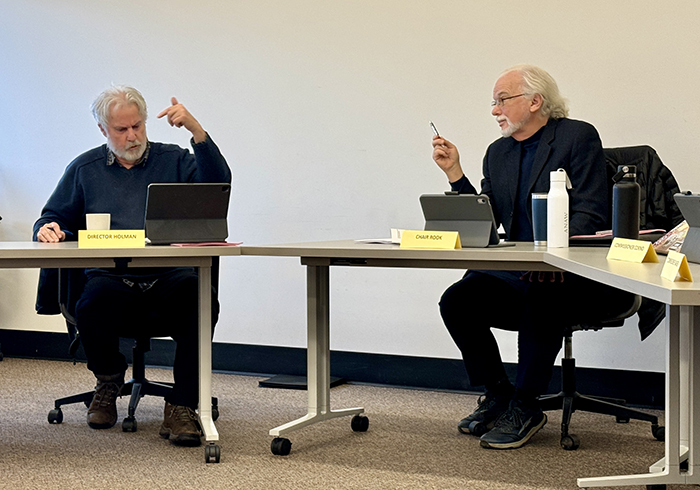
“This [motion] was passed in a closed session with the LCC in an effort to gain information on these proposals from staff,” said LCC chair Earl Rook Thursday. “However, the CRD Board and senior staff in Victoria determined on their side that this proposal needed to be run past the full CRD Board.”

That discussion took place during a different closed meeting, this time of CRD Board members in Victoria on Jan. 14. Rook said as the LCC chair he was able to make a brief presentation during that meeting, but was not present for directors’ discussions.

The upshot, according to Rook, was that the CRD Board passed a motion stating that it “will not consider the expansion of services under the [LCC’s] jurisdiction during this term.”

The CRD Board rose to report this outcome at its most recent meeting, which Rook said had prompted the LCC to report the outcome of its December closed meeting for context.

“I think this was premature on the part of the board, since we were only asking for information,” said Rook. “Since we have not received it, it makes it difficult for us to even formulate any proposals.”

On Thursday, commissioner Ben Corno suggested the LCC should perhaps consider passing the motion a second time, as it seemed the request for information itself was not explicitly denied.

“We were never asking for them to decide whether or not [to expand service authorities],” said Corno. “This has the potential to be an election issue — an election issue with no numbers to discuss, which is really silly.”

The LCC currently holds delegated authority for 12 services — a number that had been 15 prior to a budget consolidation which did not reduce the services themselves. Under CRD direction, staff within the Salt Spring Island administration department are already responsible for many of the services the LCC had eyed, according to a resources report, including operation of two sewer system plants and management of the five water utilities. 

“This did not occur in the manner we anticipated,” said Rook. “And this subject will return to the agenda of the LCC.”

Trust mulls higher pay for next term’s trustees

0

The often-thorny issue of remuneration for elected officials will be front and centre at the next Islands Trust Council meeting, with members planning to sort out whether future trustees should see an increase in what they’re paid.

The Trust’s Governance Committee is now in receipt of a recommendation from consultants targeting a “realignment” of remuneration that would essentially set trustee payments at 60 per cent of the median paid to Capital Regional District electoral area directors. That committee had requested a pay review, partly in response to increases in trustee workload and responsibilities since the current pay scheme was first established in 2010.

In the 16 years since, according to Brentwood Advisory Group’s Paul Murray, trustees’ base remuneration — ranging from $9,500 to $37,000 each year, varying based in part on the population of a trustee’s area — has increased to follow inflation through the Consumer Price Index (CPI) and also as a committee per-meeting fee was introduced. But coming at the issue as an independent party, Murray told trustees Feb. 17 that while the current methodology was reasonable, it wasn’t perfect — and has likely fallen out of “market alignment” since it was established, citing a survey of current trustees who suggested “complexity matters more than size, leadership roles are materially heavier and current proxies (folios, population alone) feel misaligned.”

There was also clear communication that remuneration levels were seen as a “barrier to renewal” — experienced trustees don’t feel like the compensation matches the workload, Murray said, and are increasingly opting not to run for office again.

“You have a fairly high turnover, and there’s concern about that continuing in the future,” said Murray. “One of the factors being remuneration, and the ability to juggle this role with all the other life and work commitments that you need to have in order to live in the islands.”

Committee members generally agreed.

“When I was first elected, being the ‘young’ member at 45 years old,” chuckled Lasqueti Island trustee Tim Peterson, “Trust Council skewed heavily toward retired and financially independent folks. That doesn’t mean there’s anything wrong with those folks, and certainly they should be represented at council, but so should younger voices — and the portions of our populations that may not be financially independent.”

Trustee remuneration currently sits at roughly 35 per cent of the median for electoral area directors; the financial implication of a raise to 60 per cent would increase the Islands Trust budget by roughly $130,000 — the equivalent on its own, according to budget estimates, of a 1.4 per cent tax increase for the Local Trust Areas. 

The draft budget for the Islands Trust currently sits at $11.9 million, supported by a projected tax increase of 9.9 per cent in Local Trust Areas and an 18.1 per cent general increase for Bowen Island — different increases than predicted earlier, partly due to the draft budget having shifted to increase draws from reserves. 

The decision lies with the broader Trust Council, which is expected to take up the issue at its next meeting March 10-12.

Any change to trustee remuneration would be approved by the outgoing Trust Council and would take effect April 1 of the first year of the new council’s term.