Home Blog Page 7

Salish Heron turns off water taps

0

As the recently refitted Salish Heron returned to Tsawwassen–Southern Gulf Islands service at the beginning of the month, BC Ferries warned passengers the vessel’s potable water source would not be available for drinking or food preparation.

The announcement came Thursday, April 2 from the ferry company, the latest in a run of poor water conditions reported on vessels — including elevated lead briefly found in the drinking water aboard the Salish Raven and discolouration seen in potable water aboard the Queen of Cumberland. Ferry service will continue as scheduled, BC Ferries said.

“Bottled water will be available on board,” according to a statement, “and full food service will be offered with adjustments in place to ensure food is prepared safely.”

The move came after routine water quality testing identified elevated Total Plate Count (TPC) levels in an initial sample, according to BC Ferries, which noted that while Health Canada’s Guidelines for Canadian Drinking Water Quality do not prescribe a limit for TPC, BC Ferries follows “industry best practices” to keep levels low and takes precautionary action when results are flagged. 

“Our approach goes beyond regulatory requirements and reflects our commitment to maintaining high water quality standards,” according to a statement. “We have restricted use of onboard potable water systems while follow-up testing and maintenance are underway.”

Ferry officials said the Salish Heron’s potable water systems will only be returned to normal use once results are confirmed safe, and insisted that despite poor water being found on several ferries, the problems weren’t indicative of a single fleet-wide issue.

“While this is more than we would typically expect to see in a short period, these cases have involved different types of test results and are not believed to be related,” according to BC Ferries. “In all of the other recent cases, follow-up testing confirmed water quality was safe, and there is no indication of a broader system issue at this time.”

Elsewhere in the fleet last month, drinking water tested aboard the Salish Orca and Queen of Alberni indicated the presence of E. coli bacteria on March 19, prompting water shutoffs. Subsequent testing came back negative for bacteria, and water service on those vessels was reinstated on March 24.

Incumbents, newcomers on fire district ballot

0

The election to fill three trustee seats on the Salt Spring Island Fire Protection District (SSIFPD) board takes place Saturday, April 11, with an advance voting day on Wednesday, April 8.

Five candidates have been nominated: incumbents Rollie Cook, David Courtney and Mary Lynn Hetherington, and Darryl Martin and Jenny McClean.

Rollie Cook was first elected to the fire board in 2017 and has been its chair since the end of 2021. Cook said he, Hetherington and Martin are running as a slate because they believe teamwork is essential to a well-functioning fire board.

“I’m respectfully asking people to not just vote for me, but to vote for the three on the team, and then we’ll deliver the results we need,” Cook said.

Cook has lived on Salt Spring since 2002 and is a sheep and poultry farmer at his Redwing Farm. He was among those working to establish the island’s abattoir and the Salt Spring Island Farmland Trust and served on boards for both bodies. He also served as an MLA in the Alberta Legislature from 1979 to 1986. 

Cook said he is running for trustee again because while the current board has accomplished a lot, citing the successful fire hall project and Fulford fire hall reservoir pond as two examples, “I want to see it through to make sure that everything works out well.” 

Finding an appropriate spot for and building a new north-end fire hall and seismically upgrading the Fulford hall are two important upcoming projects for Cook. He also aims to keep tax increases to a minimum as the department slowly replenishes its coffers. 

“I think a steady as she goes approach, keeping finances under control, but making sure we deliver on what we’ve done is the mandate for the next three years.”

David Courtney, a retired commercial airline pilot who has owned property on the island since 1999, joined the fire board three years ago. He said his campaign platform is based on the acronym FIRE: F-Fiscally Responsible. 2. I – Integrity and Credibility. 3. R – Respect for Transparency. 4. Experience. He is separately in the third year of his first term as a North Salt Spring Waterworks District (NSSWD) trustee. 

“My time at both SSIFID and NSSWD has proven insightful as to how we function — or don’t at times — as improvement districts, within our current governance model.”

For Courtney, the most important issue facing the district in the next five years is “creation of a new cost-effective satellite fire hall on Sunset Drive, now that Central Hall No. 3 will become redundant at the end of May. This will provide 172 ratepayers fire protection within eight kilometres of a fire hall and reduce dramatically fire insurance premiums for those north of the 1100 block on Sunset Drive.” He said the offer of a parcel of land for that purpose should be pursued. 

“The cost will be borne by the sale of the Central Hall facility funding the new fire hall, hopefully as cost effective as possible, providing a cost-neutral option for all ratepayers and negating a funding referendum.”

Mary Lynn Hetherington, a retired nurse, has lived on Salt Spring since 2000 and served on the SSIFPD board for nine and a half years. In that time she has sat on several committees: health and safety, finance, strategic planning, and facilities and physical plant. She also chaired the communications and marketing committee that brought about the successful referendum for the island’s new fire hall. 

Locally she has served on the boards of the Legion Branch 92, Croftonbrook, Lions Club, the Greater Victoria Labour Relations Board and volunteered as an Emergency Social Services emergency reception centre manager. In Ontario, she was a nurses’ union local president, a legislature rep at Queen’s Park and Parliament Hill and a Registered Nurses’ Association of Ontario president. 

“I grew up around fire halls and firefighters as Grandpa was a firefighter for 32 years and my father-in-law was a fire hall president,” she said.

Hetherington says the most important issues faced by the SSIFPD are ensuring islanders become more resilient through FireSmart practices for hotter, drier summers; continuing to build firefighting capacity through measures like the new Fulford Hall reservoir; keeping taxes low; and planning prudently and frugally for a new satellite fire hall in the North End.

“Teamwork will help keep us safe,” she said. “We need trustees who can work together to meet the challenges ahead.”

Darryl Martin has a mechanical engineering degree from the University of Alberta and held engineering and management positions in the manufacturing industry in Edmonton before becoming the owner and manager of recycling companies. 

After enjoying holiday times spent at their Salt Spring cottage, he and his wife moved to the island full time in 2013.

Martin has chaired the Salt Spring Community Economic Development Commission and served as alternate Capital Regional District director to past director Wayne McIntyre. He has also chaired Transition Salt Spring, whose comprehensive climate action plan detailed the serious challenges that climate change will bring for fire and emergency response agencies.

“I seek election to the SSIFPD board of trustees because with climate change, population and financial pressures bringing increased challenges, my background with professional engineering and financial management will be crucial because structures and mechanical equipment play essential roles in the function of the fire service.” 

He cited the Fulford satellite fire hall’s needs for extensive modification or a complete rebuild to withstand  a serious earthquake. 

“I can bring cost-effective ways to achieve that,” he said.

“Last and most importantly I respect the current board and am committed to working as a constructive member of a strong collaborative team toward goals of safety, reducing islanders’ insurance costs and keeping taxes under control.”

Jenny McClean was born and raised in Ganges and said she would be happy to serve the community she knows so well.

She has been on a SSIFPD committee for more than a year, has served on the Gulf Islands Secondary School Parent Advisory Council and is a board member for both Island Community Services and the Chuan Society.

“My father Jim McClean was a volunteer firefighter from 1969 to 1972,” said McClean. “He recalls when a siren would be sounded and if you could hear it, you would show up for service. I like to visit with Dad around safety issues for Salt Spring.”

McClean cited one example of when storms occur on the island “and roads can be blocked by fallen trees and that may be the only way to get to emergencies is by that one road. There is need for better protection north of Central.”

She said islanders are also concerned about runaway costs and that is also important to consider.

“In terms of the issues in the future, the most important would be the need for recruitment,”said McClean. “Firefighters can get stretched to the limit in their own communities and also help in other communities with fighting fires.”

Another important issue is education, she said. 

“Salt Spring faces unique challenges for firefighting due to roads that can be difficult to access, trees that fall on power lines, need for education for the year-round community and visitors around fire safety and increasing dryness and dangers.” 

Athletes finish first leg of ’round-island’ swim

0

Salt Spring’s Special Olympic athletes like a true challenge. 

In recent years that has seen swimming and bocce teams train and travel to attend competitions at provincial and national levels, often returning home with medals in hand. 

Without those opportunities available this year, six local swim team members decided to create an original substitute challenge: tracking their swimming distances in the pool and matching them to how far they would travel if swimming in the ocean around Salt Spring Island. 

“In January we started adding up the collective kilometres they did,” said Jill Schulze, who coaches the swimmers alongside fellow volunteer Rob Wiltzen. 

Until their season ended March 12, the swimmers had tallied 24.2 kilometres from their one-hour Thursday swim sessions.

“As a group of six, that is pretty impressive,” said Schulze. “It’s roughly the distance from Ganges to Fulford. They still have a goal of going all the way around the island, but that might take us all of next year.”

The group estimates a complete circumnavigation would take 133 kilometres worth of strokes. Athletes will resume their journey when swim season begins again in September.

“They’ve been working really hard at their endurance,” said Schulze. “They like to be challenged that way.”

The swimmers are Carlos Manzano, Debbie McNaughton, Jason Newport, Dawn Hadler, Claire Motherwell and Pam MacDonald.

Group secretary Carol Newmeyer said more volunteers are always needed to support Special Olympics athletes and programs. Restarting both the golf and Club Fit programs and initiating a new one called Fundamental Youth, for kids aged seven to 12, are among the local group’s goals that depend on getting enough committed volunteers, she said. People can contact volunteer coordinator Lisa Foster at saltspring.volunteer@specialolympics.bc.ca for more information about how to help out. 

Editorial: Growing closer

0

On our reputation alone, it probably wouldn’t surprise many mainlanders that Salt Spring’s food bank has its own organic farm.  

Perhaps more so might be the scale. Thanks to fresh produce grown on the acre it has tended at the Burgoyne Valley Community Farm — alongside ongoing donations and active gleaning and Second Harvest programs — Harvest Food Bank distributes more than 15,000 food hampers each year, with island children making up over 30 per cent of the people receiving food. The program helps individuals and families while they regain their footing, recognizing that like any emergency, food insecurity can occur at a variety of speeds — from a sudden shock like a job loss or medical crisis to a gradual reduction of options as rents and wages drift apart. 

Now, as Harvest shifts its food growing operations to part of the 10-acre parcel purchased in 2023 by Island Community Services, farmers — backyard and otherwise — can help carry this vital island program through, filling the gap while the soil at the Brinkworthy Road property is worked for next year’s crop. 

The Grow a Row campaign is certainly timely, and not just because about now is when most of us get started in our gardens. Given the growing shadows of economic uncertainty, it seems unlikely Harvest’s food programs will see fewer islanders in need of diverse, nutritional food in the months to come.

It’s also meaningful in framing intention around something many islanders do for the pure joy of it. When we plant, tend and harvest food with our local community’s needs in mind, we’re internalizing our connection to islanders in need and growing our capacity for empathy. It’s a demonstration of how shared responsibility helps strengthen our island — and how any grand notions around “building resilience” must include expanding local participation in our own food network, independent of efforts by regional governments and charities. 

Growing storage crops for Harvest this year is a truly hands-on way to help this vital program; islanders should reach out to organizers now to take part.

Opinion: Trust must help protect farming

In light of the current revisions underway by the Islands Trust on the Trust Policy Statement (TPS) and the Salt Spring Island Official Community Plan (OCP), the Salt Spring Island Agricultural Alliance sent the following letter to assure that both documents continue to protect and support agriculture and secure farmland and food production on Salt Spring. 

We agree with the Islands Trust that this is the time to review important community documents that will guide us into an uncertain future. This too for the agricultural community. In the spirit of transparency, and hoping for your support, we are publishing this letter so the community will understand our current process. It reads as follows:

The Agriculture Alliance is the caretaker of the Area Farm Plan (AFP), crafted with the community over 20 years ago. Cognizant of the fact that the most recent version of the AFP (March 2020) is being cited by the Salt Spring Local Trust Committee (LTC)’s engagement consultants as a source document for their OCP review, we wanted to inform the Islands Trust that we are currently underway with a review of the Area Farm Plan — and with this letter we would like to inform you of highlights that are emerging in this process.

• We are cognizant that the world has changed significantly and rapidly since 2020, and many of these changes endanger our food security on Salt Spring Island, which is heavily dependent (perhaps as much as 95 per cent) on food imported by truck and ferry.

• At the same time, the economics of producing healthy local food have become much more challenging, with rising land prices, competition from subsidized food produced elsewhere in the world, and an estimated 36 per cent rise in the cost of farm inputs since 2020.

• The housing shortage on Salt Spring has become a significant factor in maintaining Salt Spring’s economy, and in some cases has been a significant factor in the successful operation of local farms. As always, farm housing needs special consideration, because its requirements are very different from what guides housing density in village centres near services.

• In light of all this, the #1 goal of the AFP is urgent now more than ever: To ensure long term viability of farming and increasing food production on Salt Spring Island.

We will update you over the coming months on how we see our goals, strategies and tactics changing to address the present reality of farming and food production in general on Salt Spring Island. 

We have decided to replace our separate goal of addressing the climate emergency with an overarching commitment stated with a resolution. We want to be clear that we did this not because we don’t care (we care deeply), or because the climate emergency has been addressed (it’s worse), but rather because we see farming, and particularly regenerative farming techniques, as inseparable from mitigating and adapting to climate change. We hope that the Islands Trust and the LTC will approach the revision of the TPS and OCP in the same spirit, with addressing climate change as an integral part of all processes, policies and decisions.  

With this letter we hope to encourage the Islands Trust to place the importance for protecting and increasing farmland, including the facilitation of the special housing needs of farms and farmers, as a priority — specified within the OCP and TPS, currently under review. 

We consider the patchwork of natural ecosystems and agricultural ecosystems to be one of the “unique amenities” in the Islands Trust Area. All farmland should be protected, not just land already protected by the ALR.

Join us in the understanding that agriculture on Salt Spring, within the current commitments from island farmers towards regenerative practices, are hand in glove with the protection of our environmental amenities — and crucial to our future well being. 

Thank you for your important work for this community.

Supported by the following Salt Spring Island Agricultural Alliance organizations: 

• Farmland Trust; S.Dobie, J. Cooksey, J. LeBlanc, A. Palframan

• Abattoir Society; F. Baldwin 

• Farmers’ Institute; R. Stepaniuk 

• Island Community Services

• Island Natural Growers; A. Macey 

• Transition Salt Spring; A. McKague

• Farmers Market Society

Th-ink! now open at ArtSpring

Th-Ink!, the much anticipated second Islands Printmaking Biennale, opens today (April 1) at ArtSpring, featuring hand-pulled prints by 65 artists from Vancouver Island and the Gulf Islands. 

Exhibition entries include linocuts, wood reduction prints, lithographs, etchings, monotypes and more, which can be seen in the gallery daily through April from 10 a.m. to 4 p.m. 

The lobby areas of ArtSpring will show works by Gulf Islands Secondary School students and special displays will provide an introduction to the printmaking techniques used in the creation of the works in the show. 

“This is an opportunity to learn more about this centuries-old art form,” says material from the Salt Spring Island Printmakers Society, which has organized Th-Ink!, following the first Islands Printmaking Biennale held by the Printmakers Only Group in Duncan in 2024.

An opening reception for the ArtSpring version will be held on Sunday, April 5 from 1 to 3 p.m., with an opportunity to meet the printmakers and celebrate the show. 

Artists talks will be held Sunday, April 12 and Sunday, April 19 at 2 p.m. On the 12th, Salt Spring printmaker Richard York will talk about his journey in a presentation titled In Pursuit of a Painterly Relief Print. On the 19th, a panel discussion will look at the future of printmaking. 

Impromptu demonstrations will also be held throughout the show.

For more information about the Salt Spring Island Printmakers Society and the exhibit, visit ssiprintmakers.ca/shows.

Island growers needed to fill food bank shelves

0

Salt Spring’s market farmers — and backyard growers — have a special opportunity to help the island’s food bank this year, as organizers are launching a Grow a Row campaign to fill shelves and fridges during a period of transition for Harvest Farm.

The organic farm — which organizers say grows about 10,000 pounds of produce each year for Island Community Services’ (ICS) food bank, home meals, community fridges and other programs — is in the process of moving operations to ICS’ recently purchased property next to the new fire hall on Brinkworthy Road. Food programs manager Jamie Ferguson said volunteers were excited about the move, and were fielding interested questions from islanders who’ve noticed all the activity.

“There’s a lot of stuff happening there,” she said. “We’ve got it all fenced now, have a little parking lot and an access road; we’ve got an old well going and some water catchment, a new pump house — and two big 30 by 50 greenhouses. We’re really pushing to get the farm going.”

After drainage improvements around those greenhouses are complete, Ferguson said the next effort would be working the new land with a target of getting cover crops in this fall — so they can start growing produce in earnest next year.

“We’re fortunate; most food banks don’t have a farm,” said Ferguson. “But as we transition from one farm to another, we don’t have the funds to run two; this year, we’re going to be growing a lot less on our acre in the Burgoyne Valley.”

To bridge that gap, the Grow a Row campaign invites participants to plant one extra row in their fields and gardens — or simply sign up to donate any surplus produce to the program. Ferguson said the first step would be a conversation with growers about what they’re growing, and when. Storage crops work best for most of ICS’ programs, she said, things that keep well like carrots, beets, onions, potatoes and winter squash.

“I’ve been really clear — I don’t want to end up with everybody’s zucchinis!” she laughed. “But everybody who signs up, I’m actually going to call and have a conversation with them, because I want it to be a collaborative relationship — whatever works for farmers, as well as what works for us.”

About a dozen people have already signed up, Ferguson said, happily with no “repeats” of the same crops so far. It’s an excellent way for backyard growers and farmers to contribute, Ferguson said — and there’s even a tax credit for market farmers.

“So we’ll keep track of whatever produce they bring, we’ll track the amount and weight,” said Ferguson. “And then at the end of the season we’ll be able to give them a receipt for what they’ve donated and they’ll be able to apply for this tax credit, which could be 25 per cent back for them — which is amazing!”

Every row and every harvest helps ensure local families continue to receive fresh, healthy food, she said — and with this program, there’s no such thing as too much help.

“The produce won’t go bad,” said Ferguson. “If we have a surplus at any time, all it means is maybe people will get more delicious carrots than they would’ve normally. That’s hardly a bad thing!”

For information and to sign up, visit harvestsaltspring.ca/grow-a-row.

New island projects ‘not viable’ with solar rates: advocates

0

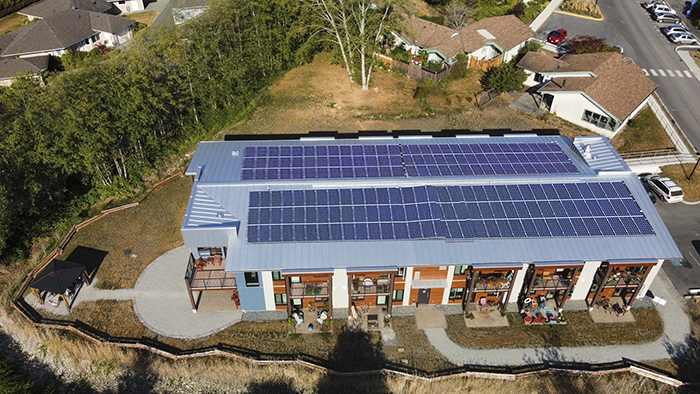
BC Hydro’s plans to shift how it pays rooftop solar customers for electricity they generate has been approved by the B.C. Utilities Commission (BCUC), a move local clean energy advocates say has likely upended financial viability for community solar generation on Salt Spring Island. 

The independent regulator issued its decision on the utility’s net metering program Wednesday, March 24, replacing the current scheme with new “self-generation” and “community generation” service rates that set compensation at a flat 10 cents per kilowatt-hour (kWh). 

But those rates come without contracts, according to Community Solar Coalition’s (CSC) Kjell Liem, who said the decision demonstrates how easily BC Hydro can change its structure. 

Liem lives on Salt Spring, where the grassroots CSC grew out of the island’s 2016 Community Solar Summit. He said that unlike power purchase agreements, the new programs have no inflation adjustment mechanism — so the actual price will decline as electricity rates inevitably go up.

“It’s just not viable on the Gulf Islands,” said Liem, who had travelled to Vancouver in November to take part in BCUC’s public hearing process. 

The two intervenor groups with direct interest in the Community Generation rate — both CSC and the Vancouver-based EcoSmart Foundation — opposed the new rate as presented; both had been part of the Net Metering Working Group.

Liem said the new rates and future uncertainty might not dissuade solar projects that had free access to acreages and federal financial assistance, but there were too many risks for smaller producers — such as community solar projects envisioned to build resiliency on islands.

“Despite over a decade lobbying for a shared solar rate, it’s unlikely that Salt Spring will be able to make use of the Community Generation rate,” said Liem. “It’s hard, if not impossible, to find the ‘community’ part of BC Hydro’s rate.”

The program also includes what BC Hydro has called “safeguards to ensure community participation” — a framework that adjusts the maximum amount of electricity that can be sold to the utility based on the number of participating customers. In its decision, the BCUC said it agreed with BC Hydro’s assessment that if rates were left unchanged, non-participating ratepayers would be gradually subsidizing an increasing share of program costs. 

The new rates both take effect July 1, although net metering service rate customers who did not receive any rebate for their solar panels will have 10 years from the date they joined the program to transition to the new rate, according to the commission.

Water restrictions streamlined

0

As Salt Spring heads into what Environment and Climate Change Canada has said is “virtually certain” to be among the four hottest years on record, the island’s largest water district is starting its annual water restrictions with a new, simpler set of regulations it says will increase compliance and spur conservation.

Trustees for the North Salt Spring Waterworks District (NSSWD) approved the changes Thursday, March 26, just in time for Stage 1 restrictions — the most permissive of potentially four that limit summertime water use — to take effect April 1. Along with simplifying when and how much people should water, according to NSSWD water data and assets coordinator Brenna Wells, trustees wanted the new rules to make the use of sprinklers less permissive, particularly for watering lawns, and encourage micro and drip irrigation and hand watering.

Longtime water users will notice the traditional odd and even dates for watering have been abandoned in the new user-friendly format, in favour of permitting a set number of days per week, depending on what stage the district is in. As well, permitted times for watering have been replaced with recommendations about when watering is most effective and when no watering should take place.

“We also added a ‘food producing plants and crops’ category, which we didn’t have before,” said Wells, “and we have that as the most permissive, relative to ‘trees, shrubs, plants and flowers.’”

Other changes include allowing vehicle and boat washing during Stage 4 restrictions for safety and invasive species control purposes, respectively; allowing more watering for public parks and fields, through not having specific hours allotted; and adding specific bylaw language setting definitions.

The new rules all fit on a handy one-page colour-coded chart that will be available to download on the district’s northsaltspringwaterworks.ca website. Staff said they would also have some printed copies available at the district office and at NSSWD’s May 6 AGM at Community Gospel Chapel.

NSSWD’s watering restrictions are in effect every year from April 1 until Nov. 1, and enter different stages mostly as conditions shift. The district uses current and historical water levels at St. Mary and Maxwell lakes to chart a course through restriction planning each year, managing both lakes to ensure adequate customer supply and maintain mandated minimum lake levels.

Also helping out with conservation efforts this year, the first of the district’s new water meters have been installed, according to operations director Ryan Moray, who told trustees that 165 of the cellular-capable devices are currently operating. The meters can transmit consumption data back to the office four times a day, he added, and replace devices in the system that are often as much as 40 years old.

“They’ll also flag continual use, no use, backflow, that sort of thing,” said Moray. “And you can look at your consumption trends.”

Eventually NSSWD plans to replace all 1,800-plus meters in the district, a project that will take multiple years to complete. The new meters have already found a few “slow leaks” on customers’ sides, according to Moray, which he said would have been “very difficult” to catch during normal meter reads that only took place every couple of months.

Customers will also have the opportunity to create their online “My360” accounts later this spring, according to district chief administrative officer Mark Boysen, bringing more information about their water use to their own computers.

“We’re getting some very excited responses from customers about these,” said Boysen. “Particularly strata owners, with 20 to 30 different people connected, there’s a lot of interest in having accurate information — and minimizing leaks that can impact the whole unit.”

The hot summer predicted for 2026 has the potential to break long-standing dry streak records on Salt Spring, which were nearly challenged last July as that calendar month came and went without a drop of rain falling. The driest month on record, according to Driftwood reporting, was August 1986, when no precipitation was recorded as part of what became a 58-day rain-free streak — although an 1898 drought was also reported in the pages of the Salt Spring Island Parish and Home newsletter. 

That year, according to the newsletter, except for “one day’s wetting” of 5.6 mm in August, there was no precipitation between June 19 and Sept. 19, or 92 days.

Three bands play for Odinfest benefit Thursday

0

Community members have already stepped up to help a young island man and his family face brain tumour treatment with a GoFundMe campaign, and now an event at Moby’s Pub is adding more impetus to offer support. 

Odin Watsonmesser, 27, who graduated from Gulf Islands Secondary School in 2016 and has developed a business as a personal fitness trainer, was diagnosed with a diffuse glioma brain tumour in December and underwent surgery at Victoria General Hospital on Feb. 9. His father Tom Messer is well known as the longtime bartender at the Salt Spring Inn. 

“The surgery was a success,” reports the GoFundMe page set up by family friend Caitlin Hart. “The neurosurgical team achieved a gross total resection of the tumour, removing the affected portion of his right temporal lobe with clear margins and no neurological deficits. This means the surgeons reached the full goal of removal. Odin has been an absolute champion throughout this entire process. He has faced surgery and recovery with strength, courage, and a positive attitude that humbles us all.”

“I’m still feeling great, taking this all day by day and enjoying life as usual,” Watsonmesser stated in a Feb. 27 update. “Family, friends, passions, goals — so much to feel grateful for and appreciate even with all this insanity I’m going through.”

Hart said Watsonmesser started receiving radiation treatments at the B.C. Cancer Clinic in Victoria on March 23. They are scheduled to continue for seven weeks. Following a four-week break, chemotherapy treatments will begin. Treatment is slated to continue until July 2027.

The GoFundMe page is still accepting donations to meet its $80,000 goal, and people can also support the family at a Moby’s Pub fundraiser on Thursday, April 2. Titled Odinfest, it features three live bands donating their talents — The Wandering Wolves, Gasoline Alley and The Gunnits — plus a raffle for great prizes, gift cards and more. All raffle proceeds and the $15 cover charge will go directly to help with Watsonmesser’s recovery and treatment. Music begins at 7 p.m.