Tuesday, April 21, 2026
April 21, 2026
Home Blog Page 13

Heritage Week marked with Feb. 16-22 museum opening

0

SUBMITTED BY SALT SPRING HERITAGE FOUNDATION

Each year, Heritage BC celebrates Heritage Week in mid-February. This year the event is focusing attention on food — and the sharing of food — with the theme of Stir the Pot.

Food brings us together. It links us to the land and to traditions, ties us to our families and ancestors, and connects cultures and communities. This year’s Heritage Week theme is an open invitation to celebrate food as a form of heritage that is both deeply personal and widely shared. From heirloom seeds and traditional cooking and harvesting methods to community feasts and intergenerational recipes, food reflects who we are and where we come from.

As well, the Stir the Pot theme suggests advocacy. It is a call to spark conversation, to bring overlooked stories to the surface and to address issues of food security, cultural recognition and access. By stirring the pot together, we not only honour traditions but also create space for dialogue and discussion.

As a celebration of this year’s theme, the Salt Spring Heritage Foundation has focused its planned activities on What’s in the Pot: A celebration of Salt Spring Island’s farming tradition. The foundation is providing an open invitation to the people of Salt Spring Island and beyond to visit the Salt Spring Island Museum to learn about the impact of agriculture on the island’s history. The museum on the Salt Spring Island Farmers’ Institute grounds on Rainbow Road will be open daily from 11 a.m. to 3 p.m. from Monday, Feb. 16 through Sunday, Feb. 22.

Museum exhibits provide an opportunity for visitors to learn about island farming traditions; to discover the forgotten stories of people, families and communities and discover little-known facts about Salt Spring’s amazing food harvests.

Along with its extensive collections, the museum will be displaying some key facts and information regarding agricultural production between 1860 and the 1950s. Volunteers will offer tours and answer questions at the family-friendly event. Drop-ins, school tours and youth are all welcome to stop by.

Admission to the museum is free, but donations to support museum activities are always welcome.

Holman: CRD leads on climate action, but more to do

0

The Capital Regional District (CRD) Board declared a climate emergency in 2019. The CRD Climate Action service (to which the average Salt Spring Island residential property contributes about $8 per year), inventories greenhouse gas (GHG) emissions throughout the region every two years. This data shows that per-capita GHG emissions have declined significantly over the 2007-2024 period by 30 per cent regionally and 23 per cent on Salt Spring, but decreased less in absolute terms by 11 per cent and 6.5 per cent, respectively, due largely to population growth.

Worldwide emissions are not declining significantly, if at all. Unless the largest emitting countries commit to more aggressive action, significant climate impacts, already occurring, will grow worse: greater frequency of summer droughts, winter flooding, wildfires, life-threatening heat domes and disease.

Smaller jurisdictions have an obligation to allocate resources to reduce emissions, but there are significant co-benefits, such as reducing the cost of energy and car dependency, or preserving forests that protect our drinking water. It is even more important for smaller jurisdictions to prepare for climate impacts that will be occurring regardless of our emission reductions.

Over the past two terms, the CRD and partner agencies have undertaken a number of initiatives that address climate change directly and indirectly, some of which include:

• Initiating and providing gas tax funding to support the update of the Salt Spring Climate Action Plan (CAP 2.0).

• Providing gas tax and other funding to support climate-related education and information, and energy and water saving measures such as heat pumps and water storage tanks. This includes such measures at local facilities including ArtSpring, Core Inn, Rainbow Road pool, Fulford Hall, and Croftonbrook and Salt Spring Commons housing projects. CRD also provided gas tax funding to upgrade the library geothermal system to establish it as a cooling centre

• Increasing funding for staffing and resources for the local CRD Emergency Program, which coordinates inter-agency preparedness and provides support for 65 neighbourhood “pods” on the island. The Emergency Operations Centre has been moved from a basement location to the SIMS building and discussions are underway regarding co-location at the new fire hall, which also received gas tax funding of $1 million that will help support improved wildfire protection on Salt Spring.

• Developing sea level rise and heat vulnerability mapping for the region and securing grant funding for EV charging stations throughout the CRD. This includes new chargers at several local parks, supporting one of the highest per capita EV ownership levels in B.C. The CRD also continues to electrify its regional and local vehicle fleets.

• Contributing $3.7 million for our new emergency room at Lady Minto Hospital that will provide essential medical assistance during a major event.

• Enhancing local food security by establishing a new voter-approved Foodland Access service, and providing gas tax and other grant and operational funding for the Burgoyne composter, and gas tax funding for construction of The Root.

• Creating new regional and local parks and a new voter-approved Biodiversity service with a focus on invasives management.

• Securing millions in grant and other funding in collaboration with the Ministry of Transportation and Transit (MOTT) and Island Pathways, to build miles of sidewalks and cycle lanes around Ganges and develop the Ganges Active Transportation Plan. CRD active transportation planning and advocacy resulted in MOTT repaving of Ganges Hill with wider shoulder lanes for pedestrians and cyclists and greatly improved stormwater infrastructure. Funding for the Salish Sea Regional Trail is now regional and also included in CRD capital plans.

• Maintaining and improving our local transit service (one of the most successful in rural B.C.) throughout Covid, including free fares for youth 12 and under, and securing funding for the design and construction of bus shelters.

• Reducing waste by banning construction materials and increasing methane capture at the Hartland landfill, and renewing another five years of funding for the Rainbow Road recycling facility.

Other agencies are also doing their part, including BC Hydro’s storm responses; MOTT’s Blackburn bridge construction, and other major storm repairs; the fire district’s new post-disaster fire hall; NSSWD’s new drinking water plants and securing funding to increase St. Mary Lake water storage. The unprecedented scale of public investments in infrastructure and other services on Salt Spring in recent years will pay climate resiliency dividends for years to come.

The Trust has also declared a climate emergency and can play a key role by retaining strong OCP policies supporting compact, less car-dependent settlement patterns and protection of drinking water, sensitive ecosystems and farm land. In considering rezoning proposals, the Trust can ensure that our very limited community drinking water and sewage system capacity is prioritized for affordable housing and community amenities. SSIWPA, the inter-agency organization with a mandate to promote protection and conservation of our drinking water, should be reinstated.

There is much that the CRD and other agencies can do to address climate change. The good news is that these investments not only strengthen Salt Spring’s climate resiliency, they improve our quality of life right now.

Teamwork key in rescue and evacuation by sea

0

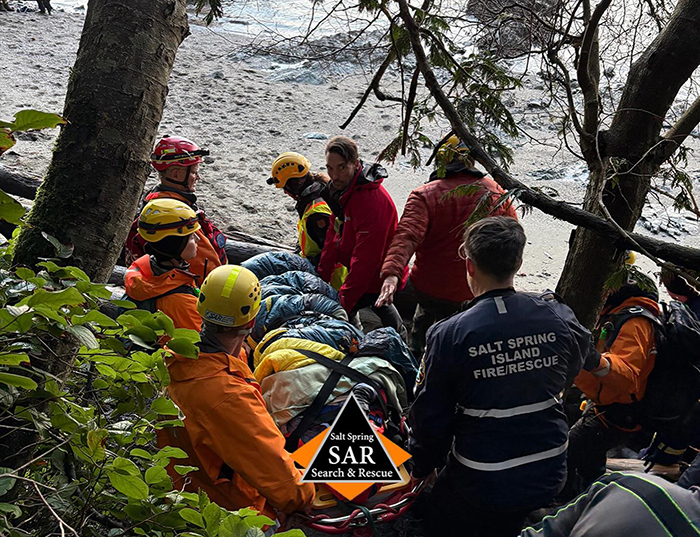
A multi-agency response to an injured Ruckle Provincial Park hiker ultimately brought by boat to Ganges and then Lady Minto Hospital was a demonstration of “incredible teamwork and collaboration,” say rescuers.

Salt Spring Island Search and Rescue (SSISAR) was tasked by BC Emergency Health Services to assist Thursday, Feb. 5 in a technical evacuation of an injured hiker at Ruckle Provincial Park. The person had slipped on wet rocks along a trail, according to officials, sustaining injuries that required a stretcher-based extraction over challenging terrain.

At Ruckle, ground teams joined Salt Spring Island Fire Rescue personnel, who had provided initial medical care at the scene. After a joint medical assessment, SSISAR’s medical team determined an evacuation by sea from a nearby beach would be safest for the patient — and the most comfortable way to get to the hospital.

“The injured subject was repackaged in a vacuum spine board and Ready Heat blanket,” according to SSISAR, “for better hypothermia and injury control.”

After administering additional pain relief, the patient was stretcher-carried by rescuers and firefighters to the awaiting Royal Canadian Marine Search and Rescue Station 20 vessel from Pender Island. The patient was then transferred to BC Emergency Health Services paramedics in Ganges and transported to the hospital in stable condition.

“This response demonstrated the incredible teamwork and collaboration between multiple agencies,” according to SSISAR, “all working together to help an individual in need . . . This call highlights the fantastic working relationships we have on Salt Spring and the Gulf Islands.”

Rescuers also extended their gratitude to bystanders who assisted at the scene, and reminded islanders there is no cost for rescue on Salt Spring Island.

‘Red flag’ raised over accessibility, Facebook role in public notification

2

The Islands Trust Council is preparing a public discussion on plans to shift notice distribution to Facebook and its website, as concerns over accessibility — and U.S.-owned social media — have dogged attempts to “harmonize” policies on individual islands.

The current proposal to eschew local print newspapers, advanced by the Executive Committee in December, will be on the next Trust Council agenda, according to staff, the latest expression of a “model” public notice bylaw intended for Local Trust Committees (LTCs) and adopted by the 26-member council last summer. 

Previously, when public notices were required by the Islands Trust Act and Local Government Act, the default notification laid out by the Community Charter was publication in two editions of a newspaper, once each week for two consecutive weeks. And while a provision also allows local governments to adopt their own notification schemes with some legislative guardrails, the new online-centric “alternate public notice bylaw” sent to LTCs — while applauded for frugality — has been met with mixed reviews.

Adoption at the local level has been less than harmonious, with the effort thus far yielding a patchwork of different standards for public notification among LTCs, reflecting the different needs of individual islands. The Gambier-Keats LTC, for example, joined Mayne, Saturna and North Pender Islands in adopting the model bylaw as-written, while Denman Island and larger Gabriola and Salt Spring Islands voted to keep the “status quo” — i.e. the legislative default.

Thetis Island added its local “E-Spokes” newsletter to the model bylaw, with Galiano Island adding its Active Page — and Hornby Island amended language to keep the Islands Trust website for notifications, but use “a local print weekly newspaper” instead of Facebook. 

Islanders have expressed trepidation over reliance on U.S.-owned Facebook for the distribution of public notices; the Islands Trust’s Executive Committee meeting Wednesday, Feb. 4 discussed correspondence urging it reconsider using the “social media behemoth” to that end, with one letter writer lamenting the cost of supporting “engagement-maximizing products that hijack attention, erode agency and creep people out through surveillance and manipulation.” 

“I do understand the sentiment around the social media company,” said Lasqueti Island trustee Tim Peterson, whose own LTC chose not to include Facebook in its adaptation of the model bylaw, substituting “a newspaper that publishes at least once a month on Lasqueti Island.” 

“And it’s a sentiment that I’ve heard from plenty of others,” he continued. “I don’t know that we’re in a position to effectively get the same reach through another platform at this time.”

At a recent meeting of the Islands Trust’s Accessibility Committee, member Theresa Burley said the online-only scheme had caught the attention of concerned islanders who had read about Trust Council’s plans in a Victoria newspaper. The committee has not yet had a chance to assess the Trust’s website for accessibility, and shifting public notices fully online “leaves out a lot of people,” she said — “particularly if our website is not up to snuff yet.”

“That’s a bit of a red flag,” said Burley. “Usually you want to have things as available — and in as many formats — as possible, unless the cost is completely prohibitive.”

Legislative and Information Services director David Marlor told that committee it was a balance Trust Council needed to consider.

“From our understanding, with the exception of the Driftwood on Salt Spring, the readership of newspapers in the islands is really quite low, and it’s getting lower because of social media and the internet,” he said. “And then of course the logistics of tying [multiple newspaper publications] all together in staff time, it becomes quite expensive for a fairly low number of people.”

“Just because numbers are low, many are probably older folks where you will have more people with disabilities among them,” said Burley. “We should keep in mind not to discount them, just because there’s not many.”

Marlor reiterated Trust Council could choose to use print media for any reason if the situation seemed to suit it — the policy scheme, staff have said, is intended simply to free them from being required to. 

“I think generally, with the exception of age issues, most people are looking to websites for that [meeting schedule information],” said Salt Spring Island trustee Laura Patrick, who as Trust Council chair sits ex officio on the Accessibility Committee. “I mean, that’s how I look. ‘When is Bowen Island Municipality meeting?’ I go to their website and look at it.”

The Accessibility Committee chose not to make a motion at its Jan. 15 meeting, and does not sit again until April — by which time the decision on Trust Council notices will presumably have been made. Trust Council’s next quarterly meeting in Duncan begins Tuesday, March 10.

Visitor Info Centre volunteers predict busy 2026 tourist season

0

Fire, floods and Fulford-Ganges Road construction notwithstanding, 2025 brought a bump in visits to the Salt Spring Island Visitor Information Centre (VIC) — a 30 per cent increase in centre visitors over the previous year.

And those nearly 10,000 visitors were mostly greeted by volunteer ambassadors, according to VIC steering committee member Elaine Senkpiel, who said the committee trains and schedules community members interested in helping out — they have a roster of 41 currently — and is always recruiting.

Even on a winter day, there is action at the VIC. People stop by to take pictures with their phones of constantly-updated daily and weekly event boards, they grab maps of hiking and walking trails. And they watch a slideshow on one of the centre’s TV screens — featuring pictures of the island from the Salt Spring Photography Club. Some are captioned, some are not; the staff identify places that catch visitors’ eyes and direct them to the relevant point of interest.

“We promote all things Salt Spring,” said Senkpiel. “Arts, culture, entertainment, adventure, recreation. We see people in person, we handle email inquiries, we talk on the telephone.”

While almost every visitor plans their trip online from home, once “on the ground” at their destination there’s no substitute for a brick-and-mortar location, according to VIC steering committee member Brigitte Diebold. The centre is currently staffed three hours a day, seven days a week — the more volunteers they have, the more they’re open.

“Online research, QR codes and so on are all great if you are starting your trip,” she said, “but once in the location, we find people want to hear a story — they want to find that special place on the island maybe nobody else knows about, or even just something they’ve never seen before. That’s the experience we’re giving.”

The Salt Spring Island Chamber of Commerce is the sponsoring organization, Senkpiel said, with the VIC itself operating as an official Destination BC facility. That means all volunteers undertake training through a provincial online learning centre program — facilitated now by volunteer certified training coordinator Dave Rumsey —  and do 20 hours of “shadowing” with an experienced ambassador.

“We’re one of 134 centres in B.C. under the Visitor Services Network Program umbrella,” said Diebold. “The mandate and the reporting line comes directly from Destination BC — they’re giving information to us, making sure we have the right training, setting standards for how we operate.” 

Volunteer training includes taking part in one of several periodic “familiarization tours,” where businesses have reached out to the centre to have VIC staff come visit — to ensure they’re familiar with what each has on offer. Senkpiel says those tours are always popular, and she finds information flows in both directions — the participating businesses learn about one another, too. 

The VIC team last year covered 1,239 hours at the centre — almost 43 per cent more time than the previous year — welcoming visitors that were overwhelmingly from elsewhere in Canada. Just 15.8 per cent were foreign tourists, according to VIC data — about half from the U.S. and the remainder mostly from Europe, Asia and Australia.

And a full 26 per cent of visitors identify as local — specifically from Salt Spring Island.

“Someone who has lived here a long time might wonder what could be in here for them,” said Senkpiel. “Maybe they just stopped in because they have visitors coming — but they’ll always discover new things they didn’t know about.” 

In addition to visitor statistics that go into the Destination BC portal, that affiliation with a larger body means VIC volunteers spend some time promoting the rest of our beautiful province alongside Salt Spring — and while they’re the first to admit they’re not equipped to plan someone’s whole vacation, centre volunteers tend to have a lot more regional knowledge than one might think. 

Senkpiel told a story about an off-season visit from a New Zealand couple planning a driving loop around the province, who found themselves delightfully chatting for nearly an hour with VIC volunteers — and wound up with all kinds of ideas for places to visit on Vancouver Island and beyond.

“I’ve camped a lot with my little travel trailer,” laughed Senkpiel. “And that’s actually been very helpful in my role here, because I can say ‘oh, if you’re in Osoyoos, you should stop into the Burrowing Owl winery,’ or whatever. A lot of us have travelled a fair bit, and we can share that information with people who come in.”

Interestingly, some 42 per cent of parties tracked were Salt Spring “day trippers,” with 44 per cent staying one to three nights; only 13 per cent were staying more than a week. For those quick-trip visitors in particular, the centre becomes a valuable resource the moment they arrive.

“They take the bus from Fulford, land at our bus shelter and go, ‘what can I do for the day?’” said Senkpiel. “Or they come in on Harbour Air or Seair, and don’t have a plan — so they end up exploring the village. We’re hoping that they’ll see, for example, ‘oh, the Apple Festival is on at the end of the month,’ and they say to themselves they should come back.”

When they’re not open, there are brochures in a rack outside, and they’re working on replacing it with one that’s more protected from the elements. Always taped in the window are easily viewable bus and ferry schedules — and Dave Paul from the Fritz pops by as often as he can to post what’s showing at the theatre, Senkpiel said.

“We operate on such a shoestring budget,” said Senkpiel. “It’s amazing the volunteers have done as well as they have over the years with the limited resources they’ve had.”

Local businesses often help fill those gaps. One grocery store stepped up last summer to fund a summer student program that greatly boosted daytime staffing, Senkpiel said — they’re also responsible for the parade of fresh flowers that greet visitors nearly as enthusiastically — and the other donates funds for supplies for centre volunteers themselves.

“It’s wonderful how the community supports us as we’re supporting them,” she said. “We couldn’t operate and do what we do without the donations we’ve had. We are here for everyone; we’re all working together.”

Senkpiel said apart from a call for ever-more volunteers — reach out to 250-537-5252 to sign up — the message for islanders today was to stop in soon to update the VIC’s supply of pamphlets, brochures and business cards. Event notices should be half page size, she added, so everything fits when it gets busier — and when they bring materials in, year-round, they can always update their hours with staff for the VIC’s information boards.

“Bring in your flyers soon, because the busy season starts fast,” said Diebold. “We’re seeing travel coming in earlier and in higher numbers than last year, and I think we’re only going to see more this year.”

LCC plans old fire hall takeover

0

Salt Spring officials won’t have to raise taxes to maintain the old Fire Hall No. 1 in Ganges next year, having found efficiencies within the budget to both maintain the 73-year-old building and slightly drop a projected tax increase.

Salt Spring’s Local Community Commission (LCC) managed to shave a little more than $62,000 off the taxpayer’s portion of their provisional spending plan Thursday, Jan. 29, even after a modest increase in the budget to maintain the soon-to-be-vacant fire hall.

Ownership of that hall is being transferred to Capital Regional District (CRD) ownership for the princely sum of $1, following terms of a 2021 memorandum of understanding between that body and the Salt Spring Island Fire Protection District (SSIFPD). That agreement has SSIFPD retaining control of the hall until four months after the new fire hall on Lower Ganges Road is occupied — and created an easement allowing the fire district to construct and maintain a 30,000-gallon water tank on the west side of the property for firefighting.

Regional staff told LCC members they expect to assume full responsibility for the old fire hall as early as this summer, and until a future use — and possible revenue stream — is sorted out, the CRD needs to keep up with basic maintenance and security.

“Once it’s transferred over to us, we’re responsible for all the utility costs and security of that building,” said senior manager Dan Ovington, outlining typical expenses such as a phone line for alarm monitoring, repairs and maintenance during the transition period.

“And quite often, when we take over a building, there’s some wiring or similar thing that needs to happen so we’ll use our regular contractors that support our other facilities.”

Ovington said staff would be bringing forward the recent assessment of the building’s compliance with the BC Building Code to the LCC’s meeting Feb. 12 — at which point commissioners could consider what future use options were possible. That’s the LCC’s monthly evening meeting, he said, and staff had set aside most of that time for commissioners to bring those possibilities to the public for their input.

“The current occupancy permit is specific to a fire department,” said Ovington. “So in order to put in anything outside of that — there are limitations.”

The net impact of Thursday’s budget discussions will be a one per cent reduction in the tax increase projected for 2026, from an anticipated 9.5 per cent bump to 8.5 per cent — a somewhat hard-fought shift that went back and forth across the meeting. While commissioners found themselves acting with less unanimity than when they began three years ago, CRD director Gary Holman took a philosophical approach to those disagreements, opining the level of discourse was something to be envied, not avoided.

“I think, after our third budget, we disagree on some outcomes because our discussions are more productive,” said Holman. “Everybody, myself included, has a better understanding of the various budgets. The discussion we have here, this is the kind of discussion that we should be having at the [CRD] board level.”

The LCC’s Feb. 12 meeting will be held at SIMS starting at 5 p.m. 

One hour per week can make a huge difference

This week in our Stepping Up series we meet Elaine Shaw, who enjoys volunteering in the Extended Care Unit of Lady Minto Hospital.

In addition to raising funds for Lady Minto Hospital, Greenwoods and Braehaven through Thrift Shop sales, the Lady Minto Hospital Auxiliary (LMHA) provides volunteers for the Extended Care Unit (ECU) at Lady Minto Hospital. LMHA volunteers take care of a regular coffee/tea/cookie service, buying treats for residents and assisting the activity coordinator with special events.

Read about volunteer Elaine Shaw’s experience as an ECU volunteer below, and if you think you might be interested in joining her and other team members, send an email to lmhas22@outlook.com or phone the ECU activity co-ordinator at the hospital at 250-538-4809.

Q. How long have you been volunteering at the hospital’s Extended Care Unit (ECU)?

A. For about two years.

Q. What attracted you to this particular group?

A. At a party I mentioned to someone that as I was retired I enjoyed doing volunteer work on the island to keep me busy. She mentioned the ECU and asked if I would like to go in with her and check it out one day.

Q. What role do you have now and what other roles have you had?

A. I spend one hour on Wednesdays making coffee and tea, serving that and cookies to the residents. I also took on buying the cookies with money from the auxiliary and Country Grocer.

Q. What past experience have you had that has been helpful in your role(s)?

A. When I lived in West Vancouver, I had a wonderful gentle Lab. He and I went for training for him to be a “visiting dog” at Hollyburn House retirement home and  the children’s hospital. It was lovely to chat and see smiles on the faces. I did that for a couple of years. So the ECU seemed a good fit, for me.

Q. What do you like best about volunteering at the ECU?

A. Being able to chat and get smiles from residents over a funny story or event from the island. Hugs (when needed), and holding hands for a while always leaves smiles.

Q. What is something that has surprised you or you did not expect?

A. Honestly, being there made me think about my own future, preparing a little and how that should be best for myself.

Q. Is there an anecdote or memory you have that epitomizes the volunteer experience for you?

A. When someone is having a really sad “lost” day, sitting and chatting with a little hug can make a big difference.

Q. How long have you lived on Salt Spring?

A. Almost 15 years.

Q. How else might islanders know you?

A. Islanders might know me from the golf course, which I used to be very involved with. Other volunteer jobs I have are meeting cars from the ferry carrying animals that are coming here from Vancouver Island for treatment at the Island Wildlife Natural Care Centre (as needed); one hour per week at the recycle depot’s book shed, sorting donations and maintaining the space; and staffing the Visitor Information Centre on two Fridays per month. It sounds like a lot, but really it’s not. I have lots of time left to play golf, do my hobby of pottery and to dog sit for friends now and then.

Q. In a nutshell, why would you recommend volunteering with the LMHA at the ECU?

A. For the one hour a week — which is the volunteer time most of us do — it can make a huge difference in both the residents’ and your own well-being.

Volunteering on the island can be for everyone, and it doesn’t have to be a huge time commitment at all, just an hour or two on whatever day you feel is open. So many options are there to be found. The ECU is very rewarding and one day you yourself may need a helping hand or a hug!

Salt Spring non-profit groups wanting to participate in the Stepping Up series should contact Driftwood editor Gail Sjuberg at news@gulfislandsdriftwood.com or 250-537-9933.

Opinion: Changing the tone of the ‘drip, drip, drip’ sound

0

By JON COOKSEY

Drip, drip, drip. That’s the poison leaking into our community. Not the forever chemicals falling with our rain (though that’s bad too) but the poison of bile, which is seeping into the way we express our opinions, and the way we treat each other, even though we are all linked by our intense love for this island.

A little over a year ago, I started working on a public engagement for Transition Salt Spring (TSS), in anticipation of a long overdue revision of our official community plan (OCP), now 18 years out of date and counting. I’m a member of the board of the Farmland Trust, and I’d chosen to work on food security because pretty much everyone likes food, so a low potential for conflict. Housing, it seemed, not so much, but — like most people, I imagine — I was only half-paying attention.

I had that luxury because I own a home (okay, the bank owns a home), but it isn’t only homeowners who aren’t paying much attention. After more than a year of talking to a lot of people, I can tell you there are many, many people who are desperately affected by our housing crisis, but they too have tuned out. 

Why? Poison. Op eds and letters that threaten to crowd out important articles about roads, climate change, water, Christmas parties, repair cafes, our need for a hockey rink and 100 other things that are talked about constructively and are consequently fun to read about. Not housing. The bile just keeps rising, and the problem keeps staying more or less the same in the face of thousands of Salt Springers either unhoused or living in substandard housing.

Who would want to jump into that conversation? I’ll tell you who. Nobody that isn’t already in it. The social cost is too high, and not everybody has the skin of a rhinoceros. But the poison in the way we communicate — as distinct from the passion of our underlying beliefs — is rippling out. The bile has risen so high against our only present islands trustee — from all sides — that it’s cited as the number one reason why great people don’t want to run for office in the upcoming election. As a result, we’re likely to get only candidates at extreme ends of the opinion spectrum. Is that the choice we want in October?

I’m not writing this to wag my finger at you, or anyone. (It would be pretty stupid to say “Okay, everybody, as soon as I’m done criticizing you, no more criticism!”) We all live in glass houses (some with mould), including me. I’m writing this because I just saw an inspiring example of how we can work together, at a time when I was wondering if we still can.

If you don’t know, seven Salt Springers volunteered to be on a committee to advise McElhanney, the consulting firm hired by the Salt Spring Local Trust Committee, on how to engage our community around the OCP revision. I’m going to name them, because these people stepped up to make our community better: Eric March, Maxine Leichter, Robert Steinbach, Riley Donovan, Tim Hiltz, John Cade and Anne Gunn. That’s how you fix things. You step up. These are the people who did that.

If you don’t know them, they have very different opinions about how to revise the OCP and what the right answer is for housing on Salt Spring. And their time on the Project Advisory Planning Commission (terrible acronym, like a baby throwing up) has not been easy — in fact, it’s been pretty frustrating. So they have every reason to be cranky with each other. Even poisonous.

But when I attended their meeting last Thursday as an observer, that’s not what I saw. I saw a group of people treating each other respectfully, voicing strong opinions but finding common ground as they went along, shifting alliances on different issues depending on the facts and their consciences, and generally observing a rule that was central to my engagement for TSS. We only had three rules, but the most important was this: We will see and treat each other as friends.

You’re driving through Ganges (at 30 km/h, of course) and glance over to see if Whiskers is open and BANG! You’ve rear-ended someone. How much differently is that going to go if the person who gets out of the car in front of you is a stranger, or your friend? But that’s the thing. The person getting out of the car has a choice: to assume you’re a person who is stupid or malicious or out to get them . . . or they can assume you’re a person just like them who had a bad moment. Which assumption would you make, if that was you?

This is the choice we have in front of us, that will change everything: to start assuming that others are just like us, thoughtful, well-intended, trying to do the best for all living things (not just human things) on this island of ours. Here’s a secret: nobody agrees with you. Not about everything. Not your partner. Not your dog. Differences of opinion are the fabric of relationship, and learning to handle them constructively is the secret to a happy life. Anger, not contempt. Passion, not poison. But for this to work, we all have to do it — it can’t just be most of us. Are you on board?

Drip, drip, drip. That could be the sound of happiness.

The writer is an independent consultant and volunteer member of the Transition Salt Spring Advocacy Circle. 

Search and Rescue group drone team puts eyes in the skies

0

BY SALT SPRING ISLAND SEARCH & RESCUE

When Salt Spring Island Search and Rescue (SSISAR) first began exploring use of a drone several years ago, the volunteers were working with little more than concepts, creativity and a donated consumer-level quadcopter.

Today, eight months after securing funding for a major upgrade, the team has a powerful new tool in its arsenal: an enterprise-grade drone designed for complex tasks that is capable of flying in harsh weather, seeing in the dark and pinpointing (literally with laser precision) the exact location of someone in distress.

The new aircraft, a DJI Matrice-series drone equipped with thermal imaging, high-resolution zoom cameras and a laser range finder, represents a significant leap forward for search and rescue operations on Salt Spring Island and across the Southern Gulf Islands. Alongside it, the team also secured a new smaller training drone, allowing new pilots to build skills without tying up the primary mission aircraft.

For the drone team, this isn’t about technology for technology’s sake. This is technology that will help them find people faster, while keeping ground teams safer. It will let them search areas more quickly, even when conditions are less than ideal — a frequent reality where we live.

Before the upgrade, the drone team was relying on a small five-year-old drone. While SSISAR was grateful for that initial drone donation that got them started down this path, it was starting to show its age. It was useful in calm, dry conditions, but it could not fly in rain, snow or even heavy humidity. Battery life was limited, there was no thermal camera to detect heat signatures and the small phone-based controller made it difficult to maintain situational awareness during complex searches.

Those limitations are now largely gone. The new drone is weather-resistant and designed for emergency services use. It can fly in rain and wind, operate in cold winter temperatures and stay airborne for extended missions. Its thermal camera allows operators to detect body heat through darkness, foliage or light ground cover.

Using special software developed out of Squamish, the drone also integrates with the existing search management and mapping software used by SAR teams across B.C., which provides a real-time understanding of the drone’s progress and location. When pilots locate a subject or item of interest, the onboard laser range finder can generate precise GPS coordinates of a person or object spotted from the air. Those coordinates, and photos from the drone’s onboard cameras, can be shared instantly with ground teams and search managers, reducing guesswork and saving valuable time.

These tools are no longer experimental; they are becoming a standard part of modern SAR, and we’re proud to bring that capability to Salt Spring Island.

CRD Transportation Committee bats SSIRT back to CRD Board

0

Salt Spring’s bucolic reputation may be working to the detriment of local active commuters, as regional officials from Vancouver Island municipalities struggled to recognize whether a proposed bicycle path there should be included in a transportation service, rather than parks.

And despite repeated pleas from community members to advance timing for the Salt Spring Island Regional Trail (SSIRT) — cycling advocate Robin Jenkinson even managed to present her delegation via telephone from Nicaragua — directors serving on the Capital Regional District’s (CRD) Transportation Committee ended the day uncertain whether it should take responsibility for SSIRT, much less move design planning up 12 months.

That hesitance came even with the CRD Board’s budget allocation of $300,000 in design funding already made, albeit slated to start in 2027 — and after an exhaustive multi-agency feasibility study concluded the trail represented a “significant opportunity” to enhance active transportation across Salt Spring, laying out groundwork on routes and trail designs. 

It also came after the CRD’s Parks Committee unanimously recommended the CRD Board refer “planning, implementation and operation” of Gulf Island regional trails to the Transportation Committee. The board did so, but on Wednesday, Jan. 28, the Transportation Committee referred the issue back to the board. 

Several directors serve on both the parks and transportation committees.

“The Galloping Goose, Lochside and E&N, those are essential high-volume trails that are used by commuters,” said Langford director Lillian Szpak, herself on both committees. “I may be wrong here, but I thought that the Transportation Authority was looking at key commuter trails [and] I’m seeing the Salt Spring Island trail as a regional park trail. Like, there’s a difference between the two.”

The CRD plans $53.5 million this year for widening and lighting on the Galloping Goose and Lochside trails, which it has said see some 3.8 million visits per year; the 55-kilometre Galloping Goose trail alone sees more than 5,000 cycling and pedestrian users on its busiest days. 

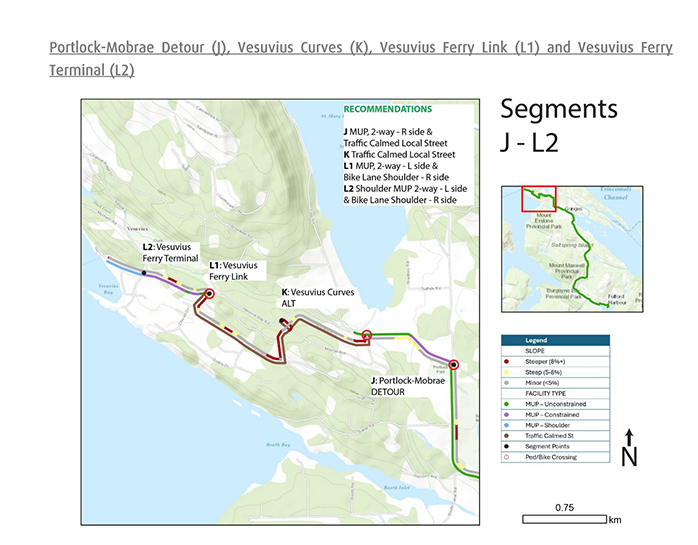
While comparable active transportation data are not available, the proposed route of the SSIRT — running between ferry terminals at Fulford Harbour and Vesuvius Bay — sees a peak motor vehicle count of just over 4,300 daily, according to the Ministry of Transportation and Transit.

Notably, Salt Spring’s only CRD regional park is the remote Mill Farm Regional Park near Mount Bruce — three non-contiguous parcels of forest with no park facilities, accessed by dirt roads well distant from the SSIRT route. 

CAO Ted Robbins pointed out Wednesday that the CRD Board itself had not made an explicit decision that the SSIRT should be designated a “transportation” trail, which would neatly put decision-making before the Transportation Committee. And while there was an ability to move the design work up to 2026, it would still be subject to staff capacity — currently “fully allocated in 2026” to work on the regional transportation plan, according to general manager Kevin Lorette.

“One of the key deliverables, we feel, would be an analysis of what guidelines and parameters dictate a trail being a regional trail,” Lorette told the committee. “We do recognize that trail construction standards and design standards would be different if it was serving an active transportation corridor purpose versus if it was a recreational trail. And staff feel strongly that we need to undertake that work during the update to the regional transportation plan before it can consider whether or not [SSIRT or other Gulf Islands trails] should be included under the transportation service.”

Salt Spring property owners are expected to contribute some $339,000 this year to support the CRD’s new Regional Transportation Service, roughly $51 per average residential property. If managed by the Regional Transportation Service, SSIRT would be the first local manifestation of a tangible benefit for Salt Spring, according to the island’s CRD director Gary Holman. Holman, along with the island’s Local Community Commission (LCC), had opposed being part of the new service at all, given Salt Spring’s extant self-funded transit service. 

Holman said the Transportation Committee indicated it wanted a fuller understanding of the implications of taking on trails in the Gulf Islands; the committee requested a staff report to that effect.

“The good news is that the dollars are still there with the Parks service,” Holman told fellow LCC members Thursday, Jan. 29. “The design work is coming out of a capital reserve, so there would be no impact on requisition in moving it up.”

Holman said he expected the issue to advance during the CRD board’s final budget meeting March 11. 

Initial work on the long-imagined 21-kilometre SSIRT is anticipated to focus on an identified “first priority” section of the trail between Portlock Park and Mobrae Avenue, a stretch advocates say is the lowest-cost and simplest of dozens of sections necessary to connect Fulford, Ganges and Vesuvius.